Tuesday, November 19, 2013

Poland: Tykocin Synagogue One of Seven “New Wonders” of Poland

Tykocin, Poland. Synagogue, Photo: Samuel Gruber 1993.

Tykocin, Poland.  Synagogue interior from before 1939.  Photo from Loukomski, Jewish Art in European Synagogues, 1947, p 102 

 Tykocin, Poland. Synagogue as a tourist destination.   Photo:K. Bielawski (Virtual Shtetl)


Poland: Tykocin Synagogue One of Seven “New Wonders” of Poland
by Samuel D. Gruber

Virtual Shtetl and Jewish Heritage Europe report (via that the historic 17th-century synagogue of Tykocin, Poland has been voted one of the “new  seven wonders” of Poland, in the third edition of a readers’ contest sponsored by the Polish edition of National Geographic Traveller magazine.

Click here for a gallery of photos of the synagogue.

Tykocin, Poland. Synagogue.  Decorated Ark.  Photo: Samuel Gruber 1990.
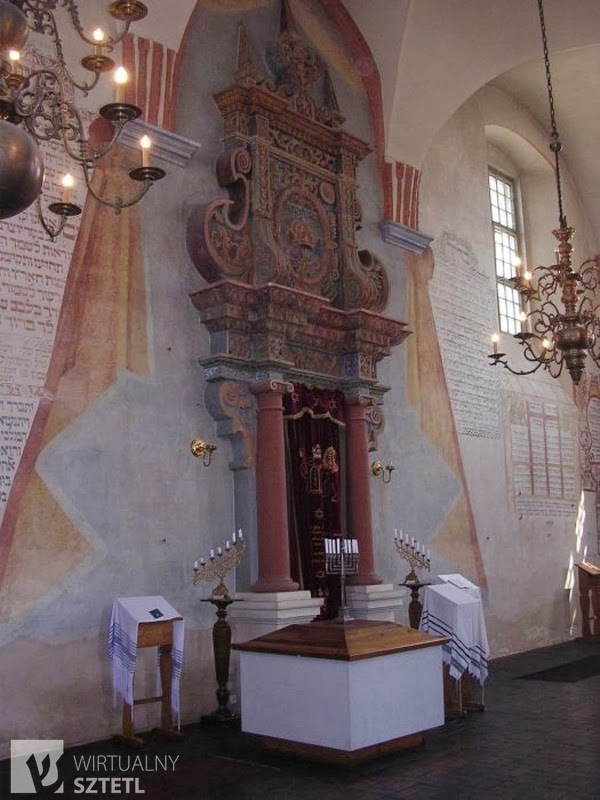


Tykocin, Poland. Synagogue.  Decorated Ark (the ark now is provided with a parochet (curtain), but still not steps).   Photo:K. Bielawski (Virtual Shtetl)

I remember vividly when I first visited the synagogue in 1990.  After traveling for many days across the Polish countryside looking at ruined synagogues, it was a revelation to visit Tykocin, where the building was reasonably well restored, and promoted as a tourist and educational site.  It made clear at that time "the art of the possible," that Poland already had most of the tools in place to protect, preserve and present other similarly important Jewish sites.   All that was lacking was better interpretive material about Jews, Judaism and Jewish history, all of which has since been developed as foreign and Polish scholars and students have delved deeply into rediscovering and interpreting the Jewish past. This year, much of that work comes to a head in the opening of the new Museum of  the History of Polish Jews in Warsaw.  But a beautiful modern museum with high-tech installations needs to connect to some authenticity of place - and visits to monuments like Tykocin (and Zamosc and many others places) are perfect complements to musuem visits.

Tykocin, Poland. Synagogue, Tykocin was the first sunagogue to have its wall inscriptions preserved.  Others (Krakow's Izaak synagogue; Pinczow synagogue) have followed. Photo: Samuel Gruber 1993.

The Tykocin  synagogue was among the very first Jewish sites restored in Poland.  The work of the 1970s and '80s pre-dates the fall of Communism, and set a high standard for subsequent Jewish heritage preservation work that began in the 1990s and continues today.  The synagogue is part of the district museum in Bialystok and houses a permanent exhibition of Judaica and the place of the synagogue in the town, but it is the impressive architecture of the building and the many restored inscription painted on the massive walls that are the real attraction of the site.   The ark is surrounded by painted carving and the inner walls and central four-pillar bimah bear paintings of prayers, texts and other decorative elements.

The Tykocin synagogue is an excellent example of an important synagogue type that appears in Poland in the late sixteenth century and is;
"defined by its square or almost square plan and the presence of a large central bimah, surrounded by four corner columns or piers that rise to the ceiling vault, which they help support.  Known to scholars as the “bimah-support synagogue,” or the “nine-bay plan, this type allowed for wider roof spans and larger uninterrupted interior spaces, to better accommodate large crowds. The size of the space, and the attention given to the reader’s platform, created a new dramatic effect. The first such synagogue may have been the MaHaRSHal Synagogue, built in Lublin, Poland in 1567, and rebuilt 1656.
Many examples of this type can be found in Eastern Poland and Western Ukraine. Some survive in Poland at Przemysl (1592-95), Zamosc, (c. 1600), Tykocin, (1642) and Lancut (1761), and in Ukraine in Satanov (18th century), Zhovkva (1692) and elsewhere."
[Samuel D. Gruber,  "Synagogues, Europe: Medieval to Eighteenth Century" The Cambridge Dictionary of Judaism & Jewish Culture. Ed. Judith R. Baskin. Cambridge University Press, 2011. 574-576. Available at: http://works.bepress.com/samuel_gruber/21]
For many years it has seemed that Tykocin will be the only example in modern Poland of the massive bimah-support type of synagogue.  Now, however, plans are getting going for the preservation and restoration of the great synagogue of Przysucha.  In ten years we may have another "New Wonder."

There are many aspects of the Tykocin synagogue that are worthy of note (and further study).  Its position in the Jewish quarter, and that relationship to the main square and the big church; the associated buildings around the synagogue perimeter; the notable tower - said to have been used as a jail for Jewish offenders; and the remarkable decorated ark made of stone, stucco and paint - that would have had wooden elements, too.  The painted drapery  made-to-appear behind the ark is a good example of an old tradition where the ark is given dramatic - and even royal treatment.  Click here for more discussion about painted ark curtains.

Tuesday, November 12, 2013

USA: Former Synagogues in Springfield, Massachusetts

Springfield, MA. Former Beth Israel, 1923. Photo: Samuel Gruber 2013

 
Springfield, MA. Former Beth Israel, 1923. Photo: Samuel Gruber 2013


  Springfield, MA. Former Beth Israel, 1923.  Photo: Samuel Gruber 2013
 
USA: Former Synagogues in Springfield, Massachusetts
by Samuel D. Gruber

I recently had the pleasure of spending the weekend in Springfield, Massachusetts, where I was lecturing on the modern synagogue architecture of Percival Goodman and the art of sculptor Ibram Lassaw, both of whom contributed to Temple Beth El, first opened in 1953 and then rebuilt and rededicated in 1968 after a devastating fire destroyed the original building.   While in Springfield I got to see a lot of the area, including former Jewish neighborhoods on the North Side and in Forest Park. 

Judaica book dealer Ken Schoen and artist and activist Jane Trigere took me around to see the sights.  Ken and Jane live in Deerfield, home of Schoen Books, and a gallery the two have just opened in an old bank building, but a decade ago Jane did research on the history of Springfield's synagogues when she was student in the Jewish art program at JTS, and she was happy to share her knowledge (I hope that someday soon Jane will publish her findings).

In this post I'll show the oldest standing synagogue buildings in Springfield, all erected between 1921 and 1924, when the immigrant communicates had settled enough, and amassed enough wealth to be able to build.

The North Side, home for decades of the city's Eastern European Jewish immigrant population, has been substantially wiped clean by so-called urban renewal of the 1960s and 70s, but two former synagogue survive, now used as churches.  By 1910 Jews had largely replaced an older Irish population on the North Side.  According to Jane Trigere: "With the large influx of Jews from Eastern Europe in the 1890’s, Springfield Jews numbered a thousand—all Orthodox in their observance. Services moved to bigger and bigger rentals until the group incorporated as Beth Israel in 1892 and built the first synagogue in Springfield on Gray’s Avenue. It was always known as the Gray’s Avenue Shul" and was demolished in the 1960s by the Springfield Redevelopment Authority. In 1923 the congregation built a bigger synagogue, commonly known as the "Big Shul," at 565 Chestnut Street, where thy remained until they left the North Side move in the early 1970’s and moved to Forest Park."

Jews still live in Forest Park, a lovely neighborhood on the south of Springfield, adjacent to the magnificent park that gives the neighborhood its name, but many have moved just further south to the wealthier suburb of Londmeadow, with its impressive houses and excellent school system.  The small town had been closed to Jews in the pre-war period, when many of its fine houses were built.  Since the 1960s the demographics of the area have changed and this has affected the "Jewish geogrpahy" of this part of Western Massachusetts.  The Springfield mid-century modern synagogues of the 1960s that were south of most Jewish settlement when they were built, are now north. 


    Springfield, MA., Former Congregation Sons of Israel, 1321 Dwight St., 1924. Photo: Samuel Gruber 2013
 

 Springfield, MA., Former Congregation Sons of Israel, 1321 Dwight St., 1924. Photo: Samuel Gruber 2013
 
In 1902 thirteen members seceded from Beth Israel to form Congregation Sons of Israel. According to Trigere: "They, too, rented various modest locations until they built Springfield’s second synagogue at 1321 Dwight St. in 1924.  They were Jews from Eastern Europe and Russia and therefore their synagogue became known as the Russische Shul. This group remained the longest in the North End and eventually disbanded. The members were absorbed by other congregations and their building was sold to a church."  Today, the building is occupied by Daniel’s New Beth El Church in Christ.


 Springfield, MA. Former Beth Israel, 1923. Note generous setback form street.  Photo: Samuel Gruber 2013

Both Sons of Israel and Beth Israel are fairly typical of their time, though the Gothic windows of  Sons of Israel was probably a little out of date at the time of construction.  Both congregations understandably lavished more attention to their building facades - which stand as separate attached blocks made of finer brick - than to the main buildings behind.  Sons of Israel sits directly at the sidewalk, near the street line, but Beth Israel was built set back from the street, with a landscaped green space buffer between building and street.  Clearly this congregation had more money and could afford a much bigger lot.  This type of park like setting presages the common development of suburban synagogues set in greenery of the post-World War II years.


Springfield, MA. Former Kodimoh synagogue, built 1921-23, now Calvary's Love Church. Photo: Samuel Gruber 2013


Springfield, MA. Former Kodimoh synagogue, built 1921-23, now Calvary's Love Church. Photo: Samuel Gruber 2013


Springfield, MA. Former Kodimoh synagogue, built 1921-23, now Calvary's Love Church.  This was an Orthodox shul, so the ample stained glass windows are made of colorful geometric - not representational - compositions.  Photo: Samuel Gruber 2013.


The last of the old standing shuls is Kodimoh, the first Orthodox congregation to establish itself in Forest Park, already in 1916. According to Trigere, after meeting in member's homes, "in 1921 under the new name Kodimoh, they laid the cornerstone for their first synagogue at 19 Oakland Street... dedicated in 1923, the same year that Beth Israel (above), still in the North End, built The Big Shul. The congregation had 250 members but as it grew, forty years late, in 1963, they built themselves a new synagogue nearby at 124 Sumner Ave."  The new building combined traditional Romanesque details with the strong massing and central dome of the new Byzantine style.  The building was subsequently sold to Congregation Kesher Israel, and more recently The Centro Cristiano Nacion de Jesus.  When  Kesher closed its doors, it almost ended the Orthodox community in Forest Park.  Today, a smaller minyan meets in part of the former (modern) Kodimoh Synagogue, built in 1963, and now owned by a church which allows the small Jewish congregation to use the premises, one of the few instances I know where an Orthodox congregation shares a facility with Christians.

Saturday, October 19, 2013

Symposium on Architecture of Percival Goodman and Temple Beth El (Springfield, MA)

 Springfield, MA. Temple Beth El. Facade seen from Dickenson St, with Ibram Lassaw's "Pillar of Fire." Photo: Samuel D. Gruber 2011.

 Springfield, MA. Temple Beth El. Sanctuary. Photo: Samuel D. Gruber 2012.

Symposium on Architecture of Percival Goodman October 27th at Temple Beth El, Springfield (Massachusetts) 
by Samuel D. Gruber

(ISJM) As part of its centennial celebration, Temple Beth El in Springfield, Massachusetts  has organized a half day symposium about the architectural legacy of Percival Goodman and the art and architecture of Temple Beth El.  The synagogue is Western Massachusetts’ largest Conservative Jewish congregation.

The event, scheduled for Sunday, October 27 at 1:30 p.m. at the synagogue, 979 Dickinson Street, Springfield, will feature a tour of the building and its art, a panel discussion led by several noteworthy scholars of the art and architecture community, and a wine and cheese reception. 

I am happy to be included as the keynote speaker and I'll be giving an illustrated talk on "Percival Goodman, Temple Beth El and the Modern Synagogue."

Afterward, I'll be join in a panel moderated by Rabbi Amy Wallk Katz with P. Scott Cohen, Chair and Professor of Architecture at Harvard University, and designer of the Tel Aviv Museum and Suzanne O'Keefe, AIA, who was a student and colleague of Percival Goodman at Columbia University, and a longtime family friend.

The event is free and open to the public, however, reservations are required. Please call the Temple Office at 413-733-4149, or e-mail office@tbespringfield.org. 

Springfield, MA. Temple Beth El. Sanctuary. The windows connect with outdoor nature.  Photo: Samuel D. Gruber 2012.

Goodman built Beth El twice - first in 1953, and then again in the mid-1960s,  after a fire devastated the first building in October 1965.  These two dates bracket Goodman's most productive and innovative work as a synagogue designer. From the late 1940s through the 1970s Goodman was the most prolific and most respected American synagogue architect.  His influence on Jewish and all religious art and architecture has been felt worldwide (for example, in the work of German architect Alfred Jacoby).  Now, a half-century after many of his synagogues were first built they are being reconsidered for practical, liturgical, aesthetic and historic reasons. 

Springfield, MA. Temple Beth El. Entrance "portico."  Photo: Samuel D. Gruber 2011.

The jury is mixed - most congregations (Providence, Albany, Springfield, Denver, etc.) still love their Goodman buildings and have or are presently engaged in treating them with respect and making sensitive adjustments.  Some others have disparaged Goodman's work wholesale and reject what has now been dubbed "mid-century modernism" as sterile and off-putting on the one hand, or too ostentatious on the other (I've heard both complaints from clergy and congregants). But Goodman's building have fared better than most of the period for several reasons.  Though innovative in theor often-expressive architectural design, Goodman's synagogues have a reputation for working well for congregations.  As worship spaces and as larger functioning community complexes they are flexible and relatively easy to adjust as needs change.   His sanctuaries - when kept clean and bright -can provide both inspiration and delight.  Most are shaped in a way to enfold the congregation, thus allowing - with a good leadership - a sense of belonging to a community.  Goodman also was master of using relatively simple and inexpensive building materials and mostly straight-forward construction methods.  The upkeep of these buildings has been more manageable than for some of the more wildly expressive synagogues of the period (yes, I know, Goodman synagogues sometimes have leaky roofs, too).

Goodman was also an active writer about many aspects of community and architectural planning, and a designer of many types of (mostly urban) environments, but he especially  left quite a legacy in synagogue design.  So many aspects now accepted as parts of the modern architectural vocabulary for religious and other public buildings were invented, developed or refined by Goodman - it is hard to begin the list.  On aspect - very noticeable at Springfield - is the inclusion of expressive artwork by modern, mostly abstract, artists (Lassaw, Gottlieb and Motherwell at Springfield).  The Springfield commission was especially important for Ibram Lassaw's career.  It was his first architectural and functional sculpture, and it helped established his reputation in the 1950s when the work was widely shown and publicized.  

At Springfield and other Goodman synagogues (Millburn, Beechwood, St. Paul, etc.), the fate of modern synagogue art has varied; some destroyed, some restored and some compromised by rearrangement or the jarring juxtaposition of new art and architectural elements.  I'll address all these themes - and others - in my talk.


Wednesday, August 28, 2013

Jewish Monuments and Architecture: New blogs and Facebook Pages

Jewish Monuments and Architecture: New blogs and Facebook Pages
by Samuel D. Gruber

Social media is making the documentation and study of Jewish architecture, cemeteries, monuments, and historic sites much easier more widespread - but harder and harder to keep track of as more and more people ranging from well-meaning (but often mis-informed) enthusiasts to distinguished scholars set up blogs, Facebook and LinkedIn pages and other easy to post and easy to search online resources.  There is great amount of information out there, but it has to be sifted; here are bad, mislabeled and mis-attributed photos, ignorant architectural and historical assessments, and prejudicial opinions.  Still, one can't ignore all this web-based information since the web is where most people are communicating today.  A happy corollary to this amateur web-surge is the appearance of www.academia.edu and other sources for the sharing of more scholarly research.  In a coming post I will highlight some of the international scholarship from specialized publications about Jewish art and monuments that is now accessible in free downloads

I started this blog in 2008 and have posted approximately 800 times with what I try to make content-rich and often new and original material, mixed with my own opinions. This has brought the blog about 300,000 page views.  It is a drop in the bucket to some of viral Youtube hits, but still not bad for a blog on a topic few were interested in when I started tracking Jewish monuments 25 years ago.  

Today, it would be a full time job - or more -  just to track all the information and pictures that are posted about Jewish heritage sites, let alone analyze them for importance or do any new research.  Websites like Jewish-Heritage-Europe.eu are doing a great job collating news from Europe and disseminating in various media (including Facebook).  Jewish-Heritage-Europe.eu was the organizing force behind the conference this past April on Managing Jewish Immovable Property held in Krakow and now fully available on vide via the wedsite.  

The blog Point of No Return, which focuses mostly on the exile and diaspora of Jews from Muslim lands (with a moral and political agenda) also includes much valuable information about this history and present plight of Jewish monuments and sites in the Mizrachi World.  

Surprisingly, there is still no similar mechanism for collecting and posting American news, most of which remains unreported.

Here are some links to some new additions in ever-expanding Jewish monuments cyberspace that might interest my readers. They have much to offer - but as always when using web-based sources, caveat lector.

1. I've long been a big admirer of Louis Davidson's website synagogues360.org.  This summer I had the pleasure to meet Louis when he and his wife came to Syracuse to photograph two architecturally significant synagogues here.  Louis has now started a blog about his work that includes history, methodology, adventure and personal observations on the many synagogues he visits and photographs every year.  Louis - welcome to the blogosphere!  You can follow Louis Davidson here.

2. West Virginia-based synagogue maven Julian H. Priesler has been collecting information about American synagogues for years (decades?).  His massive grab-bag compilation of synagogue images is still the most comprehensive and useful starting point to learn the geographic and architectural variety of the American synagogue experience.  Julian recently published an Arcadia photo-history Jewish West Virginia and he has been working more intensively documenting the scores of former and present synagogues in Pennsylvania.  Julian  regularly posts information and photos from his search on Facebook.

3. For something further afield, you can see scores of images of Romanian synagogues (collected from various sources) at the Facebook page Romanian Endangered Synagogues.  I usually do not promote anonymous websites; I think people should take responsibility for what they write and post. I don't know who maintains this site.  The initiators from Alexandria, Virginia do not announce themselves, merely stating  the "Romanian endangered synagogues is an initiative of a small group of individuals interested in the rehabilitation and preservation of the Romanian Synagogues."  The group tends not to source or date their information or credit their photos - a common abuse on Facebook, Tumbler and other social media sites, including occasionally - though inadvertently - my own).   Still, the plight of Romanian synagogues is very real - and exists for a variety of reasons - and getting out images of these many stately and often beautiful buildings is a good thing.  I hope it will prick the Jewish consciousness and stir some action.   The Jewish world needs to turn the spotlight on this largely forgotten legacy to insure the protection and survival of scores hundreds of important synagogues and cemeteries.  Every little bit helps.  I'll be writing more about Romanian synagogues in the coming months.

Do have other blogs, pages or other sources you'd like to recommend?  Send me your links.