Friday, May 8, 2020

USA: Syracuse Jewish Sites V: The Rosenbloom Cemetery


Syracuse, NY. Rosenbloom Cemetery, East Colvin Street. Rosenbloom Mausoleum. Photo: Samuel Gruber 2012.
Syracuse, NY. Rosenbloom Cemetery, East Colvin Street. Monument commemorating members of the Rosenbloom family. Photo: Samuel Gruber 2012
Syracuse, NY. Rosenbloom Cemetery, East Colvin Street. Monument commemorating members of the Rosenbloom family. Here are inscribed the names of Daniel, Hannah, Simon and Henry. Photo: Samuel Gruber 2012

Syracuse Jewish Sites V: The Rosenbloom Family and Their Cemetery

by Samuel D. Gruber 

[Cross-posted from My Central New York]

[n.b. Some information in this post may be expanded or corrected when I have access to the Temple Concord and other archives after separation restrictions ease. As always, I appreciate hearing from readers with comments and/or corrections].

A few weeks ago I wrote about the early history Temple Society of Concord, and the role played by Solomon Rosenbloom in the schism of the 1860s that led him and others to form a new more traditional congregation in 1864. That congregation, Adath Jeshurun (not to be confused with today's Adath Yeshuran) created its own independent cemetery on land purchased by Solomon Rosenbloom in 1864 at 800 East Colvin Avenue. Though originally known as the Adath Yeshurun cemetery, it is now called the Rosenbloom Cemetery. Temple Concord already had a burial ground at Rose Hill Cemetery, established in the 1840s, so the creation of a new burial ground really emphasized the seriousness and finality of the congregational break.

Syracuse, NY. Rosenbloom Cemetery, East Colvin Street. Entrance. Photo: Samuel Gruber 2012.
Syracuse, NY. Rosenbloom Cemetery, East Colvin Street. Photo: Samuel Gruber 2012.

In the 1880s Rosenbloom purchased a parcel of land on Orange Street and had a purpose-built synagogue erected for the congregation that was dedicated in 1887. This came to be known as the Rosenbloom Shul which was active until 1925, when most of the remaining congregants re-merged with Temple Concord. As I wrote previously, the building may have been left standing into the 1930s, when demolitions began in the neighborhood for Pioneer Homes, and then subsequently, for the massive "urban renewal" projects of the post-World War II period. I am presently looking for photos from this period.

Solomon Rosenbloom. Portrait, Collection of Temple Concord. Photo: Samuel Gruber.

Who was Solomon Rosenbloom? That is not a question anyone would need to ask in late 19th-century Syracuse, where Rosenbloom's Department Store was one of the major commercial engines of the Downtown. His many offspring were active in Syracuse commercial, political, social, philanthropic, and religious life. The name Rosenbloom was very well known.

Solomon Rosenbloom, the family patriarch, was born November 20, 1822, in Ober-Altheim, Bavaria. He came to America in 1846 and after a year in New York City he moved to the newly incorporated town of Syracuse. It is possible Solomon emigrated like many young Jewish men because of the restrictions on Jewish population expansion, most effectively enforced by limiting the number of Jewish marriages. According to historian Steven M. Lowenstein, Bavaria had the strictest laws:
"The Bavarian law of 1813 declared as a general principle that the number of Jews should not increase but rather be diminished. It set a fixed number of Jewish families in each locality and as a general rule ordered that no Jew might marry and establish a family unless there was a vacancy on the list of families (Matrikel) caused by emigration or death of a family head. These Matrikel laws remained in effect until 1861. Although the law admitted to exceptions for certain occupational categories, they were rarely granted. ["Ashkenazic Jewry and the European Marriage Pattern: A Preliminary Survey of Jewish Marriage Age ," Jewish History, Vol. 8, No. 1/2, (1994), p. 158]
Significantly, Solomon married Hannah Hermann (1827-1884), who he had known in Bavaria where she was born in Geroldshausen (Bavaria), in 1848, soon after settling in Syracuse. Like most of his German-speaking Jewish peers who spread out across America in the 1840s, Solomon began work as a peddler. This was not always easy work, and there were cases in the Syracuse area of Jewish peddlers being assaulted and even murdered. 

Solomon and Hannah produced a large family but that was not unusual for either Jews or Christians at the time. Marcus Rosenbloom (1849-1919); Daniel Rosenbloom (1851-1905); Simon Rosenbloom (1853-1923); Hannah van Baalen (1855-1912); Moses Rosenbloom (1860-1917); Isaac Rosenbloom (1864-1954), Henry Rosenbloom (1865-1933), and Abraham Rosenbloom (1867-1947).

From his humble beginning Solomon (and his six sons) were eventually able to build, by the end of the 19th century, a prominent commercial presence in the region. This included one of the largest department stores in Syracuse with branch stores in Utica; Auburn; Providence, RI; and Akron, OH and large holdings in real estate. The main store of S. Rosenbloom & Sons was at 216 South Salina Street, built ca. 1893.

Syracuse, NY. Rosenblooms Department Store, 216 South Salina Street. Undated postcard, mailed 1905.
Advertising trading card for Rosenbloom Bros. Store, late 19th century.

Advertising trading card for Rosenbloom Bros. Store, late 19th century.
Cover to the S. Rosenbloom & Sons Catalogue, 1909. Photo shared by Walter Miller.
S. Rosenbloom & Sons buildings illustrated in 1909 catalogue. Photo shared by Walter Miller.

Solomon was a shoemaker - perhaps this was a skill he brought from Germany. When he had enough capital from peddling he opened a shoe store in the old Bastable block on East Genesee Street. In 1869 his older sons entered the business and it was renamed S. Rosenbloom & Sons. This period coincides with the split from Temple Concord, and with his sons in the business, Solomon was able to give more time to affairs of his new religious congregation, Adath Jeshurun, founded in 1864.

The business, which was advertised by scores of illustrated collectible advertising cards, expanded from shoes and boots to include furniture, dry goods, and others items sold in a department store, and it became a leading retail venue in Syracuse with branches in many towns and cities. 

Marcus, who retired from the family business in 1897, devoted himself to real estate development, and built several commercial structures on South Salina Street. He also became active in the Adath Jeshurun Synagogue and various local charitable organizations. The remaining brothers sold the business in 1915 but they stayed involved in community and Jewish affairs. Marcus died in 1919.

Of the seven sons, five remained bachelors. Marcus, the eldest, married Rosa (née Kohn) (1855-1940). Isaac, who lived longest, married Clara, and the couple survived into the 1950s. Clara, the last of her generation buried in the Rosenbloom Cemetery in 1959.

The cemetery is laid out with rows of graves going up hill, from the north end at East Colvin to the south end at the top of a hill. The graves are laid east-west, with a more open central area where at the top of the hill is erected a classical temple-style mausoleum which looks down across the space to a tall obelisk monument close to the entrance. This central space has been filled with more graves over time.

At the cemetery, Solomon (1822-1896) and Daniel (1851-1905) have their own early graves, and Isaac and Clara have a late grave, but the rest of the brothers do not have individual gravestones, suggesting that the mausoleum was built some time after 1905, when Daniel died, but probably close to 1917 when Moses died. Moses and the remaining brothers (except Isaac) appear to be buried at the mausoleum. 1917 would be an appropriate date for the classical style of the mausoleum. Most probably such a monument would have distressed their father, the very pious Solomon, but it must have been acceptable to the sons.

About the same time, a similar mausoleum was built by their contemporary Gates Thalheimer at the new Temple Society of Concord Cemetery that had opened at Woodlawn cemetery in 1913. Gates's wife Jennie Stern Thalheimer had died in 1918. Similarly, a large obelisk monument was erected for the prominent Leiter family at the new Temple Concord cemetery, and this may have influenced the Rosenbloom obelisk - or vice versa.


Syracuse, NY. Woodlawn Cemetery, Temple Concord parcel at section 30. Thalheimer Mausoleum, 1918? Gates Thalheimer was president of Temple Concord from 1897 until his death in 1928. Photo: Samuel Gruber 2020.
Syracuse, NY. Woodlawn Cemetery, Temple Concord parcel at section 30. Leiter monument. Herman Leiter's bequest to Temple Concord allowed the congregation to seriously consider building a new Temple. Photo: Samuel Gruber 2020.
The names and dates of Rosenbloom family members are inscribed on the base of the obelisk, which seems to only be a memorial. The graves of Solomon nad Daniel, with more detailed gravestones, are to the west against the fence which delimits the cemetery parcel, and the other graves msut be in or around the masuoleum. On the east side of the cemetery, or left hand as one ascends the hill, are other graves and these belong to Jews who belonged to the Adath Jeshurun congregation. Many founders of Temple Concord are buried here along with the Rosenblooms. These gravestones do not seem to match or follow any particular pattern. All the stones have been photographed by others and can be seen on the Find a Grave website here.

Syracuse, NY. Rosenbloom Cemetery, East Colvin Street. Gravestone of Sophia Hirsch, d. 1883. The monogram at the top of the stone is an S" and "H" for both Solomon and Sophia Hirsch. Similar monograms can be found n contemporary Christian graves in Oakwood cemetery. Photo: Samuel Gruber 2012.
Syracuse, NY. Rosenbloom Cemetery, East Colvin Street. Monument commemorating members of the Rosenbloom family. Photo: Samuel Gruber 2012.
Syracuse, NY. Rosenbloom Cemetery, East Colvin Street. view looking north from the mausoleum to the Obelisk.. Photo: Samuel Gruber 2012.
Syracuse, NY. Rosenbloom Cemetery, East Colvin Street. New stones on the eastern side of the cemetery. Photo: Samuel Gruber 2012.
Syracuse, NY. Rosenbloom Cemetery, East Colvin Street. Photo: Samuel Gruber 2012.

Daniel, who died in 1905, was the most active in civic affairs of the brothers. He, too, was involved in real estate development, and owned the Rosenbloom Tract on the Eastside, where the 400 block of Columbus Avenue and the Gustav Stickley House are today. A few years ago I wrote about a house on that tract that was owned by Daniel, but it is not known if he actually lived there. The English language passage on his gravestone reads: "Devout and Faithful son of Israel; a Righteous God fearing man, mourned by his family. Loved by his race and revered by all who knew him for his charity, his integrity, his love for truth and right."

At the time of his death, Daniel was living at 704 East Jefferson Street (at State Street) with his brothers Abraham, Henry, Moses and Simon. Isaac lived at 806 East Genesee Street (Btw Forman & Almond). Marcus had an office (?) at 320 S. Salina Street and lived at 700 East Jefferson, next to his brothers. Benjamin Stolz (1857-1937), the prominent lawyer, live up the street at 718. Stolz, who served as president of Temple Concord after the death of Gates Thalheimer in 1928, died in 1937, and is buried in the Rosenbloom Cemetery.

Daniel Rosenbloom. Portrait in 1902 Political Blue Book
Syracuse, NY. Rosenbloom Cemetery, East Colvin Street. Gravestone of Daniel Rosenbloom (d. 1905). Photo: Samuel Gruber 2012.
Benjamin Stolz as a young lawyer, obviously serving the German-speaking community.

You can view many Rosenbloom trading cards at:
https://colenda.library.upenn.edu/?f%5Bcorporate_name_sim%5D%5B%5D=S.+Rosenbloom+%26amp%3B+Son


Syracuse, NY. Rosenbloom Cemetery, East Colvin Street. Photo: Samuel Gruber 2012.

Tuesday, May 5, 2020

USA: Keneseth Israel, the "Other" Mid-Century Modern Synagogue in Elkins Park, Pennsylvania

Elkins Park, PA. Reform Congregation Keneseth Israel. The formal entrance with this monumental screen, is rarely used; most people enter from the parking lot. The inscriptions include the Shema, and "Thou Shalt Love Thy Neighbor As Thyself". "Photo: Samuel D. Gruber 2019.
Elkins Park, PA. Reform Congregation Keneseth Israel. Sanctuary exterior. Photo: Samuel D. Gruber 2019.
Elkins Park, PA. Reform Congregation Keneseth Israel. Parking lot entrance with sculpture "The Family" by Joseph Greenberg, Jr. Photo: Samuel D. Gruber 2019.
Elkins Park, PA. Reform Congregation Keneseth Israel. Sanctuary. Photo: Samuel D. Gruber 2019.
Elkins Park, PA. Reform Congregation Keneseth Israel. One wall of Jacob Landau's The Prophetic Quest windows, installed in 1974. Photo: Samuel D. Gruber 2019.
USA: Keneseth Israel, the "Other" Mid-Century Modern Synagogue in Elkins Park, Pennsylvania

By Samuel D. Gruber

in 2019 I had the pleasure of visiting Elkins Park outside of Philadelphia, and spending most of a day looking at its two most notable synagogues which are located within a block of each other. The first is Congregation Beth Sholom with its world-renowned sanctuary designed by Frank Lloyd Wright about which I have written about before, as have so many others. But just up the road the is the contemporary Reform Congregation Keneseth Israel (KI), also dedicated in 1959, and which is of architectural and artistic interest, too. Notably, KI's sanctuary boasts stunning stained glass windows designed by Jacob Landau, and a rich collection of historical materials and Jewish art. I recently wrote about KI's lesser known chapel stained glass windows here.

My friend historian and KI Senior Rabbi Lance Sussman showed me around, and when travel is allowed again, I look forward to a return visit to dig deeper into the collection and the archives.

Reform Congregation Keneseth Israel (KI), founded in 1847, is one of Philadelphia's oldest Jewish congregations. KI first met in several locations, then rented and eventually bought and renovated a former church in 1854 A decade later, during the Civil War, KI sold the building to another Jewish congregation (Adath Jeshurun), and erected it first purpose-built synagogue at Sixth and Brown Streets. Then in 1891 the congregation moved north to an enormous new purpose-built synagogue building with dome and tower at 1717 North Broad Street at Columbia Avenue. That building was a North Philadelphia landmark for more than seventy years.


Philadelphia, Pennsylvania. Congregation Keneseth Israel. Sixth and Brown Street, 1864.


Philadelphia, Pennsylvania. Congregation Keneseth Israel. Broad Street and Columbia Avenue. Louis C. Hickman and Oscar Frotscher, architects, 1891-92. Postcard in collection of the Library Company of Philadelphia.

In the period after World War II, as Philadelphia's Jews moved away from the North Broad Street area towards the northern suburbs, the congregation eventually followed suit. In 1951, when esteemed Rabbi Bertram Korn headed the congregation KI sold its Broad Street buildings to Temple University which wanted them for its Law School. KI eventually found a new site on a triangular parcel of land at Old York and Township line roads in Elkins Park.

Israel Demchick (1891-1980) was hired as architect, assisted by Irwin Michaelson, a congregant who was responsible for engineering decisions. Demchick is an architect who deserves further study. He was born in Russia, came to America as a boy, and graduated from Southern and Manual Training High School for Boys (later South Philadelphia High School) in 1911. Like many ambitious young Philadelphia Jews, he was able to study architecture at the University of Pennsylvania from which he graduated in 1915. At Penn he studied with Paul P. Cret and Leon Arnal. As a senior he received both the Stewardson Scholarship and a Beaux-Arts medal. Demchick worked with several firms in his long career, and he and theater architect David Supowitz began sharing an office as early as 1945 before formally establishing the firm of Supowitz & Demchick in 1963. Demchick endowed a chair in architecture to the Hebrew University in Israel and was named the school's Man of the Year in 1971.

A symbolic groundbreaking was held on Nov. 28, 1955. Excavation began in April 1956, and the cornerstone was laid in October 7, 1956. In the summer of 1957 construction was almost complete, and a de-consecration service was held at the Broad Street Temple. Though the new building was not finished, the Ner Tamid (Eternal Light) was taken down and the Torah scrolls removed.  The actual dedication of the building took place from December 4-6, 1959, which was also the 10th anniversary of Rabbi Bertram Korn's position a Senior Rabbi.

In the style of the time, the sanctuary is a large and somber space, originally seating up to about 850 congregants without expansion. There is a flat ceiling and artificial light (which has been enhanced) but no natural light entering anywhere near the ark and bimah. After the installation of the Landau windows in the 1974 the room got darker, since the richly colored windows filter out sunlight. This was the style in the 1960s, though today congregations crave more contact with the natural world.

The floor level slopes from the rear to the front, and in the style of the time the bimah and Ark are raised high - one needs to ascend seven stone stairs to get to the top of the bimah and the ark is three steps higher. consequently, a new lower and more accessible bimah has been built out into the congregant space which fortunately was large enough to accommodate this 21st century change. Even so, it must be hard to adapt the hierarchical architecture of the 1959 building to the more collective, communal and intimate preferences of modern Reform services. The chapel, however, is more modest in size, but large enough to offer a less formidable space.

The form of the ark is simple; a clear rectangle, emphasizing horizontal lines, and framed with expensive polished marble. The architects of KI followed a path laid out by Percival Goodman a decade earlier at the Baltimore Hebrew Congregation. Behind the Ark rises an enormous screen that transitions the size of the Ark to a much larger scale, and also enlivens the wall with patterned screen. This still uses the established rectangular form, but multiplies it and lightens it. For an example of other near-contemporary Ark wall screens, see my post from 2019 about the DeHirsch Sinai Temple in Seattle.

Elkins Park, PA. Reform Congregation Keneseth Israel. Sanctuary Ark. Photo: Samuel D. Gruber 2019.
Flanking the ark, but included within the large stone frame, are a series of ten reliefs by Philadelphia decorative sculptor George Kreier depicting the life of Moses. These works from 1938 had been moved from the Broad Street Temple. In the 1930s and 1950s (as even today), including narrative and figural sculpture on an ark was unusual. Traditionally, arks have not included human representation, even for symbolic or narrative purposes. Though not the same thing, we do find in antiquity four large patriarch and/or prophet figures painted on the ark wall at the 3rd century synagogue at Dura-Europos. These and the overall narrative decoration of the ancient synagogue were discovered in 1932, and certainly would have been known to Rabbi William Fineshriber who officiated at KI when the Moses reliefs were made, and presumably to the artist as well. There may, in fact, be some direct references in the KI ark reliefs to the Dura paintings, such as the scene of Moses and the Burning Bush, though the KI artist George Kreier does not have Moses remove his footwear (boots at Dura-Europos, sandals in Philadelphia and Elkins Park).

Elkins Park, PA. Reform Congregation Keneseth Israel. Ark reliefs by George Kreier (1938), moved from Broad Street Temple. Photo: Samuel D. Gruber 2019.
Elkins Park, PA. Reform Congregation Keneseth Israel. Ark reliefs by George Kreier (1938), moved from Broad Street Temple. Detail of Moses and the Burning Bush. Photo: Samuel D. Gruber 2019.
Dura-Europos, Syria. Synagogue wall painting of Moses Before Burning Bush. Photo: Kraeling, The Synagogue, Pl LXXVI.
There a few exceptions to the rule of figures on arks, nearly contemporary with the building of the new KI in the 1950s. In 1956, Ilya Schor created an Ark at Temple Beth El in Great Neck, New York, with metal plaques illustrating human action. The Doors of the 36 consist of highly-stylized silver repoussé panels based on the Hasidic legend of the thirty-six wise and good humans who live in every generation (Schor’s ark is fully illustrated in Kampf, Contemporary Synagogue Art, op. cit., pp. 204-207). Soon after, Luise Kaish was at work on her great Ark of Revelation for Congregation Brith Kodesh in Rochester, New York which was commissioned in 1960 and installed in 1964.

At KI in Elkins Park, a large stone Decalogue with the Ten Commandments inscribed in English is set over the ark. Above this is a large relief sculpture of the letter Shin, added in 2010 by calligrapher and congregant Karen Shain Schoss, which stands for HaShem (the ineffable  name of God). It can also be taken as the first letter of Shalom, the Hebrew word for welcome and peace. Embedded in the screen as sculpted reliefs are carved panels, representing  holidays, the Twelve Tribes of Israel, and various symbols of Judaism I think these were all brought from the earlier building and incorporated into a new design.

Elkins Park, PA. Reform Congregation Keneseth Israel. Photo: Samuel D. Gruber 2019.
On the side walls of the rear half of the sanctuary are installed the magnificent and brilliantly colored stained glass windows designed by American artist Jacob Landau. These ten windows were not part of the original building design, though the designers and the congregation apparently anticipated installing stained glass. These tall windows, five on each side, were only commissioned in 1970 and installed in 1974. They are a major work of American Jewish art, and American expressive art, and deserve a full scholarly, descriptive and critical treatment.

When they were installed Rabbi Korn wrote an explanation to help the congregation understand and adjust to the images - a copy was placed at every seat. In 2015 Rabbi Lance Sussman and graphic and comic book artist JT Waldman created a new Reader's Guide to the windows to make them accessible to a new generation. Very soon, there will also be a substantial sumptuously illustrated new book from Penn State University Press about the windows that will have critical and appreciative texts from a wide range of authors (myself included). Therefore, I'll soon give these windows a separate blog entry as a third installment on KI, so readers can appreciate them more fully. 

I hope that when the book is published it will revive interest in Landau, synagogue stained glass, and the remarkable history of Keneseth Israel. These windows should re-emerge in the public awareness as major 20th century works of stained glass, Jewish and American art.

Elkins Park, PA. Reform Congregation Keneseth Israel. Prophetic Quest windows in sanctuary, Jacob Landau, artist, 1970-74.  Photo: Samuel D. Gruber 2019.
Elkins Park, PA. Reform Congregation Keneseth Israel. Sanctuary windows from exterior.  Photo: Samuel D. Gruber 2019.
Elkins Park, PA. Reform Congregation Keneseth Israel. Sanctuary windows detail, Elijah window. Jacob Landau, artist, 1974.  Photo: Samuel D. Gruber 2019.

When KI opened in 1959 there were 1700 family member units, making it one of the largest Reform congregations in the area. Today, the membership is closer to 1,000 families, which is still large enough to make good use of the facility, but much smaller than planned. Consequently, KI offers space to the Conservative congregation Melrose B'nai Israel Emanu-El which occupies part of the former education wing, but has its own entrance. With two congregations, there is more activity in and around the large complex, and this also helps to share the costs.

Though the KI sanctuary is large, it can be made even larger for High Holiday services when attendance soars. Like most mid-20th century American synagogues, the space was expandable by the means of partitions which opened up onto the large social hall. Though examples of movable partitions and folding walls can be found in synagogues and churches going back to the turn of the 20th century, it was Percival Goodman, again, who set a new and popular example by having large worship and social spaces separated by large folding  doors. But as at so many other congregations of its size, today regular services are often held in the ample chapel space. 

Elkins Park, PA. Reform Congregation Keneseth Israel. Sanctuary, view from ark to rear partition walls. Photo: Samuel D. Gruber 2019.
Elkins Park, PA. Reform Congregation Keneseth Israel. Social hall adjacent to sanctuary. Photo: Samuel D. Gruber 2019.

Besides being a worship and educational center, KI is known for rich and varied cultural offerings. Its extensive Judaica Collection is housed in the Temple Judea Museum and throughout the complex. The Museum has posted much of its collection of 4,000 plus Judaica, photos, and other objects on-line. It also maintains a gallery space and active exhibition schedule (obviously, presently suspended during the pandemic) that includes exhibits generated by work from an active Artist's Collaborative. When I visited there was on view a very engaging and high-quality exhibit: "Recycled/Repurposed/Repair the World: Art as Tikkun Olam, a show filled with marvelous collage creations in many media (examples of which can be seen at the museum website).

KI also houses an exceptional archive and it has the substantial Meyers Library, with over 13,000 volumes, for the congregation and larger community. Because Rabbi Sussman is. like his predecessor Rabbi Korn, a distinguished historian of American Jewish history, he has given encouragement and attention to various historical initiatives from the congregation and partnerships with local and national institutions including the Library of Congress and the National Museum of American Jewish History.


Elkins Park, PA. Reform Congregation Keneseth Israel. Meyers Library. Photo: Samuel D. Gruber 2019.
Elkins Park, PA. Reform Congregation Keneseth Israel. Historical Archives. Photo: Samuel D. Gruber 2019.


You can read about the history of Keneseth Israel at 
https://en.wikipedia.org/wiki/Reform_Congregation_Keneseth_Israel_(Philadelphia)

And at the Congregation archives and history webpage here:
https://kipah.org/ki-jewish-history/

Wednesday, April 29, 2020

Stained Glass: The Neumann Chapel at Keneseth Israel, Elkins Park

Elkins Park, PA. Reform Congregation Keneseth Israel. Neumann Chapel, 1959. Photo: Samuel D. Gruber 2019.
Elkins Park, PA. Reform Congregation Keneseth Israel. Neumann Chapel, Stained-glass windows, 1960. Photo: Samuel D. Gruber 2019.
Elkins Park, PA. Reform Congregation Keneseth Israel. Neumann Chapel, 1960. Stained-glass window detail, "Proclaim Liberty". Photo: Samuel D. Gruber 2019.
USA: A 1960 Stained-Glass Cycle at Keneseth Israel, Elkins Park, PA

The Neumann Chapel by William Haley and the Rambusch Company

by Samuel D. Gruber 

Occasionally on this blog I've written about synagogue stained glass, and for several years The International Survey of Jewish Monuments has been documenting examples of stained glass, especially from American synagogues. Why? Because this seems to be an area of Jewish and synagogue art that has been neglected, and it can be in many ways revealing not only about changing artistic tastes, but also institutional and artistic messaging about Judaism. My goal for ISJM is to create for synagogues a collection of images and information similar to what the Census of American Stained Glass has tried for churches.

Last year I spent a few hours at Reform Congregation Keneseth Israel in Elkins Park, Pennsylvania. Today, Reform Congregation Keneseth Israel in Elkins Park, Pennsylvania, is home to two significant cycles of stained glass installed in the suburban synagogue complex opened in 1959 after the congregation moved from their 1892 building on North Broad Street. The congregation also salvaged a few of its windows from the older building. The first stained-glass series was installed in 1960 in the Neumann Chapel, located off the main vestibule of the synagogue complex. The second was installed in the sanctuary in 1974 and is a ten window cycle by Jacob Landau entitled The Prophetic Quest. The older windows are in the Temple vestibule.

I'll write further elsewhere about the 1959 building and the Landau windows and we await a new book from Pennsylvania State University Press about those windows, too. This post, however, introduces the earlier and lesser known cycle that is installed in the chapel. as art, they are not really my cup of tea, but they do sum up in art a particular moment in American Jewish life and thought. And stylistically, they are probably closer to contemporary trends than at any time in the past few decades. The figure is back, especially in illustration and animation for story telling in comics and graphic novels ...of which there is an ever-increasing number with Jewish content aimed at a Jewish audience.

Elkins Park, PA. Reform Congregation Keneseth Israel. Neumann Chapel, 1960. Stained-glass window detail illustrating Isaiah 2:4. Photo: Samuel D. Gruber 2019.
The earliest known use of stained glass in American synagogues is from the 1840s, and the types and techniques used have changed over the decades, as has the types of abstract patterns, and symbolic and narrative imagery used. Colored glass with painted symbols start getting used in 1870s, and single figures and narrative scenes begin to show in Reform temples in the 1890s, though usually Christian-themed windows are merely repurposed and re-titled. Additionally, but sometimes using similar iconography, were windows honoring important individuals. The Reform congregation Keneseth Israel had two such figurative windows in its Renaissance style 1892 building on North Broad Street in Philadelphia. These were large memorial windows to Rabbi Isaac Mayer Wise and to President Theodore Roosevelt which were dedicated in 1909. There were also windows with Biblical scenes, one of which is on view in the vestibule of the present-day Keneseth Israel, dedicated in 1959.

Former Temple Keneseth Israel, Philadelphia, Rabbi Isaac M. Wise Memorial window, Moses Jacob Ezekiel, 1909.

Elkins Park, PA. Reform Temple Keneseth Israel. Window from former synagogue on North Broad Street. Subjects are Ruth and Naomi on the right and Abraham and Isaac on the left. Photo: Samuel Gruber 2019.
Elkins Park, PA. Reform Temple Keneseth Israel. Window honoring President Theodore Roosevelt from former synagogue on North Broad Street. Photo: Samuel Gruber 2019.
In the interwar period, there continued to be the use of non-representational windows, too, using patterns of colored glass, or more often, mixing these with a limited number of panels representing Jewish symbols, life cycle events and broad Biblical stories and Jewish precepts, even including Hebrew inscriptions.

As we have seen, already by 1909, and even more so in the 1920s, some Reform congregations had begun to include large windows with individual human figures - usually prophets - or narrative themes representing either Biblical events or Jewish themes. These programs were usually developed by rabbis and building committees in conjunction with the established stained-glass studios from where windows were ordered.


Chicago, IL. Temple Isaiah. Stained-glass window of figure representing "Kadosh" (Holy), ca. 1924. Photo: Samuel Gruber 2004.
The post-World War II period, however, was especially a period of transition in the planning and production of synagogue stained glass. Many more themes relevant to contemporary Judaism were introduced, and patrons and artists were more confident in including individual figures, but especially narrative scenes to be used for spiritual and community messaging. This was especially true in Reform synagogues, but even Conservative and Orthodox congregations adopted more stained glass, though this tended to be more abstract, even if the themes - such as "creation" - were specific.

Some congregations reached out to leading Jewish artists to decorate their new mid-century modern synagogues with either large windows or series of windows on Jewish themes: Marc Chagall, Ben Shahn, Abraham Rattner, Adolph Gottlieb, Jacob Landau, David Holleman, William Saltzman, and others. Often these were well-known artists who were not experienced in the art of stained glass. They learned on the job and worked with individual or studio glass fabricators. Quite often, rabbis would work with the artists to develop the themes and to choose appropriate texts to be inscribed as part of the overall design.

Still other congregations engaged leading modern stained glass artists such as Robert Sowers or Jean-Jacques Duval. Most often these works are abstract. I do not know why Rabbi Bertram Korn chose the New York-based Rambusch Company to make this chapel cycle, but the rabbi apparently worked closely with Rambusch artist William "Bud" Haley on the designs. Haley and the Rambusch team were leading creators of American church stained glass in the 1950s. Haley worked for Rambusch for forty years and is responsible for many large window cycles, especially for Christian churches. A good example of his work is the Holy Cross Catholic Church in Omaha which can be viewed here. I am not aware of any other synagogue work.

Elkins Park, PA. Reform Congregation Keneseth Israel. Neumann Chapel, Stained-glass detail, Fourth window: "Do Unto Others..., Talmud, Shabbat 31a, 1960. Photo: Samuel D. Gruber 2019.
There are five large vertical windows all on one side of the chapel, seen in a row as a series. Korn wrote that the design and artistry should serve "the greater issue of Judaic content. This and all windows designed for the Neumann Chapel are to carry the double purpose of commemorating important historical personages and to inculcate spiritual teaching to our own generation."
For KI, Rabbi Korn chose five themes that were important within the Reform Movement: Justice, Peace, Women's Rights, Charity, and Liberty/Americanism.

  
First window: Justice, Justice, Thou Shalt Pursue (Deut. 16:20)

Instead of showing prophets such as Isaiah or Micah, we see the figure of Moses giving the law to the Tribes of Israel who are represented by their tents and as a mass of people. This passage always resonates, but for Jews it might have had special significance in 1960, at the end of the McCarthy era blacklist and at the height of the Civil Rights Movement.
 
Elkins Park, PA. Reform Congregation Keneseth Israel. Neumann Chapel, 1960. Stained-glass window detail illustrating "Justice, Justice Thou Shalt Pursue. Photo: Samuel D. Gruber 2019.

Second window: They Shall Beat Their Swords into Plowshares (Isaiah 2:4)

The second window was paid for in part by the children of the congregation so not surprisingly, two modern children, a boy and girl, are being shepherded by the prophet Isaiah, who calls for swords to be beaten into plowshares. We see a lot of soldiers, but I would doubt that these suburban Philadelphians would even know what a plowshare was - I don't think I did was their age in Philadelphia just a few years later. But there is a lot of weaponry, and the juxtaposition of the old timer prophet and in the modern children now part of his world presents a sense of adventure, something like the children encountering Oz or Narnia (a very Christian adventure), or maybe in America in 1960, the Hardy Boys and Nancy Drew. Today Isaiah looks like Dumbledore, and the children Harry and Hermione. Or perhaps, Rabbi Korn and Bud Haley were thinking of the older windows of Keneseth Israel, like the one shown above with the beard Patriarch and a boy (Abraham and Isaac?)

Thematically there is something poignant about the sentiment. It comes just at the end of the Korean War and at the beginning of the Vietnam War. The Cuban Missile Crisis was only two years away, but Israel's War of Independence was twelve years past, and the Suez War only four years previous. The world was scared of nuclear destruction, while more immediately gunfire in American would soon slay the president and moral leaders, and by the late the 1960s begin to take thousands of lives of citizens every year - a process that has only escalated in the years since. There continue to be more swords than plowshares, more handguns and semi-automatic rifles than shovels, hoes and rakes.

When I look at this image of the children surrounded by soldiers and swords, I also look ahead. This is not the beginning of giving children a place in Jewish art, but soon as Holocaust commemoration takes its center place in Jewish memory, the memory of children will be push and promoted. Already in 1960 Anne Frank has become the poster child for the Holocaust. The Broadway production of the Diary of Anne Frank ran from 1955 to 1957, and then traveled the country. The film version came out in 1959, just as these windows were being planned.


Elkins Park, PA. Reform Congregation Keneseth Israel. Neumann Chapel, 1960. Stained-glass window detail illustrating Isaiah 2:4. Photo: Samuel D. Gruber 2019.
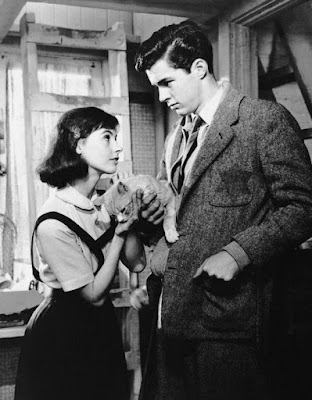
Richard Beymer and Millie Perkins in The Diary of Anne Frank (1959).

Elkins Park, PA. Reform Temple Keneseth Israel. Window from former synagogue on North Broad Street. Subject might be Abraham and Isaac. Photo: Samuel Gruber 2019

Third window: Queen Esther / A Woman of Valor (Proverbs 3)

This window celebrates Queen Esther as a woman and as a hero - a Woman of Valor in multiple ways. The women's movement was only just getting started in 1960, but many of the soon-to-be leaders were Jewish women like Betty Friedan who applied Jewish teaching about women outside the Jewish home and the synagogue into society. She published the Feminine Mystique in 1963. Already, most American synagogues knew they could not survive without the extensive - usually unpaid - assistance of women. The Temple Sisterhood routinely helped organize and often fund all sorts of synagogue events, and at KI, they were the ones who sponsored this window.  

Interestingly, Esther the Queen is placed on an actual pedestal in this image (like Grace Kelly's Tracy Lord in the hit 1956 musical High Society), with Mordecai looking up to her. This American-Jewish version of the heroic woman still has a long way to go to bring her off the pedestal into the world, as Zionist art had been attempting, and as some representation of Holocaust heroes had achieved.

Elkins Park, PA. Reform Congregation Keneseth Israel. Neumann Chapel, 1960. Stained-glass window quoting Proverbs 31m but illustrating the Book of Esther. Photo: Samuel D. Gruber 2019.
Lisolette Girschebina, Photo from Sports in Israel: Discus Thrower, 1937. Collection of Israel Museum
Warsaw, Poland.  Warsaw Uprising Monument. Nathan Rapoport, sculptor. dedicated 1948. Photo: Samuel D. Gruber 2008.
Fourth window: Do Unto Others... (Talmud, Shabbat 31a)

This window features Rabbi Hillel, and celebrates that the performance of good deeds-helping and supporting others-is at the heart of Judaism. Though a mild scene of a teacher or Torah and his students, the image and the message are essential to the optimism and outreach of Liberal Judaism as it developed in post-World War II America. This a time when Judaism, because in large part of sacrifices during the war (and the Holocaust), was elevated to an equal status with Protestant Christianity and Catholicism as one of the three religious pillars of America. The choice of this passage from the Talmud is intentional - as it is the same oft-quoted New Testament passage from Matthew (7:12), thus indicating that at their cores, Judaism and Christianity are united, not opposed. 

This is a very liberal American idea. On April 1, 1961, just a year after the completion of these windows, the artist Norman Rockwell made this point on the cover of the Saturday Evening Post with one of his most famous illustrations of exactly this passage. It is important to remember, too, that this cover was published just shortly after the inauguration of John F. Kennedy, the country's first Roman Catholic president. Kennedy himself, echoed this passage in his inaugural address when he said famously, “And so, my fellow Americans: ask not what your country can do for you – ask what you can do for your country.”

Elkins Park, PA. Reform Congregation Keneseth Israel. Neumann Chapel, 1960. Stained-glass window illustrating Rabbi Hillel with the admonition "Do Unto Others ...". Photo: Samuel D. Gruber 2019.

Norman Rockwell. "Do unto Others ..." Saturday Evening Post cover April 1, 1961.

Fifth Window: Proclaim Liberty (Leviticus 25:10)

This window celebrates the Jewish contribution to the Revolutionary War, and introduces us to Haym Salomon who is shown shaking hands with Robert Morris, and taking his place as a financier of the Revolution. Salomon was made famous (again) through the erection of a bronze statue in Chicago in 1941 and by the Howard Fast historical novel Haym Salomon, Son of Liberty of the same year. Rabbi Korn was an historian of American Jewish history, and Salomon was a Philadelphia hero, so it not surprising to find him on these windows as a More "modern" Jew.

Howard Fast was blacklisted for his active membership in the Communist Party, but in 1958 the reissue by Crown Publishers Spartacus, Fast's most famous novel, effectively ended his blacklisting within the American publishing industry. The timing might be coincidence, or perhaps this window, is also a celebration of Freedom of the press and political liberty in contemporary times. Salomon would be celebrated again in 1975 on a United States commemorative stamp and would figure as the "token" Jews in any representation of Founding Fathers and Heroes of the American Revolution.

Elkins Park, PA. Reform Congregation Keneseth Israel. Neumann Chapel, 1960. Stained-glass window detail, "Proclaim Liberty". Photo: Samuel D. Gruber 2019
Chicago, Illinois. Monument to Washington, Robert Morris, and Haym Solomon, 1941. Photo: Samuel D. Gruber, 2008
Elkins Park, PA. Reform Congregation Keneseth Israel. Neumann Chapel, 1960. Stained glass Window detail, "Proclaim Liberty". Photo: Samuel D. Gruber 2019.
Significantly, there are no windows referring directly the Holocaust, the still-new State of Israel, or the nascent Civil Rights Movement, all issues which would engage the Reform Movement in the 1960s - but also all of which could stir controversy within the congregation. Still, the themes chosen could reflect those "silent" themes, too. The first window about Justice could refer to the Civil Right Movement; the second window about Peace could refer to hopes for the state of Israel; the third window about Esther could refer the Holocaust since the enemy Haman was seen in the post-warrior period as an earlier Hitler. The fourth window, "Do Unto Others," was certainly meant to encourage charity and tolerance; and the fifth window to both encourage patriotism but to emphasize that American Jews were and always had been, patriotic.

I want to thank Rabbi Lance Sussman of Reform Congregation Keneseth Israel for his hospitality.

 For more posts about synagogue stained glass click below:

 USA: Cincinnati's Alhambra (Plum Street Temple's Dazzling Interior)

Cincinnati's (former) Wise Center Windows: A Mid-Century Modern Surprise in a Majestic 1920s Building

USA: Jean-Jacques Duval's Connecticut Synagogue Stained Glass Still Dazzles After 50 Years

USA: Woonsocket, Rhode Island's Remarkable Tent of Meeting, of Concrete and Colored Glass