Friday, February 18, 2022

Skokie Holocaust Monument: A Return to "Realism" in Holocaust Remembrance

Skokie, Illinois. Holocaust Monument on Village Green, Bert J. Gast, designer and Edward Chesney, sculptor. Dedicated 1987. Photo: Samuel D.Gruber 2021.
 

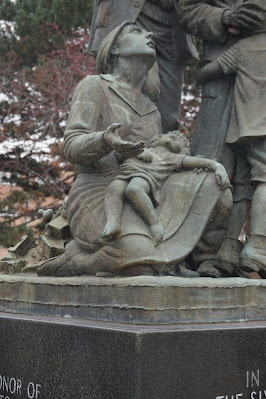
Skokie, Illinois. Holocaust Monument on Village Green. Dtl of Ghetto rubble. Bert J. Gast, designer and Edward Chesney, sculptor. Dedicated 1987. Photo: Samuel D.Gruber 2021.

Skokie Holocaust Monument: A Return to "Realism" in Holocaust Remembrance

by Samuel D. Gruber 

For the past year I have been working on a collaborative project with the International Survey of Jewish Monuments, the Center for Jewish Art at Hebrew University and the Sue and Leonard Miller Center for Contemporary Judaic Studies at the University of Miami, to design a database and searchable website to present hundreds - and eventually of thousands - of Holocaust memorial monuments around the world. Part of this project is just to document and save information - a very big and necessary task. But even a small collection of Holocaust Memorial Monuments gives considerable insight into have different communities and different countries have faced the legacy of the Holocaust, and how they interpret and present individual events and the collective horror of the Nazi destruction of Jewish life in much of Europe. You'll be hearing a lot more about this project in coming months.

As we have been develping the prototype of the database, I've been looking more closely at all types of memorial monuments, and also going out of my way when possible to visit them. There hasn't been much travel during the pandemic, but when I was in Chicago in December, I did make it to nearby Skokie, to see firsthand the well-known statue dedicated in 1987. When I was last in Skokie I went directly to the Holocaust Museum there, and missed this memorial completely.  The statue is really made for local people, especially Survivors, while the museum serves a much wider population as an educational center especially for young people.

Skokie, Illinois. Holocaust Monument on Village Green, Bert J. Gast, designer and Edward Chesney, sculptor. Dedicated 1987. Photo: Samuel D.Gruber 2021.

This Holocaust memorial monument of a group of ghetto fighters and survivors is not my preferred style - but this type of emotional realism, or at least representation, is anecdotally the most popular form of memorial presentation. The statue was made in the 1980s when new Holocaust and Tolerance museums were gearing up for participatory programs (as if one can really ever "participate" or "reenact" experiences of the Holocaust). Films at the time were increasing grpahic, too, in their depiction of Holocaust violence. After several decades of increasing abstract and conceptional memorials, there was strong return to trying to humanize the Holocaust experience, to make numbers into real people, and to link big ideas to experiences of action and suffering. The designer here has used old artistic tropes, but he's trying to convey the events of people rather than explain processes or preach ideals.

This is a return to the memorial preferences of the years immediately after the defeat of the Nazis and the liberation of camps. We see it in many monuments of the 1940s and 1950s, some of which I've wirtten about previously, such as the Warsaw Ghetto Uprising Monument and the Mauthausen Memorial in Paris.  Another example from the early 1990s is the "Vel 'Hiv" Memorial in Paris, which has been frequently criticized for its lack of Jewish identifiers. both Skokie and Paris include the traditional and now-requisite figures of a mother and child.

Seeing human figures - and especially mothers and children - arouses real emotions. These can be positive - and this is a monument about resilience. Or they can be negative. The monument was vandalized the very day is was inaugurated in 1987, though obviously by an anti-Semitic Holocaust denier, not an art critic.Ironically, because of that shocking defacement, the monument has taken a greater stature in Holocaust remembrance than it might have otherwise.

Skokie, Illinois. Holocaust Monument on Village Green, Bert J. Gast, designer and Edward Chesney, sculptor. Dedicated 1987. Photo: Samuel D.Gruber 2021.

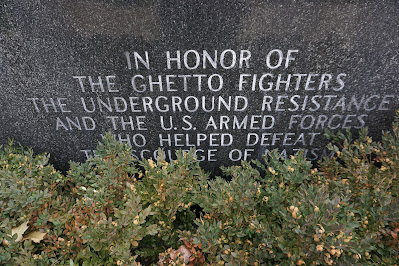
The monument was dedicated May 3, 1987 on the Village Green of Skokie, between Skokie Village Hall and the Skokie Public Library. The other sculpture on the Village Green is placed there as art, without historical or commemorative purpose. Skokie was selected because when the monument was installed, Village officials estimated that 7,000 of Skokie`s 69,000 were Holocaust survivors. The monument primarily commemorates resilience, rather than mourning extreme loss. It is officially dedicated to Ghetto fighters, the underground resistance, the U.S. Armed Forces who helped defeat the scourge of Nazism and the six million Jews and all other victims who perished at the hands of the Nazis.

Skokie, Illinois. Holocaust Monument on Village Green, Bert J. Gast, designer and Edward Chesney, sculptor. Dedicated 1987. Photo: Samuel D.Gruber 2021.

Skokie, Illinois. Holocaust Monument on Village Green, Bert J. Gast, designer and Edward Chesney, sculptor. Dedicated 1987. Photo: Samuel D.Gruber 2021.

The bronze figurative sculpture designed by Bert J. Gast and sculpted by Edward Chesney depicts four individuals during the 1943 Warsaw Ghetto uprising. The group consists of a Jewish resistance fighter (identified by his bandolier), a mother holding a dead child, and a small boy with kippah who clings to an older bearded man dressed in more traditional garb. The feet of the figures rest on ruins of the Ghetto including scattered bricks and other building rubble, and a damaged Torah scroll. 

At the bottom of the statue amidst this depiction of ruin is inscribed: "Thou shallt not kill." The bronze group is set on a black marble base with inscriptions in English and Hebrew on all sides. A separate free-standing bronze plaque with information about the history of the memorial is set next to monument.
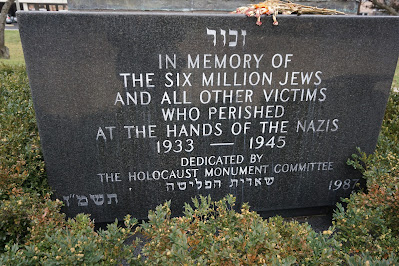
Skokie, Illinois. Holocaust Monument on Village Green, Bert J. Gast, designer and Edward Chesney, sculptor. Dedicated 1987. Photo: Samuel D.Gruber 2021.


Tuesday, October 26, 2021

Poland: Multiple Layers of Wall Painting at Krakow's Remu Synagogue

Krakow, Poland. Remu Synagogue. Two phases of wall painting at the base of the vault. Photo: Samuel Gruber 2018.

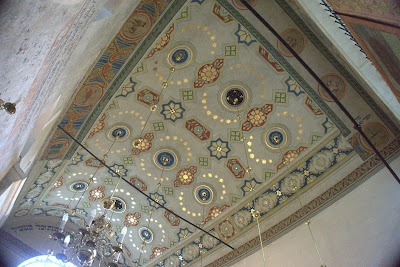
Krakow, Poland. Remu Synagogue. Two phases of wall painting on the vault. Photo: Samuel Gruber 2018.

Krakow, Poland. Remu Synagogue. Painting on the west wall. Photo: Samuel Gruber 2018.

Poland: Multiple Layers of Wall Painting at Krakow's Remu Synagogue
by Samuel D. Gruber

[revised and expanded on Oct 27, 2021]

In 2010 Polish conservators unveiled the restoration of the small 16th-century Remu synagogue in Krakow, one of the oldest surviving synagogues in Poland, and one that is important for its architectural and religious history. The original Remu synagogue, probably of wood, was built in 1553. It soon burned down, but was almost immediately rebuilt in 1556-57 in masonry. The synagogue combines thick wall masonry in a medieval tradition with more delicate Renaissance-inspired details. It remained in continuous use until the Nazis sacked it in 1940. Refurbished after the war, but not re-dedicated until 1957, it was the only officially the only functioning synagogue in Poland during most of the Communist era.

Krakow, Poland. Remu Synagogue. Painting on the east wall. Photo: Samuel Gruber 2018.

Krakow, Poland. Remu Synagogue. Painting on the west wall. Photo: Samuel Gruber 2018.

Several layers of interior wall painting have been revealed by conservators. I did not see the completed work until I was in Krakow in 2013 and only took good photos in 2018; the “new” synagogue interior is quite dazzling. It will surprise anyone how knows the synagogue from past years (as I did) when it was presented as a monochromatic space. With its simple geometry and Renaissance decoration, the small shul had seemed an escapee from an Albertian paradigm.

When I was often in Krakow in the 1990s, the Remu was the only fully functioning Jewish worship space in the city. It some ways it was more my regular synagogue than at home. I think I’ve had more aliyot there than anywhere else. Back then, there were still few visitors to Krakow and the small community struggled to get a minyan, so even with my bad Hebrew I was always welcome. I enjoyed the schnapps served from a little table in the entryway after every service.

So much has changed in Krakow since then, and no place more than in the old Jewish quarter of Kazimierz. The renovated Remu is part of this. Of course, I bear some small responsibility for this, since back in 1992 I helped kick off and organize the restoration of the Tempel Synagogue. That great building of Krakow’s 19th and early 20th-century Progressive Judaism is just a stone’s throw from the Remu, but centuries away in practice, design, and decoration. When we rediscovered and then conserved the decoration of the Tempel it was the only brightly painted synagogue interior in town.

Krakow, Poland. Tempel Synagogue. Restored 1890s and 1920s decoration. Photo: Samuel Gruber 2008.

Krakow, Poland. Tempel Synagogue. Restored 1890s and 1920s decoration. Photo: Samuel Gruber 2018.

For most people, the Remu Synagogue is renowned more for its associations with Rabbi Moses Isserles (known as the ReMa or ReMu) than for its architecture. The great rabbi is buried behind the synagogue with family members and his grave is a place of pilgrimage. The building was erected as a private synagogue by Moses Isserles’s father. But still. Carol Krinsky singled the Remu  out as an important transitional building in her authoritative book Synagogues of Europe. It is also a rare surviving example of private synagogue from the period. I remember our visiting the building together in 1992. It looks very different now.

Krakow, Poland. Remu Cemetery. Graves of Moses Isserles, his father and his siblings. Photo: Samuel Gruber 2018.

The Remu synagogue has gone through several restorations including at least two major reconstructions in the 20th century, one in 1933 and one in 1957, when it was rededicated. In 2010 it was restored again. This time, extensive remains of 19th and 20th-century wall painting were revealed. Krakow tour guide Tomasz Cebulski told the website Jewish Heritage Europe that most of the restoration costs, which were more than  2.000.000 PLN (about 435,000 euro), were covered by the Social Committee for Renovation of Krakow Monuments which had also played a major role in the restoration the temple Synagogue back in the 1990s.

According to historian of Jewish Krakow Eugeniusz Duda, the barrel vault was remade by architect Herman Gutman in a substantial 1933 restoration. Roof and vault were replaced, so that is likely the date of the last decorative program. The interior would have been whitewashed either during the German occupation of Krakow, or in the post-war years when, according to Duda, the synagogue served as a fire station.

Krakow, Poland. Remu Synagogue. Ceiling vault painting. 1930s? Photo: Samuel Gruber 2018.

Krakow, Poland. Remu Synagogue. Ceiling vault painting. 1930s?  Photo: Samuel Gruber 2018.

Krakow, Poland. Remu Synagogue. White washed interior. Photo:Katalog Zabytkow Sztuki, fig. 41

The new look of the Remu is dazzling, but it is confusing. The conservators made some subjective choices about which parts of which mural layers to fully conserve and present. To my eye there are at least three levels of painted decoration, and possible more. So rather than being a near-embodiment of the architectural style of its time (1570s), the Remu now is instructive about the passage of time, and of changing tastes in synagogue decoration. The type of conservation that creates an historical collage, has been in employed in the old churches for many decades. 

The process of conserving the walls of synagogue as a palimpsest is discussed in an important article ("Ars brevis, vita longa: On Preservation of Synagogue Art," Studia Hebraica 9-10 (2009-10), 91-111) by art historian and professor at Bar-Ilan university Ilia Rodov, who discusses several Krakow synagogues, but the article was written before the Remu murals were revealed. Ilya discusses the tension between "restoring" an interior as a museum or as an active synagogue. Museum goers expect a lesson in history. Worshipers prefer a unified and preferably uplifting space. Unless they have a strong sense of indemnity tied to that place and those decorations, they'd prefer paintings that are neat and tidy over ones that are "historic," from the hand of someone long dead. Ilia discusses the case of the Tsori Gilod Synaoguge in L'viv which I have also spoken about many times. There, neither the young American rabbi nor the small Russian-speaking congregation had any historic or emotional connection to the building's history and art, except that it was the one extant and active synagogue in a city that once had many. Making it pretty and shiny and new was more important than making it historically accurate. At the Tsori Gilod synagogue the old painting were nto conserved, they were made new by begin entirely paint over. The iconography remained mostly the same, but the effect the old versus the new is dramatically different. 

The conservators at the Remu synagogue have opted for a different solution. They chose to sample history rather than recreate or invent out of whole cloth a unified decorative program

Krakow, Poland. Remu Synagogue. Two layers of painting. Photo: Samuel Gruber 2018.  

Krakow, Poland. Remu Synagogue. Painting on the north wall. Av Harachamim (Merciful Father) prayer. Photo: Samuel Gruber 2018.

The newly revealed decorations include wall inscriptions of prayers or scriptural passages of which large parts are damaged or destroyed. This type of decoration was common in Polish synagogues from the 17th through the 19th century, and possibly earlier, and fragment can now also be seen in the High and Izaak Synagogues, now also carefully conserved. The wall prayer is apparently an Av Harachamim (Merciful Father) prayer variant, possibly written to remember a specific event in Krakow.

Krakow, Poland. Remu Synagogue. Painting curtain over the ark. Photo: Samuel Gruber 2018.

Krakow, Poland. Remu Synagogue. Painting curtain over the ark. Photo: Samuel Gruber 2018.

There is a painted red curtain on the Ark wall. This type of decoration was common from the 19th century on, and even earlier. Examples are usually hard to date. I've written about these before, including example in other Krakow’s High and Kupa synagogues. I would love to know on what basis the Ark wall curtain was painted - were there traces beneath the whitewashed walls, or were the conservators influenced by other synagogues? I hope there are some interwar photos of the interior - but I have never seen any.

The ceiling barrel vault is beautifully painted with a patterned design that includes symbols. This type of highly accomplished decorative painting was common in the early 20th century through the 1930s. This seems to overlay a painted Zodiac (mazoles) frieze that is likely to date from the early 20th century. These are very well done and expand our collection of mazole types.

Krakow, Poland. Remu Synagogue. Mazoles of Ari/Lion (Av) and Sartan/Crab (Tammuz). Photo: Samuel Gruber 2018.

Krakow, Poland. Remu Synagogue. Mazol of Moznayim (Scales) for the month of Tishrei. Photo: Samuel Gruber 2018.

Krakow, Poland. Remu Synagogue. Mazol of Betulah (Virgo) for the month of Elul Photo: Samuel Gruber 2018.

Krakow, Poland. Remu Synagogue. Mazol of Ari (Lion) for the month of Av (Ab). Photo: Samuel Gruber 2018.

On the west wall - facing the Ark - under and behind of which is the women's gallery, there are two types of decoration. Under the arch of the vault is an inscription over two fantastical beasts. They suggest griffins, which themselves often refer to cherubim, but these have serpent bodies. They hold up a cartouche with a painting of grapes. Other roundels painted by the same artists with bouquets of flowers adorn the other walls.

Krakow, Poland. Remu Synagogue. Painting on west wall. Photo: Samuel Gruber 2018.

Krakow, Poland. Remu Synagogue. Painting on west wall. Photo: Samuel Gruber 2018.

Krakow, Poland. Remu Synagogue. Painting on west wall. Photo: Samuel Gruber 2018.

Krakow, Poland. Remu Synagogue. Painting on west wall. Photo: Samuel Gruber 2018.

Krakow, Poland. Remu Synagogue. Painting on west wall. Photo: Samuel Gruber 2018.

Krakow, Poland. Remu Synagogue. Painting on west wall. Photo: Samuel Gruber 2018.

Beneath the big arched window of the west wall, but above the women's gallery, are three Biblical and Holy Land scenes. They represent what is probably The  Tower of David, Noah's Ark, the Kotel (Wailing Wall). The scene of the Tower of David has been identified as Rachel's tomb by Duda, and the domes suggest it is a variant of the more common representation. The original caption is lost. Ilya Rodov has provided a likely source indicating the true identy of the scene.  All these scenes are substantially retouched or even repainted, but even so it is likely that all the decoration of the west wall was done at the same time - when scaffolding was up. I guess that this was in the 1920s or 1930s.

Krakow, Poland. Remu Synagogue. Painting on west wall. Photo: Samuel Gruber 2018.

Krakow, Poland. Remu Synagogue. Painting on west wall. Monument (tomb) of David. Photo: Samuel Gruber 2018.   

Krakow, Poland. Remu Synagogue. Painting on west wall. Noah's Ark. Photo: Samuel Gruber 2018.

Krakow, Poland. Remu Synagogue. Painting on west wall. Kotel (Western Wall). Photo: Samuel Gruber 2018.

When I last visited there was no information available at the synagogue about the restoration or the history and meaning of the murals. The visitor – at least when I was there – is left to puzzle over where the paintings fit both in the broad history of Jews and Jewish art, or for the specific history of the Remu and the Krakow Jewish community. While photographing for an hour in the small space many tour groups came in - and though they were addressed in several languages - it did not seem to me that any of the guides made specific mention of the decorations in their set talks about the history of Judaism and then about parts of the synagogue (but my Polish and German are very limited, so I may have missed something).

I’m trying to obtain a copy of the conservators’ report on the Remu. Presumably they did preliminary research, and this might answer my questions. Until then, just ponder these, and enjoy these new contributions to the corpus of Jewish art.