Showing posts with label Holocaust site. Show all posts

Wednesday, November 2, 2011

Exhibition: Photos of Death Camp Drawings on View at Auschwitz


Exhibition: Photos of Death Camp Drawings on View at Auschwitz

Forbidden Art is the title of a new exhibition at the Auschwitz-Birkenau Memorial and Museum Memorial on view until November 20, 2011 on the grounds of the former Auschwitz I camp in the camp laundry building.
The exhibition features photographic reproductions of twenty works of art made illegally and under the threat of death by prisoners in German Nazi concentration camps. The photographs are accompanied by commentary and excerpts from archival accounts.

Artists represented in the exhibit include: Peter Edel, Maria Hiszpańska, Franciszek Jaźwiecki, Mieczysław Kościelniak, Halina Ołomucka, Stanisława Panasowa-Stelmaszewska, Marian Ruzamski, Josef Sapcaru, Włodzimierz Siwierski, Zofia Stępień, Józef Szajna, Stanisław Trałka, The anonymous artist with the initials MM, other Aanonymous artists.

On the Auschwitz memorial webpage you can also view a gallery of over 90 artworks from the camp and post-liberation period.

The exhibit is scheduled to travel.

Read more about the exhibtion here.

Monday, October 24, 2011

Poland: Auschwitz’s future secure, preservationists worry about ‘forgotten’ Nazi camps

Auschwitz’s future secure, preservationists worry about ‘forgotten’ Nazi camps

By Ruth Ellen Gruber · October 12, 2011

ROME (JTA) -- Auschwitz, the most notorious camp in the Nazi killing machine, may soon claim success in its campaign to preserve the legacy of the Holocaust.

The foundation supporting the site in southern Poland has attracted tens of millions of dollars from donor countries, and the camp’s barracks and other buildings seem set to be preserved for decades to come. The museum memorial at the former Nazi death camp attracts more than 1 million visitors per year.

Some fear, however, that the concentration of resources and attention on Auschwitz could overshadow other preservation efforts and threaten the integrity or even the existence of the memorials and museums at lesser-known camps and Holocaust sites in Poland.

"Because Auschwitz is treated as the symbol of the Holocaust and the whole world is supporting only this museum, everybody in Poland, including the government, seems to think that this is enough," said historian Robert Kuwalek, a curator at the state-run Museum at Majdanek, the Nazi concentration camp and killing center near Lublin in eastern Poland. "The problem is deeper because it is the lack of basic knowledge that the Holocaust happened in forgotten sites like Belzec, Sobibor, Treblinka, Majdanek and Chelmno.”

Belzec, Sobibor and Treblinka were the three killing centers of the so-called Operation Reinhard plan to murder 2 million Polish Jews in 1942 and 1943. During that operation, Kuwalek said, "more people were killed in a shorter time than in Auschwitz-Birkenau during the whole period that that camp functioned."

Despite their importance in the history of the Holocaust, these and other sites -- such as the forced labor camps at Stuffhof and Gross-Rosen -- are overlooked by the vast majority of visitors who want to learn about the Holocaust or pay homage to its victims firsthand. All are marked by memorials or even museums. But some are located in remote parts of the country, and most are in serious need of upkeep and preservation.

Read the entire article here.

Monday, September 5, 2011

Romania: Popricani (mass-grave) Memorial at Iasi Jewish Cemetery


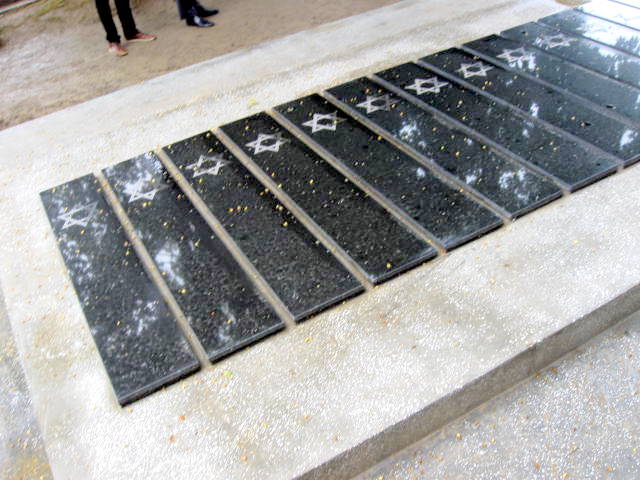
Iasi, Romania. Dedication of the New Grave and Monument to Popricani Massacre Victims in Jewish Cemetery (June, 2011). Photos courtesy of Lucia Apostal, FED-ROM

Romania: Popricani (Mass-Grave) Memorial at Iasi Cemetery Dedicated
by Samuel D. Gruber

(ISJM) Last April I wrote about the reburial in the Iasi, Romania Jewish cemetery of the remains Jewish massacre victims discovered in November 2010. In June a monument was erected to cover the grave. The inscription was composed by Romanian "Elie Wiesel" Institute for Study of Holocaust.
According to the Elie Wiesel National Institute, the victims were killed in the summer of 1941 at Popricani, close to Iasi, by the Romanian army, an ally of the Nazis during World War II. They were among more than 15,000 Jews killed in Iasi during pogroms in 1941. A Romanian historian, Adrian Cioflanca, found the site thanks to the testimonies of Romanians who had witnessed the killings. "We will continue the historical research in order to try to determine where the victims came from, whether it was from Iasi or the surrounding villages", the director of the Elie Wiesel Institute, Alexandru Florian, told AFP.
The grave is very large - 11.00 m x 2,50 meters. The cover of the grave is made concrete, cast in place, with terrazzo finishing. This large and heavy lid sits on foundation-beams cast a half meter beyond the grave boundary. On the lid are 36 slim black granite plaques, each engraved the Magen David, symbolizing the 36 unknown victims buried, all of whom were murdered by the Romanian Army. At the far end of the grave there is a tombstone clad in black granite, with the text engraved in Romanian, English and Hebrew.

The project was organized and designed CAPI-FedRom (Lucia Apostol) and carried out by the Jewish Community of Iasi, with full financial support of Caritatea Foundation.

The monument dedication took place as part of the commemoration ceremony of the 70th anniversary of the Iasi Pogrom, that was held on June 28 2011, in Iasi.

Sunday, August 28, 2011

Belarus: Ivenetz Update - Synagogue Adaptive Reuse Begins


Ivanetz, Belarus. New door and window shutters on former synagogue. Photos: Jewish Heritage Research Group in Belarus

Belarus: Ivenetz Update - Synagogue Adaptive Reuse Begins

In May 2009 I wrote about the need to save the wooden synagogue of Ivanetz, Belarus. At that time local Jewish activists and preservationists were determining the feasibility of the project.
The building was used as a movie theater from the 1950s to the 1980s, and then as a dance club. Ironically and tragically, given the fate of the Ivenetz Jewish community, the last tenant was a private business which produced tombstones. The Belarus Jewish community obtained the building last year, and now the Jewish Heritage Research Group in Belarus is restoring it for use, probably as a Jewish research center and archive of Ivenets and region, as well as a Holocaust educational center.

I am happy to report that Yuri Dorn, Coordinator of Jewish Heritage Research Group in Belarus writes that the restoration project of the Ivenetz synagogue is moving forward. This summer a front door has been replaced and exterior protection blinds have been installed on part of the windows of the building. The next phase is to build the fence and to restore the original facade of the building.

Contributions are welcome to continue this work. Even small amounts can make a difference.

For more information about Jewish heritage sites in Belarus or to contribute to this project go to:www.jhrgbelarus.org

Friday, July 29, 2011

Latvia: New Plaque at Riga's Old Jewish Cemetery

Riga, Latvia. New plaque at Old Jewish Cemetery. Photo courtesy of U.S. Commission for the Preservation of America's Heritage Abroad (2011)

Riga, Latvia. dedication of new plaque at Old Jewish Cemetery. Choir performing in Yiddish before ceremony. Photo courtesy of U.S. Commission for the Preservation of America's Heritage Abroad (2011)

Riga, Latvia. President of the Jewish Communities of Latvia, Arkady Suharenko and Lee Seeman unveiling new plaque at Old Jewish Cemetery. Photo courtesy of U.S. Commission for the Preservation of America's Heritage Abroad (2011)

Riga, Latvia. Old Jewish Cemetery. This how the site looked when I visited with Commission members Lee Seeman and Gary Lavine in 2003. Photo: Samuel D. Gruber (2003).

Latvia: New Plaque at Riga's Old Jewish Cemetery
by Samuel D. Gruber

(ISJM) On June 30, 201 the Jewish Communities of Latvia organized a series of events commemorating the 450th anniversary of the Jewish community in Latvia and to the 70th anniversary of the beginning of the Holocaust. As part of those events, a new explanatory plaque sponsored by the United States Commission for the Preservation of America's Heritage Abroad was installed at Riga's Old Jewish Cemetery. Commission member Lee Seeman organized the project and raised the funds.

U.AS. Commission Member Lee Seeman and U.S. Ambassador to Latvia, Judith Garber

I am especially pleased to see Lee's continuing commitment to this project and so many others in the region. We visited the site together in 2003 with Meijers Melers, the preeminent expert on Latvian Jewish sites, and saw the relatively new large boulder on site, with a prominent Jewish Star, but there was no text or other information telling what the site was and what had happened to it. Without an informed guide, we would have been entirely in the dark. Lee Seeman persevered and saw to it that future visitors would not be so perplexed.

In all its projects the U.S. Commission has never felt it enough to charge people to "Never Forget." The Commission insists in all its projects that accurate information is provided to the visitor or viewer to better teach them what to remember. Its previous work in Riga, on the Rumbula massacre and mass grave site monument is a good example.


Riga, Latvia. Old Jewish Cemetery. Impressive memorial stone placed on site in 1990s, but with explanatory text. Photo: Samuel D. Gruber (2003).

The plaque is in Latvian and English. I do not yet have photos to post, but here is the English text:

2011
The old Jewish Cemetery
This is Riga's first Jewish cemetery. It was opened in 1725 and burials continued here until the late 1930s. after German forces occupied Riga in 1941, the prayer house and the mortuary were burned down. the cemetery became a mass burial site for over 1000 Jews killed in the streets and houses of the Riga Ghetto. Following World War Two, many of the cemetery's tombstones were removed and used as building material. Others deteriorated. The wall surrounding the cemetery collapsed, and the site left uncared for fell into disrepair. In the 1960s, the site was razed and renamed "The Park of the Communist Brigades." In 1992, the park was renamed "The Old Jewish Cemetery”

Sunday, April 17, 2011

Holocaust Memorials: More on Stumbling Blocks (Stolpersteine)

Holocaust Memorials: More on Stumbling Blocks (Stolpersteine)
by Samuel D. Gruber

(ISJM) I have written in the past about the Stolpersteine project ("Stones of the Vanished" or "Stumbling Stones") which began in Germany, and has now spread to many countries. The project, originated in 1994 in Cologne by artist Gunter Demnig, embeds small stones resembling cobbles, in the pavements near houses where Jews lived before their deportation out of Germany, or to their deaths.

There have been many stories in the press about the project - which to my mind is one of the most effective acts of Holocaust remembrance created. It is at the same time obvious and brilliant. It brings the act of memory into everyday life, and it reminds us that unexpected events - including the banal and horrific - can occur, or at least appear to us, at almost any time. We should seek to remember something or someone, from the past, every day.

Here is a link to recent story by Winston Pickett about the Stolpersteine project from the Jewish Chronicle.

Tuesday, April 12, 2011

Romania: Iasi Holocaust Victims Reburied

Romania: Iasi Holocaust Victims Reburied

AFP reported on April 4, 2011 the following story of the reburial in the Jewish cemetery of Iasi, Romania, of the remains of about 40 Jewish Holocaust victims. The reburial is significant for many reasons, not least of which is the fact that the victims were the first found in a mass grave in Romania since 1945 - despite the widespread belief that many such graves exist. Romania's long-standing official reluctance about pursuing Holocaust history is well known.

Elsewhere in Europe more concerted efforts are in progress to identify such graves - but these efforts, too, are often hampered by mixed local sensibilities about confronting the past and priorities about the future.

The second issue involves how to treat such graves when found. Many observant Jews prefer, and many insist, that graves be undisturbed, but marked and in some way consecrated and protected; in essence making every mass grave a Jewish cemetery. This follows Jewish law and tradition, and does not "disturb the dead."

On the other hand there are many who insist and require - for legal and historical reasons - that such graves when found be investigated, which usually mean the exhumation of the dead in order to try to describe the crime and identify the victims. Sometimes this is required to ascertain the fact that the victims were in fact Jews - or all Jews - something that in many cases, however, can never be fully known. A new field of forensic anthropology has developed in recent years specializing in such work - the result of horrific crimes in countries around the world. Following this scenario, Jewish communities usually prefer to see the exhumed remains reburied in Jewish cemeteries with other Jews in already consecrated ground, though for some Orthodox Jews the fear of interring a non-Jew in a Jewish cemetery is also a concern. Historical markers recounting the circumstances of their murders can still be placed at the mass grave site. The speed with which investigation and reburial is carried out can also become a contentious issue.

In Jewish history there are many precedents for the removal and reburial of human remains in order to protect them from destruction or to reunite them. Usually such removals and reburials follow prescribed procedures under rabbinic supervision, but truthfully, most of these are of fairly recent invention. How bodies were dealt with in the past in times of oppression and duress, and in times of communal recovery, is not fully known.

One thing that all sides agree on - is that graves of the dead need to marked in some way. Historians and archaeologists want the events of the past to be remembered. Observant Jews want to respect the dead, and also provided a warning to those (such as Cohanim) who cannot come in contact with the dead.

Dozens of Holocaust victims laid to rest in Romania

by: Isabelle Wesselingh

Rabbis from Britain and the United States bury on April 4, 2011 in the town of Iasi, 410 kms north of Bucharest, some 40 Jews killed during the Holocaust and found in November 2010 in a mass grave in the northeastern Romanian village of Popricani.

The remains of about 40 Jews killed during the Holocaust and found in a mass grave were laid to rest Monday in an emotion-filled ceremony in northeastern Romania. Five rabbis from Britain and the United States performed the funeral service under a grey and cloudy sky. Dressed in black, they carried the remains, unidentified and contained in paper bags and cardboard boxes, and put them into a single grave in the Jewish cemetery of Iasi, overlooking the city. "We have come here to help these people rest in peace. We believe it is God's will", British rabbi Meir Twersky, whose grand-parents are buried in Iasi cemetery, told AFP. "We are gathered here today to remember these men, women and children who were brutally murdered in a forest in 1941 (...) only because they were Jews", Israel's ambassador to Romania, Dan Ben-Eliezer, said during the official ceremony.

According to the Elie Wiesel National Institute, the victims were killed in the summer of 1941 at Popricani, close to Iasi, by the Romanian army, an ally of the Nazis during World War II. They were among more than 15,000 Jews killed in Iasi during pogroms in 1941. A Romanian historian, Adrian Cioflanca, found the site thanks to the testimonies of Romanians who had witnessed the killings. "We will continue the historical research in order to try to determine where the victims came from, whether it was from Iasi or the surrounding villages", the director of the Elie Wiesel Institute, Alexandru Florian, told AFP.

The exact number of victims, including women and children, has not been determined, but Cioflanca told AFP, "We found the skulls of at least 35 people but there were other body parts so we can talk about at least 40 people." The victims were buried just a few metres (yards) away from thousands more Jews killed during the pogroms. "I ask the forgiveness of the deceased for the suffering that has been brought to their holy bones", rabbi Meir Schlesinger said, referring to the belief that the remains should have been left where they were originally found. But Abraham Ghiltman, the president of the Iasi Jewish community, said it was a "relief" to see "those whose memory was forgotten" to be lying next to their fellow citizens in the Jewish cemetery. "We hope that the events we witnessed during the Holocaust will never happen again, neither in Romania nor in the rest of the world", he added.

According to an international commission of historians led by Nobel Peace laureate Elie Wiesel, himself a Romanian-born Jew, between 280,000 and 380,000 Romanian and Ukrainian Jews were killed in territories run by the pro-Nazi Romanian regime during 1940-1944. The Popricani mass grave is the first to be discovered since 1945, when 311 corpses were exhumed from three locations in Stanca Roznovanu, close to Iasi, according to the Wiesel Institute.

Sunday, April 10, 2011

Macedonia: Holocaust Memorial Museum Opened


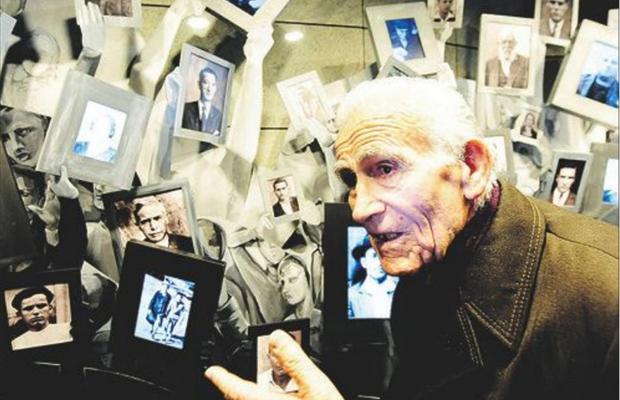
Skopje, Macedonia. scenes from the inauguration of the new Holocaust Museum. Photos from web.

LinkBlagoj Gjorcev, 92, looks at portraits of Macedonian Jews killed during the opening ceremony of the Holocaust memorial center for the Jews of Macedonia in Skopje Photograph by: OGNEN TEOFILOVSKI REUTERS, AFP.

Macedonia: Holocaust Memorial Museum Opened

In a recent post I mentioned the new Holocaust museums in Skokie and Los Angeles. I should also have mentioned the new center in Skopje, Macedonia. There, the actual and remembered history and landscape are quite different than in U.S. cities - where they have been more survivors living, but where many remade lives far from the site of community destruction. In Macedonia, a small country with few Jews, a large new center has risen on the site of the Jewish ghetto.

Last month a Holocaust museum and educational center was dedicated in the former Jewish quarter of Skopje, Republic of Macedonia. The project had been announced with great hoopla in Link2005 in a public ceremony involving the Macedonian President and Prime Minister among others, with an anticipated completion date of 2006 or 2007. as with many such projects that have to negotiate a complex financial, political, aesthetic and historical path; things took longer.

'The Memorial Holocaust Centre, in a symbolic way, will bring the victims of Treblinka home to Macedonia', said Prime Minister Buckovski, after laying the center's cornerstone.

According to Katherine Clarke writing in The Forward:
Co-curator Yitzchak Mais, who was previously director of Yad Vashem and founding curator of New York’s Museum of Jewish Heritage, terms the special exhibit accompanying the opening a “cultural insight into a dynamic Jewish world that was destroyed.” He stated that the exhibit, which features hours of interviews with Macedonian Jews, “focuses on Macedonian Jewry before the Holocaust, on forgotten history, and on tremendous stories of Jewish vitality and vibrancy wiped out by external causes."

The official celebrations marked only the first phase of the center. A special children’s museum will open in the complex in March 2012, to be followed by the permanent exhibition, in March 2013. The completion of all phases of the project coincides with “Skopje 2014,” a $273 million initiative to transform the city into a competitive European capital and rebuild its infrastructure after a 1963 earthquake that destroyed about 80% of the city’s architecture.
Not everyone is pleased with the memorial.

An article in Macedonia Daily addresses some of the very real concerns of people in Macedonia - including some Jews - about the cost and scope of the project at a time when other infrastructure in thew country needs costly attention.
The Holocaust Center also illustrates a recent trend in Macedonia to more strongly assert the country’s identity as an independent nation. The project dovetails conveniently, for example, with Skopje 2014, the government’s controversial, $273 million plan to transform the city from a provincial seat into a full-fledged European capital.

The center and Skopje 2014 are technically unrelated. But if the center is completed next year, as expected, and Skopje 2014 remains on schedule, the new center will eventually stand in a radically redesigned downtown, near a new Macedonian history museum, new national theater, a massive triumphal arch and other proposed monuments.

Taxpayers are footing the bill for Skopje 2014, making it a subject for public debate. The center’s costs, alternatively, are covered by a special fund created in 2000 from the assets of Macedonian Jewish families who perished in the Holocaust and left no heirs. But critics within the Jewish community nonetheless link the two, arguing the center’s backers are overreaching in the same way the government is trying to do too much with Skopje 2014.

“It’s become big, maybe too big,” said Samuel Sadikario, a former president of the Holocaust Fund, a quasi-public organization that administers the center’s budget. “Maybe such a project should be done in Poland.”

Located on a 30,000-square-foot parcel near the River Vardar, in Skopje’s former Jewish quarter, the Holocaust Memorial Center will commemorate the 7,200 souls sent to the Treblinka death camp in 1943, when Nazi-ally Bulgaria occupied Macedonia, then part of Yugoslavia. The $23-million center is slated to contain a museum, arts center and hotel.

About 220 Jews remain in Macedonia, too few to merit a grand center, said Sadikario. He thought the millions invested in the project might be better spent on Macedonia’s crumbling universities. He also noted that construction was supposed to finish two years ago, but has been repeatedly delayed by the Jewish leaders struggling to manage the project.

“There is no capacity,” Sadikario said. “Judaism is actually dying out in Macedonia. It’s not too much to say its dead."
Others, however, consider this a "world-class" museum and look forward to it becoming a destination - helping to put Skopje on the travel map.

Here is the report posted by the World Jewish Congress:

Macedonia praised for honoring its Jews at opening of Holocaust memorial museum

11 March 2011

A museum dedicated to the memory of the Jews of Macedonia who perished in the Shoah has been inaugurated in the former Yugoslav republic, in the presence of the country’s president and representatives of international Jewish organizations, including the World Jewish Congress (WJC). In his speech, the WJC’s Research Director Laurence Weinbaum pointed out that no Jewish community in Europe had suffered a greater degree of destruction than the Macedonian one. Referring to Macedonia's principled stand on the restitution issue and to its unwavering friendship with Jews and Israel, he said: "In much of contemporary Europe, dead Jews are respected, but live ones are defamed. You honor the dead and the living, and in so doing you have set an example to which other nations should aspire. There are nations that are larger, richer, better known and more powerful than Macedonia, but none more decent, gracious, good-hearted and noble.”

In a video message to the event, US Secretary of State Hillary Clinton said that "this museum and memorial will document the long and rich history of Jewish life in the Balkans and honor the memories of those who perished in the Holocaust. Schoolchildren and visitors from throughout the region will be able to see their faces, hear their stories, and learn about their lives. The government of Macedonia has shown real leadership by enacting legislation resolving compensation claims for Jewish property stolen during the Holocaust and supporting the establishment of this memorial and museum. And today your entire nation can be proud of this effort." The modern, multi-million dollar edifice stands in the heart of what was once the city's Jewish Quarter, in the center of the Macedonian capital Skopje. It was built by the Jewish community of Macedonia, which today numbers some 100 members. Macedonian Jewry benefited from a 2002 law providing for the return of heirless Jewish property, a law that is widely recognized as one of the best in Europe.

"The only surviving member of the 81-strong Misrahi family was my father," Viktor Misrahi (pictured on the left), one of the few Macedonian survivors still alive, told the news agency AFP. "Today, the ashes of our people were brought back here from Treblinka and they will remain here, at their home," he added. At the ceremony, Macedonia was hailed for enabling the Jews to regain the assets they had lost in the Shoah. The cornerstone for the museum was laid in 2005. Ljiljana Mizrahi, president of the local Holocaust Fund that had initiated the project, opened the ceremony by reading the names of some of the victims and explained that the museum would "preserve the memory of the Jews of Macedonia, not only commemorate their deaths, but also their lives and the civilization that perished with them."

In his address, Macedonian President Gjorje Ivanov recalled the long history of co-habitation between Jews and Macedonians of other faiths and said that with the loss Linkof the Jews "a part of Macedonia had been torn out and that on the Jewish streets of Skopje, Bitola and Stip, after the war there was silence." He went on to note Macedonia's support for Israel, which he said would continue.

In April 1941, Macedonia - then a part of Yugoslavia - was occupied by Bulgarian troops. In contrast to its policy back home, Sofia instituted a regime of terror and plunder against Macedonian Jews. That policy culminated in the deportation in March 1943 of some 7,200 Jews to the German death camp at Treblinka, from which not a single one returned. Some 98 percent of the Jews were killed. The only survivors were those who had managed to evade deportation, many of whom fought with the partisans.

Also, Read the AFP story here.

For more on Jewish sites in Macedonia click here.

Saturday, January 23, 2010

Exhibition: Architecture of Murder: The Auschwitz-Birkenau Blueprints

Chairman of the Yad Vashem Directorate Avner Shalev studies one of the plans in the exhibition together with Prime Minister Netanyahu. Photo: Courtesy of Yad Vashem

Exhibition: Architecture of Murder: The Auschwitz-Birkenau Blueprints at Yad Vashem

January 27th is International Holocaust Remembrance Day - a Commemoration recently established by the United Nations to be celebrated on the anniversary of the liberation of Auschwitz by Soviet troops in 1945. In fact, when the Red Army arrived there was little to liberate. The German had moved west forcing a deadly evacuation of Jewish prisoners by forced march. Only the very sick and the dead remained to greet the advancing Russians (see the final entries in Primo Levi's famed memoir Se Questo e un Uomo (Survival in Auschwitz).

On Monday, January 25th, as part of a symposium for the diplomatic corps in Israel, a new exhibition, Architecture of Murder: The Auschwitz-Birkenau Blueprints will open at Yad Vashem. On display will be original architectural blueprints of Auschwitz-Birkenau, given to Yad Vashem for safekeeping last summer by the German newspaper Bild, For more on today's event click here.

For a video presentation about the architectural and engineering plans and drawings click here
.

According to the website of Yad Vashem:

“The original plans detailing the construction of Auschwitz, constitute graphic illustration of the Germans’ systematic effort to carry out the ‘Final Solution.’,” said Avner Shalev, Chairman of Yad Vashem. “We have chosen to display them to the public to illustrate how seemingly conventional activities of ordinary people brought about the construction of the largest murder site of European Jewry.”

Marking the 65th anniversary of the liberation of Auschwitz and International Holocaust Remembrance Day on January 27, the opening will take place as part of a special symposium in the presence of dozens of members of the diplomatic corps - representing some 80 countries - and Auschwitz survivors, and with the participation of Prime Minister Benjamin Netanyahu. The Prime Minister, Minister of Education Gideon Saar, Jerusalem Mayor Nir Barkat, Holocaust survivor Ruth Bondy, Prof. Shlomo Avineri, Prof. Moshe Halbertal, Bild Editor Kai Diekmann, Auschwitz-Birkenau State Museum Director Dr. Piotr Cywinski, Historical Advisor to the exhibition Dr. Daniel Uziel, Chairman of the Yad Vashem Council Rabbi Israel Meir Lau and Chairman of the Yad Vashem Directorate Avner Shalev will address the participants.

The exhibition was curated by Director the Museums Division Yehudit Inbar. Along with the blueprints, the photo album of the construction of Auschwitz will be exhibited for the first time. In addition, an aerial photo of Auschwitz from the RAF, the Vrba-Wetzler Report (written by two Jewish escapees from Auschwitz in 1944), and quotes from SS men and Jewish prisoners describing the site and its murderous purposes. A copy of the poem “Death Fugue” by Paul Celan will also be displayed.

The exhibition is funded thanks to the generous support of the Greg Rosshandler and Harry Perelberg families, Australia.

A traveling version of the exhibition will open at the United Nations in New York in advance of International Holocaust Remembrance Day. The exhibition will open in the presence of Minister of Diaspora Affairs and Public Diplomacy Yuli-Yoel Edelstein, US Ambassador to the UN Susan Rice, Israeli Ambassador to the UN Gabriela Shalev, Chairman of the American Society for Yad Vashem Eli Zbrowoski, and curator of the exhibition and Director of the Yad Vashem Museums Division Yehudit Inbar.

Wednesday, October 28, 2009

Romania: More on Bucharest Holocaust Monument

Bucharest, Romania. Holocaust Memorial. Photos from www.holocaustmemorial.ro

Romania: More on Bucharest Holocaust Monument
by Samuel D. Gruber

(ISJM) Earlier this month I wrote about the pending dedication of the new Holocaust Memorial in Bucharest. Romania: Holocaust Monument to be Dedicated in Bucharest. The inauguration did take place, but the monument remains incomplete.

For more and continuing information about the monument and and to see pictures of the inauguration and the structure click here for the web site about the monument created by Marko Maximilain Katz, Director of MCA Romania
-The Center for Monitoring and Combating Anti-Semitism in Romania.

Regrettably, many of the inscriptions which will tell some of the facts about the Holocaust in Romania, and which are the real rationale for the memorial, were not ready for installation.


Bucharest, Romania. Inauguration of Holocaust Memorial, October 8, 2009.
Photos from www.holocaustmemorial.ro


What participants in the formal ceremony and observers (including the Romanian and international press) saw was an architectural framework and an ongoing worksite. We have all experienced time and budget overruns on construction projects. Still, in the case of a much anticipated monument such as the one in Bucharest, we can certainly wonder why the decision was taken to dedicate it before its completion. Was it simply that the government sponsors thought the deadline of the local Holocaust Remembrance day would force the contractors to hurry up? Or were there other reasons? Has rushing the dedication in any way diminished the impact of the monument?

K.K. Brattman, Managing Editor of the Holocaust Survivors and Remembrance Project: "Forget You Not" reacted strongly to the apparent inadequacies of the new monument, perceiving the one inscribed plaque in situ to be the only working that was to be included. This plaque merely indicates the sponsor and the artist, Romanian sculptor (who lives in Germany) Peter Jacobi.

Bucharest, Romania. Holocaust Memorial. Photos from www.holocaustmemorial.ro

In fact, several more historical and commemorative plaques are still to be completed and installed. The texts to these plaques – or something close to the final texts – were apparently included in the program of the inauguration.

I have been in contact with representatives of United States Holocaust Memorial Museum, the American Jewish Committee and the US Commission for the Preservation of America's Heritage Abroad, three organizations that actively pressured the Romanian government to create the Wiesel Commission, and then to follow through with many recommendations. They all shared the concerns of Mr. Brattman, but assured me that his concerns would be resolved when the monument was complete, with all the intended text.

One problem causing delay was the Hebrew inscription, which was being engraved in Germany. According to my sources, there were problems, but I don’t know whether these were in the text, the translation or the actual carving of the Hebrew letters. Other source reported that at the time of the dedication, where many things were rushed, there may have been some issues about having the proper translations (it is in Romanian, English and Hebrew) or questions about misspellings, which could require it to be remade.

I can attest from prior experience the difficulty in moving from idea to finished text on a Holocaust monuments. I have folders full of draft texts for monuments in Estonia, Croatia, Poland, Ukraine and elsewhere. Sometimes a single word or number - or the translation of the ta word - can hold up a project for a long long time.

In Bucharest (and in Washington) the general expectation is that all the problems about the final inscriptions should be resolved soon, and the final installation should take place within “a month or two.”

I encourage readers of this blog to report in from Bucharest with information and new pictures when they have occasion to visit the site.
I post here part of the moving speech by Liviu Beres, President of The Association of the Jews from Romania - Victims of the Holocaust, delivered at the unfinished monument on Romania's Holocaust Remembrance Day (the Text of the speech by the President of Romania has not yet been posted in English):

It was my destiny to have lived the best years of a person’s life during a dramatic turning point of history. It was a time when the commandment “Thou shall not kill!” was reversed. A time when the spiral of evil was expanding in Europe and all over the world, when anti-Semitism, hatred and discrimination were dominant and lawlessness became a state of the law.

Its initiators conceived the Holocaust in such a way that it was supposed to have no witnesses or history. As you know, the fate of the war turned against them and there remained many witnesses. Thus, the Holocaust has a history.

One of the witnesses is the person who wrote these lines. I belong to a fading generation: the survivors of the Holocaust.

We all know that, as persons, we move in space and change in time. We can return to the same location in space, but never in time. Only memory remains, with what you were able to keep in mind. For me, memories are often conversations with the dead or with myself, as I was at a time and changed to what I am now.

Sixty-eight years have passed since the freight trains, filled with the Jews who were deported from Bukovina, were running to the Dniester River. They “unloaded” the merchandise at the bank of the river for them to cross to “the other side”. At the same time, after the mass executions of the Jews, which took place in July-August 1941, when the troops entered Bassarabia and Northern Bukovina, the survivors were forced to walk, in convoys, to the same place. Whoever stayed behind was shot. I was part of those convoys when I hadn’t been 14 of age, yet.

Having been looted of their goods, of their rights and especially of their right to live, the Jews were going to an unknown place, which also got a new name: Transnistria.

The extermination policy was set into motion. Tens and hundreds of thousands of people were sentenced to death. Their only fault was that they were born and their parents were Jewish. It is true: no gas chambers were used in the Holocaust perpetrated by Antonescu’s government. People died from bullets, cold, hunger, insanitary conditions and disease (and they made “all the proper conditions” for it to appear). People also suffocated in tightly closed freight trains (the death trains from Iaşi). They were set on fire and blown up while crowded in warehouses. They were hanged (Odessa) and they died because the people around were bad.

In this bleak picture, where the scene is mainly occupied by the victims, perpetrators and indifferent spectators, there were good people as well. They were not many, among those who believed in light, despite the general dark. They risked their own life so as to save others.
The Holocaust is still here, in the memory of the few survivors. It is here with us in its whole horror. It was a cruel reality, a denial of any sense of morality, a denial of humanity. This memorial that we inaugurate now and here was made in honor of the victims of this cruel reality. As a tombstone for the ones who have no grave, the memorial will be a token for all those who want to know what happened. For, if we speak about learning from the Holocaust, it means we should not only tell the truth about the past, but also show how the same mechanisms act today in various societies and in people as well.

The fear of unknown finds its release in the fear and hatred for the “stranger”. Intolerance, fundamentalism, fanaticism, they all get their nutrients and new energy precisely from this “fear”. This is why it is necessary to spread the knowledge about the Holocaust.

By knowing our past, they will be able to act efficiently so that it does not become their future. It is possible that many will start thinking about what life and death is, and especially about what the world is. Even today, there are enough signs that warn about the always active potentiality of evil.

People forget too often that whatever starts with the hatred against the Jews continues with the loathing of all that is different. Mankind, who created tyrannical utopias and suffered from their disasters, can now better understand the consequences of one’s deeds.

This Memorial about people who existed at one time was erected for the people of today and of tomorrow. It is meant to remove indifference, the lack of knowledge about this matter and it should have an important contribution in this sense.

Let me tell you that, despite of all that happened, I still believe that MAN should be the purpose of man, in life.