Friday, July 24, 2009

UK: London Jewish Museum Must Purchase Lindo Hanukkiah on Display for 70 Years

UK: London Jewish Museum Must Purchase Lindo Hanukkiah on Display for 70 Years
by Samuel D. Gruber (based on news reports)

The London Jewish Museum reports that it is close to raising funds needed to purchase the famous 18th century Lindo hanukkiah (click here for photo) which it has displayed for seventy years - since the museum was founded. The silver hanukkiah was commissioned from artisan John Ruslen in 1709 to honor the marriage of Elias Lindo to Rachel Lopes Ferreira. Descendants of the "donors" to the museum want to sell the renowned object, and the museum must raise £300,000 to avoid the work leaving public view to most likely enter a private collection.

Unless the family is really hard up for money or to pay taxes, it seems disgraceful and extortionary that the family should ask for money for the work generations after it was put on display. Are they taking advantage of the Museum's reopening - knowing that this is a central object of the collection, one that the Museum can not afford to lose? One would think that the work is de facto the property of the museum after all these years.

The Museum has raised £250,000, including £145,000 from the National Heritage Memorial Fund (NHMF), £75,000 from the independent Art Fund, and £30,000 from the MLA/V&A Purchase Fund; £50,000 are still needed. This purchase is on top of the £14 million raised for the expansion of the museum’s Camden Town facility (including £4.2 million from the Heritage Lottery Fund), scheduled to reopen in early 2010.

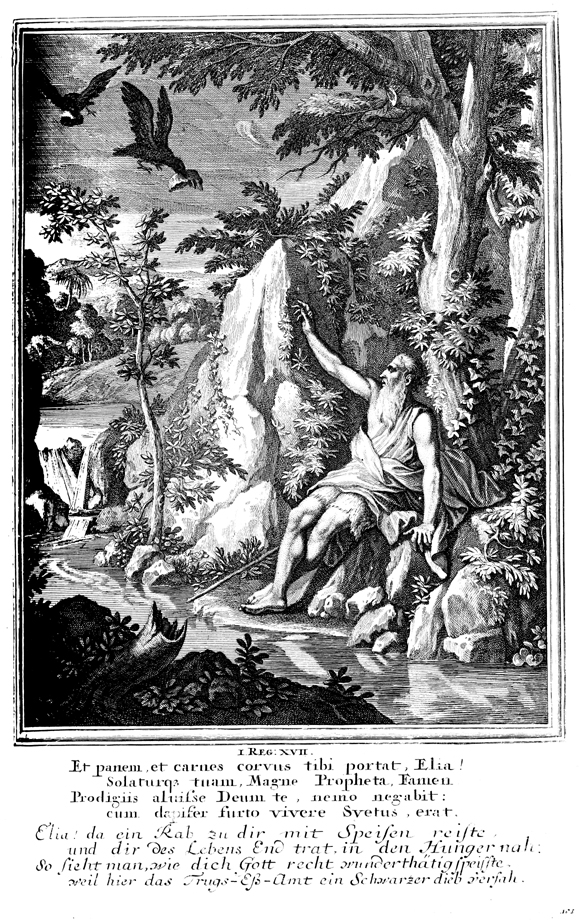
In addition to the importance of the Hanukkiah for its age (London's oldest standing synagogue, Bevis Marks, for example, was built only in 1701) and certain provenance, the work is unusual for its iconography of the Prophet Elijah begin fed by Ravens (I Kings 17:6) a allusion to the patron Elias (Elijah) Lindo. Though the subject is not very common in Jewish art, it was popular during the Baroque period in both Catholic and Protestant lands. For example, there is a late 16th century version by the Flemish painter Paolo Fiammingo (now in San Francisco), and a well known version from 1620 by the Italian artist Guercino (coincidentally, now in London at the National Gallery). A version by Dutch artist
Abraham Bloemaert (1564-1651) was copied in prints of the 17th and 18th centuries. Click here to see an anonymous print of the subject from 1712. Such printed works probably influenced Ruslen's design.

Read the full story as reported from ArtDaily.org (presumably from a press release). The Jerusalem Post ran the story almost verbatim, read it here.

Thursday, July 23, 2009

Tour: Synagogues & Sacred Sites in NYC's Lower East Side

Tour: Synagogues & Sacred Sites in NYC's Lower East Side

I frequently point out to the need to integrate Jewish heritage sites into broader heritage contexts, as there are relatively few places where Jewish sites can be sustained through Jewish visitorship and use alone. One growing movement is to provide walking tours based on themes in which Jewish sites are included because of history, art, music, location, etc.

These can be one-time events to better promote a building, or to strengthen ties with neighboring institutions and community organizations. They can be aimed to expose a non-Jewish audience to an interesting and important Jewish site, or they can be aimed to broaden the horizons, and offer greater programming options, to an already "captured" Jewish audience. This types of integrated programming also works in the development of permanent hertiage routes for hertiage tourism. Synagogues played many roles in Jewish communities and at communities at large. Thus, they can often take their place in tours devoted to historical themes other than strictly Jewish history - ethnic and immigration history, women's movement, labor history, etc. as well as tours devoted to art and architecture.

This Sunday the Museum at Eldridge Street on New York's Lower East Side offers an example of a varied tour of local sacred sites, putting Eldridge in a broader religious context, and focusing on the changing demographics of the Lower East Side as witnessed through synagogues, churches and (Buddhist) temples.

- SDG

Sacred Sites Walking Tour

Sunday, July 26 at 11am

Find sanctuary in the city on the Sacred Sites Walking Tour. On this tour—which begins at the 1887 Eldridge Street Synagogue—participants will stroll the streets of the Lower East Side visiting synagogues, churches and temples spanning 200 years of religious life in America. Discover many types of houses of worship, from early structures built by wealthy English landowners to historic houses of worship central to the Jewish, African American, Italian, Chinese and Hispanic immigrant experience.

$15 for Adults; $12 for Students & Seniors

RSVP to: hgriff(at)eldridgestreet.org

Museum at Eldridge Street
12 Eldridge Street
Between Canal & Division Streets


The Museum at Eldridge Street presents the culture, history and traditions of the great wave of Jewish immigrants to the Lower East Side drawing parallels with the diverse cultural communities that have settled in America. The Museum at Eldridge Street is located within the Eldridge Street Synagogue, which opened its doors in 1887.

Germany: New Dedications at Lieberose and Siegburg

Germany: New Dedications at Lieberose and Siegburg

(ISJM) Here are notices of two recent monument dedications in Germany that I missed. The information comes from German press accounts reports in the July Newsletter of the Lo Tishkach Foundation. - SDG

Memorial Stone Unveiled in Siegburg Jewish Cemetery

10 June 2009 - In the presence of Holocaust survivors, the mayor of the German city of Siegburg has unveiled a memorial stone in the local Jewish cemetery. The stone, featuring a plaque with the first article of the Universal Declaration of Human Rights, is part of a project co-ordinated by the Cologne Archbishopric and local secondary schools. On the same day, a new oak tree was also planted in the cemetery.

Jewish Cemetery to be Consecrated at the Site of a Former Concentration Camp in Eastern Germany

9 June 2009 - On 16 June, Rabbi Menachem Halevi Klein of Frankfurt consecrated the site of a former concentration camp in the Brandenburg town of Lieberose. The area was identified as a mass grave in 1958, when the remains of twelve Holocaust victims were located and exhumed. Additional remains belonging to 577 victims were located and exhumed in 1971; they will be reburied during the consecration next week. Recent excavations aimed at finding an estimated 753 additional remains were unsuccessful, but the Central Council of Jews in Germany is demanding searches be resumed.

Established in 1943 as part of the Sachsenhausen concentration camp, the Lieberose camp was dissolved in February 1945 and 1342 individuals were shot to death. Read the original articles here and here.

Wednesday, July 22, 2009

USA: Tupper Lake's Beth Joseph Synagogue Recalls Jewish Peddler Life in New York's Adirondacks


USA: Tupper Lake's Beth Joseph Synagogue Recalls Jewish Peddler Life in New York's Adirondacks
by Samuel D. Gruber

All photographs by Samuel D. Gruber

Ten days ago my son and I headed up to the Adirondacks for some mountain climbing – and I returned with the sore muscles, blisters and black fly bites to prove I backpacked into wilderness and ascended one of the 46 Adirondack High peaks. I had hoped to do more, the three peaks of the Seward Range, but after getting to the summit of Mount Donaldson it was enough for me.

Why am I writing this on my Jewish monuments blog? Well, because the Seward Range rises between two loci of historic Jewish activity, and it may be surprising for some to find there, in the midst of the great Adirondack State Park (bigger than some states and some countries), representative sites of the two poles of American Jewish life a century ago. A short distance to the northwest is the village of Tupper Lake, once a thriving lumber town, and place where in the late 19th century about 35 Orthodox Jewish peddler families from Eastern Europe settled down, eventually opened stores, and in 1905 built their synagogue – the now restored Beth Joseph.

To the East is Saranac Lake, site of the great summer camps of several of New York's most prominent German-Jewish families – the Seligmans, Kahns, Lewisohns and others. One of the first of these was Fish Rock (later known as Sekon), established by Isaac (Ike) Seligman. You can read more about Sekon here. The camp lifestyle was written about in the August 1904 issue of
New Era Illustrated Magazine that you can read here.

Though the two groups of Jews hardly interacted – the Orthodox Jews did sell supplies to their Reform brethren, and when it came time to build Beth Joseph, many of the New York elite donated to the cause.

I include here a brief description of Beth Joseph and some photos.


Click images for caption and larger view.

https://photos.google.com/album/AF1QipNxFEaFs9ACLU1Q7VQ7o0ba5rjskkelMN3Qhbh5

Beth Joseph is one of small group of intact rural and small town synagogues built by Eastern European Orthodox congregations at the turn of the 20th century. There were once many more such structures, but besides Beth Joseph, only a few – such as B’nai Abraham in Brenham, Texas and Tifereth Israel Synagogue in Alliance, New Jersey remain dedicated as synagogues, with their original furnishings intact.

Beth Joseph is a two and one-half story, three-bay by five-bay, vernacular style wood frame building, covered with clapboards. Its most distinguishing features are tall square corner tower-like pilasters and a pair of square pilasters flanking the entrance that divide the façade into three bays. The central entrance bay terminates in a pediment, and is marked with a sundial style decoration over the entrance, above which is the Hebrew inscription “This is the gate of the Lord. The righteous shall enter it.” The letters were originally wood, painted gold. Last week these were replaced by metal letters of the same color. Higher up the central bay is a round stained glass window and still further up a small rectangular plaque with the Hebrew date corresponding to 1881, the date when the synagogue founders arrived in Tupper Lake.

[Added to blog 11/25/2011. According a note sent to me by synagogue historian Mark Gordon, "the first two Hebrew characters reading right to left were incorrectly applied during the rehab. - Thanks for the correction, Mark!]

Inside, one passes through a vestibule area with stair to the right leading to a women’s balcony, set above the vestibule. In the vestibule and in the women’s gallery are now exhibitions related to the community’s history. The pine paneled sanctuary has three sections of six Gothic-style wooden pews reputedly originally from a Catholic church. At the far end is a free-standing raised bimah, immediately beyond which is the Ark. To the right are more pews set perpendicular to the other rows, and which face the bimah. The bimah may originally have been place in a more central location. The sanctuary is well lit with large round arched windows. Only a round window above the Ark, and the round window of the façade, is of stained glass.

Like many small town American synagogues, Beth Joseph fell upon hard times, especially following World War II. The doors were closed n the 1950s, and the synagogue sat remembered but hardly used, and then only for non-Jewish purpose. A few members of the founding families still resided in the area, and many more maintained connections to their roots, but there were not enough people for a congregation, and no money to maintain the building. This was the situation when the building was rediscovered by Sharon Berzok in the 1980s. Sharon and her Jewish husband Robert researched the history of the structure, and led a campaign to have the building listed on the National Register of Historic Places. Then, in 1988 just before their success, Sharon was killed in a car accident in California. Her death traumatized the community, but also galvanized it to continue her work, and over the next few years the Beth Joseph Historical Preservation Society raised funds and restored the building. At first they only conceived of it being a museum of sorts - n could believe that it would serve for religious use, too. But quickly , as the building's restoration became known, Jews appeared. Some had been in the region for years, others were seasonal visitors, but over time a new congregation - now affiliated with the Reform movement - coalesced. Today, Beth Joseph has a rabbi (Rita Leonard) and regular Shabbat and holiday services. There is a small but active group of local congregants who also keep the building open for visitors in the summer, and a more distant Board of Directors, many in New York City, who help with funding.

The rediscovery, restoration and revival of Beth Joseph has not been without setbacks and conflicts over a period of two decades. But overall, the project has done well. As the oldest standing building in Tupper Lake it has great appeal to the entire town, and it has proven an inspiration and a community magnet for local Jews. The projects has mostly followed appropriate historic preservation methods and has gathered the support (and grants) from many local and regional history and preservation organizations. The tenacity of its volunteers in getting the project down, and the variety of the ways they achieved their goals provide lessons to smaller congregation in the Untied States and also worldwide.

Tupper Lake's Beth Joseph is well worth a visit - even if you are not there to climb a mountain.

For more information or to make donations contact Janet Chapman, President, Friends of Beth Joseph Synagogue, P.O. Box 625, Tupper Lake, NY 12986-9703. The synagogue is open to visitors in July and August from Tuesday to Friday, 11 am to 3 pm.