Museum as Memoryscape: The Virtual Shtetl Portal of the Museum of the History of Polish Jews
Pauline Sliwinski, Museum of the History of Polish Jews, Poland
http://www.sztetl.org.pl
Abstract
This paper focuses on the Virtual Shtetl Portal of the Museum of the History of Polish Jews. Virtual Shtetl utilizes a Web platform that enables registered users to participate in the sharing of public history and the preservation of Jewish cultural heritage. It aims to transform the passive role of the museum visitor to that of an active stakeholder in the preservation of Jewish heritage closely linked to the Polish landscape.
Keywords: virtual museum, heritage preservation, community, Virtual Shtetl Portal, memory
1. Introduction
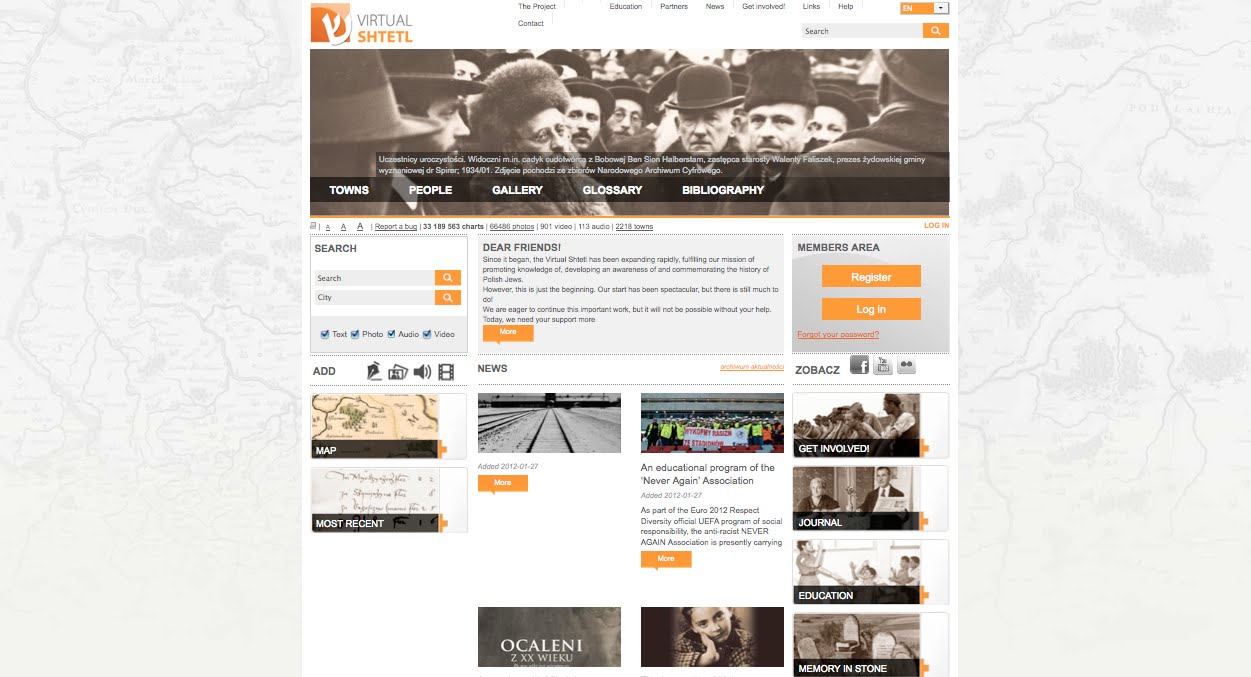
The Virtual Shtetl Portal project (Portal Wirtualny Sztetl, http://www.sztetl.org.pl) is an initiative of the Museum of the History of Polish Jews (Muzeum Historii Żydów Polskich) that was first launched online in June of 2009. The Virtual Shtetl chronicles the history of Polish Jews by providing information about the small towns and big cities where for centuries Jews, Poles and other minorities lived together. The project is constantly growing and improving with the addition of new entries by participating users. Under the guidance of the Museum of the History of Polish Jews, online visitors are helping to create an interactive database of information about Jewish communities from over 2,200 towns across Poland. After its first year, there were more than 40,000 photos and 500 films. As of today there are more than 65,000 photos, 900 films and these numbers are continuing to grow.
From September of 2008 to the launching of the site, I conducted an internship at the Museum and my main responsibility was to assist with the creation of the English version of the site. The major task was to contact volunteers and professional translators who could help to translate hundreds of historical texts written in Polish to English. But more importantly, during this internship, I became not only familiar with the textual content of the project but also I observed and participated in the social network that makes the Virtual Shtetl possible. When the project was officially launched and my internship drew to a close, hundreds of people from across the world were sending their feedback and uploading their own materials to the site. The network of volunteers working on the Virtual Shtetl has expanded since then and the website’s user base has grown considerably to well over 1,500 registered users as of January 2012.
I chose to examine these encounters from a qualitative and cultural theory perspective because of my training in the field of sociology and my introduction to one of the early contributors to the field of memory studies, anthropologist Clifford Geertz (1973). When expanding upon a semiotic approach to the theories of culture, Geertz began to theorize cultures as “webs of significance” that are “spun” by humans. Paradoxically, humans also end up being “suspended” by them (Geertz, 5). I came to understand over the course of my studies that the museum is such a web and that as the visitor, the curator, the volunteer and the scholar, we are all “suspended” in those webs.
The concept of memoryscape serves as an entry point for interpreting the Virtual Shtetl Portal of the Museum of the History of Polish Jews, the memories it sustains and contests, and its stated and less explicit social purpose. A museum itself is a memoryscape, a portal through which societies remember. The Virtual Shtetl Portal is more than a multimedia exhibition that provides a new way of experiencing a museum. It is a place of concentrated cultural practice where public history is being rewritten, where individuals become guardians of historical memory, where the public is empowered by a passion for the subject and the availability of an Internet connection, and where memories and identities are constructed and negotiated.
Read the rest of the paper here: Museum as Memoryscape: The Virtual Shtetl Portal of the Museum of the History of Polish Jews | museumsandtheweb.com
Sunday, April 8, 2012
Pauline Sliwinski Writes About the The Virtual Shtetl Portal of the Museum of the History of Polish Jews
Thursday, August 25, 2011
USA: Claudia Gould named new Jewish Museum director
Claudia Gould named new Jewish Museum director
August 24, 2011
NEW YORK (JTA) -- The Jewish Museum of New York has named Claudia Gould as its new director.
Gould, director of the Institute of Contemporary Art at the University of Pennsylvania, will succeed Joan Rosenbaum, who has served in the position for the last 30 years.
The 107-year-old museum located on the Upper East Side of Manhattan is dedicated to “the artistic and cultural heritage of the Jewish people," according to its mission statement.Monday, January 3, 2011
Judaica Europeana Provides a Unified Digital Presence for Judaica Collections
Nothing beats visiting a museum in person, as these visitors to Manchester's Jewish museum learn firsthand, but someday soon Judaica Europeana might be the next best thing. Photo: Samuel D. GruberJudaica Europeana Provides a Unified Digital Presence for Judaica Collections
Judaica Europeana is a growing network of Jewish museums, libraries and archives which have joined to present a unified digital presences to highlight the strengths of their collections. So far twenty-three institutions in 17 cities have joined forces to provide integrated online access to Jewish collections. These include the Jewish museums of Amsterdam, Berlin, Frankurt and Toledo as well as London’s Ben Uri Gallery. The National Library of Israel will strengthen Judaica’s technical expertise and provide access to its collections. The Center for Jewish History in New York, which includes outstanding collections on Jewish life in Europe such as those of YIVO and Leo Baeck Institute, will complement the content held in Europe.
I hope I'll be able to use Judaica Europeana to getter better images than this one, which I took a few years ago without flash at the Budapest Jewish Museum. photograph: Samuel Gruber.The Paris Yiddish Centre-Medem Library which has been associated with the project from an early stage, will provide among other things, a remarkable collection of Yiddish music. The Steinheim Institute in Duisburg has a very large database of Jewish tombstones and important photographic archives. The Spanish Ministry of Culture and the Sefardi Museum in Toledo will provide valuable content from their collections. See a full list of Partners at www.judaica-europeana.eu/partners.html
Judaica Europeana is one of a series of initiatives supported by the European Commission’s eContentplus programme that harvest and aggregate content for EUROPEANA, Europe's museums, libraries and archives online. A prototype which features 14 million items online can be accessed on www.europeana.eu. A fully operational version will become available later in 2011. Judaica Europeana is co-funded by the European Commission under the eContentplus programme, as part of the i2010 policy.
The project is just the latest in an still-evolving pan-European community of Jewish culture. In the past decade we have the slow but still struggling efforts of the Association of European Jewish Museums and also the highly popular annual Day of Jewish Culture. Judaica Europeana aims to create the most visible type of product from such international culture efforts - namely to show shared collections of Judaica to everyone, all the time, online. If successful the project will trample those last remaining cultural borders in Europe - recognizing that historically and now in contemporary terms, the Jewish people and Jewish culture are trans-national. The great strength of the site appears to be its intent and ability to house thousands of images. The weakness will be one shared with many websites - that there will be limited depth of information and analysis. For web-designers, seeing is often believing. Still, having such a big image library handy will be a boon to many.
The project, however, dramatically demonstrates again the great divide that still exists in vision, organization, and technical resources between institutions in the old "West" - may of which receive state aid - and the struggling institutions in the former Soviet block. Twenty years after Communism only a few institutions such as the Prague Jewish Museum and the Jewish Historical Institute have been able to compete in competence with the old centers of London, Paris, and Berlin. A few centers, such as Budapest are also now emerging as major exhibition and research centers (on Budapest link to the JE newsletter below). Sadly, there are still many "orphaned" institutions in former "East" that most need to catalog, digitize and publish their collections. I hope that Judaica Europeana will extend a helping hand to institutions large and small.

Two views form the Amsterdam Jewish Historical Museum. Video can be watch online at home, but old synagogues are best understood in the spaces, moving around, turning this way and that, and experiencing passing time and shifting light. Ah, but how many musuem goers work that hard? Photos: Samuel Gruber.According to Judaica Europeana, its strength "lies in the diversity and richness of its cross-domain offerings. Users will find at their fingertips ― only a few clicks away ― books, documents and manuscripts along with images, film and sound recordings on almost any subject. Everyone will be able to integrate this material in virtual exhibitions or in learning resources. The APIs (Application Programming Interfaces) developed by Europeana will allow the distribution of these resources directly into the workflow of the users, on PCs and mobile devices. This vast Jewish content resource will become progressively available online during 2011 and will continue to grow in the coming years."
The new Judaica Europeana illustrated newsletter is out and presents highlights from the collections of Frankfurt University and the Jewish Historical Museum, Amsterdam, two virtual exhibits from Budapest and Athens and some papers given at the EAJS Congress in Ravenna. It can be viewed here.
Tuesday, December 28, 2010
Poland: New Director at Krakow's Galicia Jewish Museum


Poland: New Director at Krakow's Galicia Jewish Museum
Nowakowski will replace Kate Craddy who has returned to England, to take up an appointment at the Barber Institute of Fine Arts in Birmingham. Craddy herself became director after the death in 2007 of the museum's founder, the British photographer Chris Schwarz. The museum's core exhibition is formed by Chris's photographs of Jewish heritage sites, taken mainly in the 1990s -- they also form the basis for the book Recovering Traces of Memory, with text by Jonathan Webber.
I congratulate Kate on all she has achieved at the museum, and wish Jakub all the best in his new position.
Nowakowski has an MA in History from the Department of Jewish Studies at the Jagiellonian University, as well as a postgraduate diploma in Management and Marketing from the Kraków School of Economics and Computer Science. He also holds a Tour Leader’s License from the City of Kraków.


In addition to its permanent photographic exhibition, the museum hosts traveling exhibitions about history and art, and also has one of Poland's best Jewish book stores and gift shops, and a hospitable cafe that provides a good rest and meeting place in Kazimierz. My family was pleased to donate one of my mother's (Shirley Moskowitz) monoprints from her Polish synagogue series to the museum in 2009, based on her visits to ruined synagogues in 1993. The wntire series had previously been exhibited at the museum.
The Galicia Jewish Museum employs over 20 full- and part-time staff, in Museum Operations; Education and Research; Projects and Publications; External Relations and Communications; and Finances and Administration. New Museum Director Nowakowski is supported by an active Board of Directors in Poland and a Board of Trustees in the UK, led by Chairman Prof. Jonathan Webber (UNESCO Chair of Jewish and Interfaith Studies, University of Birmingham).
Friday, September 3, 2010
Philanthropy: Rothschild Foundation (Europe) Accepting Proposals for Jewish Heritage
The Rothschild Found (Europe) has for much of the past decade been the quiet support of Jewish heritage projects in Europe. Foundation grants have been critical in all many of ways, but especially as catalyst money for new initiatives in Jewish heritage and in Jewish academic studies. Rothschild was a major supporter of conferences in Prague (2004) and Bratislava (2009) in which I was involved, and it has supported scores of projects to help museums, archives and historic sites - especially those managed by struggling Jewish communities.
Now the Foundation has reorganized - moving from London back to its origins at the Rothschild estate in Waddesdon. There has been staff turnover in the move, but the primary mission has not changed. The heritage mission has, in fact, been strengthened. The foundation is now more public and for the first time has launched a website with a public call for applications. It is a two-part process and those seeking grants now need to get in a first inquiry by September 13th.
Go to the website for eligibility requirements and information on applying for project support.
This tgext comes form the website:
Rothschild Foundation
http://www.rothschildfoundation.eu/
The Rothschild family has a long tradition of philanthropy, starting with Mayer Amschel Rothschild (1744-1812) and his five sons. From the very beginning their philanthropy was concerned with ensuring equal opportunities for disadvantaged groups across Europe. Other areas of support have included health care, housing and education. The Rothschild Foundation (Europe) continues this philanthropic tradition under the Chairmanship of Lord Rothschild and during the last ten years, we have supported a range of educational, cultural, heritage and community-based initiatives in over 40 European countries. From September 2010, we will be focusing our activities in academic Jewish studies and Jewish heritage
Honouring, celebrating and learning about the history and culture of Jews throughout Europe can be done in so many ways. Our Jewish Heritage programme focuses on the archives, museums and historic buildings reflecting Jewish life in order to help create and sustain an active interest in the Jewish heritage of Europe. Specialist support for archives and museums is offered and communities are encouraged to apply for research and educational projects that use Jewish heritage as a means of engaging a broad spectrum of people in discovering more about Jewish life.
Monday, July 26, 2010
Greece: Jewish Museum in Athens Vandalized
The Jewish Museum in Athens was vandalized this week. On July 22nd, red swastikas were painted on the building's exterior walls. Despite frequent acts of vandalism against Jewish targets throughout Greece, including those in Ioannina, Hania, and elsewhere previously reported on this blog, this is the first time the museum has been the target of and anti-Semitic attack. According to community representative security cameras recorded the eight perpetrators during the museum attack.
Monday, May 31, 2010
Germany: Berlin Jewish Museum to Keep Growing with New Libeskind Designed Addition
The Berlin Jewish Museum unveiled plans in mid-May for an expansion to be completed by the fall of 2011. The new facility, located across from the current site on Lindenstrasse will be designed by Daniel Libeskind, architect of the Museum's original zig-zag building which opened in 2001. Since then there have been more than six million visits to the museum, with 750,000 visiting in 2009. During the past decade the Museum has increased it programmatic, educational and archival offerings requiring more space.
The Jewish Museum consists of two buildings, the Kollegienhaus, a former Baroque Prussian courthouse which was originally the Berlin City Museum to which the first Libeskind building was added, connected by underground passageways. A few years ago the Museum built the glass courtyard, also designed by Libeskind, between the rear wings of the Baroque building to serve as a venue for large gathering and events.

The 10-million-euro (12.7-million-dollar) extension will consist of the conversion of a large existing warehouse currently housing a flower market, to which will be added three cubes for entrance, library and auditorium.
Sunday, February 7, 2010
USA: Jewish Museum Cleans and Conserves Adolph Gottlieb Designed Parochet for Upcoming Exhibition

More photos here.
Millburn, New Jersey. Congregation B'nai Israel, original sanctuary configuration showing parochet hanging on ark.USA: Jewish Museum Cleans and Conserves Adolph Gottlieb Designed Parochet for Upcoming Exhibition
(ISJM) As the Jewish Museum gears for an exhibition of the modern art created for the Percival Goodman-designed B'nai Israel synagogue in Millburn, New Jersey (1951), its been cleaning and conserving art from the congregation (notably the large Robert Motherwell painted panel) and its own collection. It has been several years since the Adolph Gottlieb designed parochet, donated to the museum by the congregation (which has a replica in its place) in 1987, has been on view. In January museum conservators were cleaning and repairing the large fabric collage.
For more on Gottleib's synagogue art see my Tablet Magazine article about his stained glass windows in the Kingsway Jewish Center.
The following is from the Jewish Museum blog (Jan. 7, 2010):
Created for the Congregation B’nai Israel synagogue in Millburn, New Jersey, Adolph Gottlieb’s Torah Ark Curtain is decorated with symbols in a compartmentalized form, a scheme that the artist also used in his Pictograph paintings at the time. Gottlieb was inspired by forms and expressions associated with non-Western art as well as Jungian philosophy of the unconscious. In this curtain, he abstracts elements of Jewish religious belief such as the Tablets of the Law, the twelve tribes of Israel, the Temple, and the Ark of the Covenant. He also includes stylizations of objects developed for synagogue use (Torah mantles and Torah shields) and emblems that have become synonymous with Judaism (the Lion of Judah and the Star of David). The curtain was designed by Gottlieb and sewn by the women of the congregation.
Abstract Expressionist works–including Gottlieb’s curtain, a mural by Robert Motherwell and a monumental relief sculpture by Herbert Ferber–will be included in the upcoming exhibition Modern Art, Sacred Space: Motherwell, Ferber, and Gottlieb, on view March 14 - August 1, 2010.
In preparation for the exhibition, the Museum has begun cleaning the work. In the below photos, textile conservators Shelly Greenspan and Judith Eisenberg are doing surface cleaning and stabilizing appliques.
Symposium: "Jewish Art and Worship: America in the Post-World War II Era"
Millburn, New Jersey (USA). Congregation B'nai Israel, Percival Goodman, arch. Photo: Samuel D. Gruber
Millburn, New Jersey (USA). B'nai Israel entrance vestibule, original appearance. Robert Motherwell panel will be on display at the Jewish Museum.The Friedman Society of the Jewish Museum sponsors its annual S. Moldovan Memorial Symposium on sunday March 14
"Jewish Art and Worship:
The Jewish Museum (NY) from 9:30am-3:00pm.
Advance reservations required (Fee: $50, $10 student).
I am honored to be invited as one four speakers at the symposium. The schedule is:
Samuel Gruber, Managing Director, Gruber Heritage Global & Rothman Lecturer in Judaic Studies, Syracuse University, on "Post-World War II Synagogue Architecture: An Escape from Tradition?"
Karen Levitov, Associate Curator, The Jewish Museum, on "Modern Art for the Modern Synagogue".
Daniel Belasco, Henry J. Leir Assistant Curator, The Jewish Museum, on "The Tradition of the New: Modernism in American Judaica 1956-1967".
Matthew Baigell, Professor Emeritus of Art History,
Thursday, January 21, 2010
Exhibition: Chagall Illustrations for Gogol's Dead Souls at Tel Aviv Museum of Art

Exhibition: Chagall Illustrations for Gogol's Dead Souls at Tel Aviv Museum of Art (ISJM) Art Knowledge News reports on a current exhibition at the Tel Aviv Museum of Art of etchings by Marc Chagall illustrating Gogol's Dead Souls. The collections was given by Chagall to the Museum when he visited Tel Aviv during his visit to Tel Aviv in the 1931, where he had been invited by Mayor Meir Dizengoff, who had met Chagall in Paris the previous year. Chagall had joined the Paris Committee to promote the new art museum in Tel Aviv which opened the following year. At the time Tel Aviv was a quickly growing city establishing itself through art and architecture as a world capital of modern art and design.
Marc Chagall's Illustrations for Gogol's "Dead Souls" at the Tel Aviv Museum of Art
At the center of Gogol's "Human Comedy" Dead Souls is the character of Chichikov, a charming, shrewd scoundrel, who buys from landowners dead serfs whose names have not yet been taken off the official census, that is, the "dead souls" that must be disposed of in order to avoid paying serf tax for them. Chichikov intends to present these souls as living persons, "deposit" them as collateral against a bank loan, settle in a far province and establish himself as a respectable country gentleman. Through Chichikov's journey the reader is exposed to Russia's people and social classes: the lazy, greedy landowners; the power-hungry, honor-craving bureaucrats; the destitute serfs who are nothing but their masters' chattel – in life as well as after death. They are all described by Gogol – and illustrated by Chagall – with exaggeration, as a larger-than-life yet compassionate grotesquerie.Visit : http://www.tamuseum.com/index.
Gogol wrote Dead Souls, a penetrating yet affectionate novel, in 1842 while far from Russia, in Rome, and that Chagall, too, made his witty prints when he was far from Russia, in Paris. The satirical prints are characterized by an acerbity that at times verges on cruelty, and are reminiscent of the work of expressionist artist Georg Grosz, whom Chagall had known in Berlin. Distorted, diagonal scenes and a top angle view evoke a sense of movement and instability. This arrangement of form and space, so typical of Chagall, appears in this series for the first time.
From 18 January 2010 Grotesque, exaggerated figures that are more than slightly critical of 19th century Russian society, with its characteristic corruption and bureaucracy.
The Tel Aviv Museum of Art, Israel's main art museum, first opened to the public in 1932 in the home of Tel Aviv's first mayor, Meir Dizengoff. The Museum quickly became the cultural center of the Tel Aviv, presenting local and foreign artists.
Friday, December 4, 2009
Obituary: Terri Trieger, curator for the Koslower Gallery at the Westchester Jewish Center

Obituary: Terri Trieger, curator for the Koslower Gallery at the Westchester Jewish Center
I just learned this week of the recent death of Terri Trieger, on October 24, 2009. On behalf of ISJM, I send condolences to all of Terri's extebded family.
Terri was curator for the Koslower Gallery at the Westchester Jewish Center, where she installed its first art exhibit, based on life cycle events and holiday ritual objects, in 1991. Many New Yorkers have known Terri, too, for her active role as a docent at the Jewish Museum in New York for four decades. Terri was also an advisor to the Judaic Museum of Riverdale Hebrew Home for the Age.
Terri worked with the International Survey of Jewish Monuments in 2005 to install and present an exhibition of Vincent Giordano's Before the Flame Goes Out at the Koslower Gallery, as a work in progress. Terri was a woman of tremendous energy, enthusiasm, experience and insight. She will be missed by all who knew her.
Terri graduated from Brandeis University in 1955. She is survived by her husband Dr. Norman Trieger, 4 children, 13 grandchildren, and 11 great grandchildren.
Wednesday, November 4, 2009
Conference: Lviv Meeting for Museum Workers with Judaica Collections
Lviv, Ukraine. Judaica items in the collection of the Ethnographic Museum. Photos: Samuel D. Gruber, 2000.
Conference: Lviv Meeting for Museum Workers with Judaica Collections
by Samuel D. Gruber
The Faina Petriakova Center in Lviv (UKraine) will host a one-day conference on November 23rd dedicated to the methodology of the display of Judaica,Jewish history, culture and religion in the museums of Ukraine. The organizers tell me the 45 museum workers
from different cities will participate, and probably 10-15 local professionals from L'viv.
The conference comes at at time when there is growing talk, though still few resources, of establishing Jewish exhibitions and museums in several cities. At present, however, most Judaica collections in Ukraine remain in storage or in exhibitions hardly changed since the fall of Communism.
This conference is an important step in the development of the professional network of Judaica curators in Ukraine, and also an important opportunity to develop standards for information, conservation, interpretation and exhibition of Jewish history and art. It will also be important for this group to establish ongoing relations with Jewish museum professional groups elsewhere in Europe, Israel and the United States.
The language of the conference is Ukrainian, though special arrangement can be made for foreign museum professionals interested in participating. For more information contact Meylach Sheychet at meylach@mail.lviv.ua
The scheduling of the conference is at the same time as the annual meeting of the Association of European Jewish Museums. While at present there is no overlap between the participants in these event, though I hope in the future there will be an opportunity for the two conferences and their sponsors to connect.
The Faina Petrakova Center is named after art historian Faina Petriakova, former Lviv curator, who made known to the world the Judaica collection at the Ethnographic Museum in Lviv. I remember well Faina's tenacity in arranging my viewing of the collection at the Museum, against the wishes of the then-director, during my first visit to Lviv.
In 2004, as part of the discussion about founding the Center, I wrote "Faina’s efforts were recognized internationally, but her efforts and expertise were largely thwarted locally within the local museum system. This situation was just beginning to change at the time of her death. It is important to build upon Faina’s achievements, and the establishment of the Research Center as a central coordinating point for activity in the realm of Jewish heritage in the L’viv area is a crucial step. Similar efforts have taken place in other countries where established museums, university departments or Jewish communities themselves, have taken the lead. Unfortunately, this had not been the case in Ukraine in general, and certainly not in L’viv or elsewhere in Western Ukraine, once a thriving center of Jewish Europe."
The Center's organization of this conference continues Faina's legacy. I can foresee several immediately results of this meeting - including the establishment of a network connected by email, and a compilation of a (at least briefly) descriptive list Judaica collections and exhibitions in Ukraine.
Friday, October 30, 2009
Obituary: Seymour Fromer, Co-Founder of Magnes Museum
I am sad to report the passing of Seymour Fromer, beloved teacher and friend to generations. Seymour will be remembered for his kindness and achievements, especially the founding (with Ruth Camhi Fromer) and development of Judah L. Magnes Museum in Berkeley, California.
Seymour died in his home in
Colleagues and friends can share their memories of
Seymour knew - and in almost every case helped – most of people active in the Jewish Museum world, including many of the younger generation, some of whom got there start (and their enthusiasm) under his tutelage.
Born and raised in the Bronx,
In the late 1950s, the Fromers came to
Eventually, through years of energetic and creative collecting, the Magnes grew to be the third largest repository of Judaica in the
The story of the founding and early years of the museum is vividly told by Ruth Camhi Fromer in “The Creation of the
Before Seymour’s "retirement" in 1998 (my recollection is he was forced out, in a familiar case of “founding director syndrome”) the Magnes grew to become the third largest Jewish museum in North America, specializing in Judaica from North Africa and India, and in ceremonial art and posters and paintings of Jewish interest.
The Fromers kept expanding the collection by rescuing artifacts from endangered Jewish communities around the world. A planned, expensive - but ultimately failed - merger with the Jewish Museum San Francisco temporarily closed the Magnes.
In 1967,
Especially in the 1970s and 80s,
Seymour Fromer is survived by his wife, Rebecca Camhi Fromer; their daughter, Mira Z. Amiras, Professor of Comparative Religion at
The family requests that any donations in Seymour Fromer’s memory be sent to the Judah L. Magnes Museum,
My comments are adapted from the obituary posted by the Magnes Museum: Magnes Founder,
Monday, September 28, 2009
USA: Orthodox Synagogue Restored in Portsmouth, Virginia as Museum and Cultural Center
Photos: Samuel D. Gruber 2009
USA: Orthodox Synagogue Restored in Portsmouth, Virginia as Museum and Cultural Center
by Samuel D. Gruber
(ISJM) Earlier this month I had the pleasure of lecturing at the Jewish Museum and Cultural Center in Portsmouth, Virginia, housed in the newly restored former Chevra T’helim (House of Psalms) synagogue.
Chevra T’helim was founded in 1917. IN the following year, the new Orthodox congregation purchased its property at 607 Effingham Street, where it began to build a new synagogue. The result is a building that combines Old World and New. The brick exterior is fronted by a Colonial style columnar façade. Inside, the architecture and furnishings maintain a traditional Eastern European synagogue arrangement with galleries for women in three sides and a central bimah. The brick exterior is fronted by a colonial style columnar façade. Or so it seems at first but it's not as simple as that. The façade columns are much taller than one expects in a traditional Georgian/ Colonial Building, and above, in the pediment, is a Magen David. The columns are sheathed in metal; something strange to me, but that I was told was not uncommon in the South- apparently wood in this climate is susceptible to rot and insect infestation. The Magen David, however, is decorated with light bulbs, and that is something I know is uncommon everywhere.
Inside, the classical Ark breaks tradition, too; it has decorative lightbulbs along the intrados of the arch. Crowning the Ark, as in many Eastern European and American immigrant synagogues of the time, is a pair of carved lions flanking a Decalogue. But these lions are special, too. They have red eyes, lit by colored lights that flash on and off. Chrevra T’helim isn’t the only example of this love of (electric) lights. In Baltimore, the immigrant Orthodox Congregation that took over the 1876 B’nai Israel Synagogue on Lloyd Street in 1895 installed festive electric lighting on its ark, probably around 1910. Similar lights decorate the Ark at New York’s Eldridge Street Synagogue. Murray Zimiles exhibited several examples of red-eyed lions in his "Gilded Lions and Jeweled Horses" exhibition at the American Folk Art Museum. One pair of lions originally from Scranton, Pennsylvania also has light bulbs for eyes. I don’t know if they flashed!
The timing may have been coincidental that the region’s oldest congregation, Temple Ohef Shalom – originally Orthodox but Reform since the mid-19th century – also laid the cornerstone for their new Temple in 1917. Temple Ohef Sholom (of which I hope to write more later) is a massive Neo-Classical building designed in tandem with an imposing Methodist Church across the street. At the time Norfolk and Portsmouth were only connected by ferry. The cultural divide between Cheva T’helim and Ohef Shalom was even greater than the geographic distance. Still, both Reform and Orthodox congregation used columnar facades – no doubt to emphasis their American spirit.
Restoration of Portsmouths’s unused and deteriorating synagogue began in 2001 after intense and sometimes acrimonious negotiations among several groups seeking the site. As in Boston in the early 1990s, where at the Vilna Shul a small Orthodox congregation aged and died, leaving the future of its building unplanned, so too, in Portsmouth, where only one surviving trustee remained committed to the building. Eventually, the courts ceded control over the congregation’s cemetery to a Conservative Synagogue that has its cemetery immediately adjacent, but the independent not-for-profit Friends of Chevra T’helim was able to secure the building, with the promise to protect and preserve it. The fact that this not-for-profit citizens' group had already been formed gave it the standing to receive the building without further litigation.
The goal of the restoration project is now partially achieved: the 1918 building itself is secure, intact and restored. It can now host visitors and small events, including the lecture series to which I contributed this year. To do more, however, The Museum and Cultural Center needs more space, and the next phase of the project is to build a modest structure at the north side of the synagogue (where there is now an empty lot). This building will house an archive and exhibition space with memorabilia and historical material from Jewish families of the Tidewater Region. The new building will also house the necessary restrooms, service areas, elevator, and conservation work spaces.
At present, despite the fact that a new $50 million Jewish Community Campus has been erected on the edge of Norfolk on the way to Virginia Beach, there is no active Jewish historical center or archive for the region. The Friends of Chevra T’helim look north to what has been achieved at the Jewish Museum of Maryland in Baltimore, and also the successful state-of-the-art Jewish archive at Beth Ahabah in Richmond, Virginia, and they have high hopes.
I was tremendously impressed by the talent and energetic dedication of Minette Cooper and Zelma Riven, two of my hosts for the weekend and two of the movers and shakers in this project. It seems possible – even likely – that they can and will achieve what they set out to accomplish. Considering the cost (and the luxury of some the materials used) of the JCC Campus, the budget for the new museum and archive building is quite modest – about $1.5 million dollars. The organization has been developing creative ways to raise this money. The building has been listed on the National Register of Historic Places, and one option being explored is the establishment of an LLC (limited Liability Company) to actually own the building, and thus as a for-profit entity, benefit from available historic preservation tax credits.
Effingham Street is in downtown Portsmouth, an area essential to the long term cultural and economic revival of the city. Civic leaders have recognized this and have gotten behind the synagogue restoration project. Indeed, it was a secular local foundation that provided the first funds needed to restore the building’s roof when the project was just starting. Since then, the building has been included as part of Portsmouth’s “Path of History” that celebrates historic sites in the city with signage and public events.
As with many urban synagogue restoration projects in the United States, Jewish organizations have been slow to get involved. As in Boston, Hartford, Tucson and Phoenix and elsewhere, some see these efforts not sufficiently Jewish, or not sufficiently Orthodox, or not sufficiently something this or something that. Federations and established synagogues see historic projects as at best irrelevant and as worst as competitive for resources, for audience and for publicity. Not surprisingly, however, once grassroots and sweat-equality restoration projects are successful, the establishment is often eager – sometimes insistently – to claim them for their own. Things are not as bad as they were twenty years ago. The success of many Jewish historical projects in more than a dozen states has proven their relevance and their popularity. But in Portsmouth, it remains to be seen whether the former Chevra T’helim synagogue will be a thorn in the side of the Tidewater Jewish Community or a jewel in its crown.
Wednesday, September 16, 2009
Baltimore: Jewish Museum of Maryland Plans Expansion on Site of Lenny's Deli

Baltimore: Jewish Museum of Maryland Plans Expansion on Site of Lenny's Deli
by Samuel D. Gruber
(ISJM) In August, the Jewish Museum of Baltimore announced the purchase of the site of Lenny's Deli on "Corned Beef Row" adjacent to the museum site - home of two historic 19th century synagogues.
The Deli will continue to operate at its present location for the next five years, but the museums eventual expansion to the space to provide room for a new educational wing and on-site parking.
The cost of the purchase was $1.5 million, made possible by a grant from the Herbert Bearman Foundation which has already been a major benefactor to the institution (an existing wing is already named for Herbert Bearman).
While Lenny's is viewed by many Baltimoreans of this generation as an historic institution, the Lombard (Corned Beef Row) location was opened only in 1991. Still, it is the last vestige of a much older tradition of Jewish eateries in the neighborhood.
Thursday, August 27, 2009
Lecture: Gruber to lecture in Portsmouth, Virginia on "The Architecture of Immigration: American Synagogues from 1760 to 1920"
Lecture: Gruber to lecture in Portsmouth, Virginia
"The Architecture of Immigration: American Synagogues from 1760 to 1920"
An illustrated lecture
by Dr. Samuel D. Gruber
(former Chevra T’helim Synagogue)
Tel. 757-391-9266
For information: info@jewishmuseumportsmouth.org
Admission: $15
Jews came to
This lecture traces this history through the religious buildings erected by each Jewish immigrant group. Through a rich architectural legacy, Dr. Gruber examines the history, experiences, tastes, influences and aspirations of American Jewish immigrants.
The Jewish Museum & Cultural Center
The Jewish Museum & Cultural Center opened in March 2008 in the former Chevra T'helim Synagogue, built in 1918 and closed in1985.
In 2002, the Friends of Chevra T'helim, Inc., formed a 501(c)(3) organization and stepped in to preserve this historic landmark. They acquired the building, and launched a Capital Campaign to raise $500,000. Architect John Paul Hanbury of the firm of Hanbury Evans Wright Vlattas & Company, noted for their excellence in historic preservation, oversaw the restoration.
The former synagogue, now completely restored, has been recognized by the National Trust for Historic Preservation and is listed on the Virginia Historic Register.
SAMUEL D. GRUBER is Director of the Jewish Heritage Research Center (
Dr. Gruber received his B.A. degree in Medieval Studies from


