Showing posts with label Jewish Art. Show all posts

Sunday, February 12, 2012

Conference Call for Papers: Ukrainian and Jewish Artistic and Architectural Milieus of Lwow...

Call for Papers

L'viv, Ukraine. Tzori Gilod Synagogue. Ceiling/wall painting, dtl.  (before 'restoration').  Photo: Samuel D. Gruber (2006)

The Ukrainian and Jewish Artistic and Architectural Milieus of  Lwow/Lemberg/Lviv

International Conference, to be held in Lviv, Ukraine, on November 5-7, 2012,
organized by:

Center for Urban History of East Central Europe (Lviv, Ukraine)
Center for Jewish Art, Hebrew University of Jerusalem (Jerusalem, Israel)
Polish Institute of World Art Studies (Warsaw, Poland)
The Leonid Nevzlin Research Center for Russian and East European Jewry (Jerusalem, Israel)
Ukrainian Jewish Encounter Initiative (Toronto, Canada)

The following call for papers is posted by the organizers:

The period between Ausgleich and Holocaust (1867-1939) witnessed the rapid modernization of Galicia, and especially its metropolis, Lwow/Lemberg/Lviv. Citizens of the Austro-Hungarian Monarchy, and then of the Second Polish  Republic headed in a diversity of paths, leading from the segregated traditional societies towards the modern integrated one, and at the same time, to a number of nationalist perspectives. These uneasy political and cultural conditions presented challenges for every group, and especially for their creative individuals, the artists.

L'viv, Ukraine. The Temple Synagogue (from postcard).  Liwicki, architect (1840-46).

The conference focuses on artists and architects, who defined themselves or were defined as Ukrainians and Jews, and thus were the representatives of the two largest non-dominant groups in Lviv before World War II. Their modern identities were shaped, in respect or contrast to, but almost always in the context of the Polish dominance in the city, and - from the last third of the nineteenth century - in the context of Polish national resurgence.

Ukrainian and Jewish artists were haunted by stereotypical views and self-views, both similar and dissimilar: while none of them had had any "national art," the former were known as indigenous builders and artisans, though confined to the peasant's background, the latter as "an artless people," "isolated in ghetto for centuries."  For some artists it was an existential choice to acknowledge or oppose the stereotypes. Another artists' challenge was the ubiquitous modernization, reflected in the diversity of  available concepts, whether evolutionist, "renaissance," or revolutionary. How artists constructed their artworks, their selves, and their group affiliations in relation to this changing world and specific urban environment, will be the topics of the conference.

 L'viv, Ukraine. The Jewish Hospital, dtl. of dome.  Kazimierz Moklowski, arch. (1898-1902).  Photo: Samuel D. Gruber (2006)

We invite scholars to present their studies of artistic and professional strategies within the highly prolific Ukrainian and Jewish communities  of artists and architects.  We invite papers questioning how artists and architects articulated their belonging to different groups, how this influenced their work and their social position, how interaction with other artists in the multi-ethnic environment of the city have influenced ideas and concepts of art and its role in society.

Moreover, we would like to learn how the social position and perception of artists and architects varied in different ethnic communities, and how they changed over time. While individual papers may only focus on the artistic life and architectural practices within one community, Ukrainian or Jewish, we aim to bring a comparative perspective by inviting scholars to discuss narratives and strategies of these two groups together.

We hope for insights in three chief directions: making and socializing the art; retaining, constructing, and re-constructing bonds with the ethnic-religious groups; shaping the cultural elites by non-dominant groups.We also invite papers dealing with the question of interaction between the urban environment and artistic milieus. Inquiries into the role of Lwow/Lemberg/Lviv, but also perceptions and reflections of the city by  Jewish and Ukrainian artists and architects are thus especially encouraged.

The conference participants are encouraged to discuss a broad variety of
matters concerning creative individuals and groups, including, but not limited to:

1.    Emancipation and education: artists, architects, and engineers.
2.    Individual professional activity and career: graphical arts, painting, sculpture, photograph, decorative art, architecture and engineering; interaction of arts; religious and secular art; funerary art.
3.    Architectural presence and visibility in the cityscape: representation of minority in modern city; leaving and retaining the frameworks of the traditional environment.
4.    Education in traditional arts and crafts. Individual and group
reaction to the numerus clausus restrictions.
5.    Defining and shaping heritage: documentation, preservation, and promotion of landmarks
6.    Artistic and professional milieus of a non-dominant group: professional unions; associations; exhibitions; competitions; art critics; press.
7.    Supportive communities: welfare and social care, from orphanages to academic houses and spas.
8.    Art collecting and patronage. Private collectors. Jewish Museum and National Ukrainian Museum. Libraries.
9.    Circles of identities: local, imperial, national, and universal identity. Loyalty and nationalism in art.
10.    Relations with the "others": tutorship, co-operation, sympathy, competition, and separation.
11.    Prejudices in the realm of art, architecture and beyond: anti-Semitism, ethnic and religious discrimination.
12.    Constructing "national styles": defining Jewish and Ukrainian art and architecture.
13.     Destiny of Jewish artists and their works in Holocaust. Ukrainian artists and architects in the wars and under occupations: World Wars I and II.
14.     Post-Lviv/Lemberg/Lwow stories: artists and architects outside of Lviv.

Languages of the conference: English and Ukrainian.

Abstracts (up to 200 words) of a twenty-minute presentation with a short CV should be submitted (as an attached MSWord documents) by April 1, 2012 to Dr. Iryna Matsevko, the Academic Coordinator of the Center for Urban History at i.matsevko@lvivcenter.org, with "Conference" in the subject header.

Applicants will be notified of the decision regarding their proposals by May 1, 2012.

Limited funds for reimbursement of travel expenses and accommodation are
available. No conference fee will be charged.

Symposium: The Art of Being Jewish in the City

This will surely be a day of interesting discussion...unfortunately the schedule doesn't go into more detail about specific topics.

THE ART OF BEING JEWISH IN THE CITY
Thursday, March 15, 2012

Edward H. Rosen Hillel Center
Temple University (Philadelphia)
1441 Norris (corner of N. 15th Street)
Philadelphia, PA 19122

A day-long symposium exploring arts-led urban development and the role that Jews play in envisioning new forms of urban life. Free and open to the public.

Temple University's Feinstein Center for American Jewish History brings together scholars and urban practitioners to consider the public and private forces that shape urban art and culture. The culminating event of two years of programming on "Jews and the American City," this symposium invites the public to join in conversation with some of the most important urban thinkers today. How are Jews imagining, funding, and creating urban arts and culture for the future?

SCHEDULE

9:00 a.m. - 9:30 a.m.
Registration and breakfast

9:30 a.m. - 9:45 a.m.
Opening Remarks, Lila Corwin Berman, Director of the Feinstein Center and Murray Friedman Professor of American Jewish History, Temple University

9:45 a.m. - 11:45 a.m.
Jewish Centers of Urban Arts and Culture
  • Elise Bernhardt, President and CEO, Foundation for Jewish Culture
  • Rachel Chanoff, Founder and Director, THE OFFICE performing arts + film, and Artistic Director, Celebrate Brooklyn!
  • Daniel Belasco, Henry J. Leir Associate Curator, The Jewish Museum of New York
  • Dan Friedman, Arts and Culture Editor, the Forward
  • Dan Schifrin, Director of Public Programs and Writer-in-Residence, Contemporary Jewish Museum
  • Julia Foulkes, Associate Professor of History, The New School, and author of To the City: Urban Photographs of the New Deal (2010)
  • MODERATORS: Warren Hoffman, Director of Arts and Cultural Programming, the Gershman Y, and Josh Perelman, Chief Curator and Director of Exhibitions and Collections, National Museum of American Jewish Histor
1:00 p.m. - 3:00 p.m.  
Private Funds and Public Urban Missions
  • Andrew Eisenstein, Managing Director of Ironstone Strategic Capital Partners and real estate developer
  • Jeremy Nowak, President, William Penn Foundation, and former CEO, The Reinvestment Fund
  • Zannah Mass, Director, Brooklyn Creative Lab, and former Cultural Affairs Director, Two Trees Management Company, and General Manager, St. Ann's Warehouse
  • Michael Royce, Executive Director, New York Foundation for the Arts
  • Sharon Zukin, Professor of Sociology, Brooklyn College and City University Graduate Center, and author of Naked City: The Death and Life of Authentic Urban Places (2010)
  • MODERATOR: Bryant Simon, Professor of History, Temple Universit
3:15 p.m. - 5:15 p.m.  
Visions of a City and Its Public Meaning
  • Cara Schneider, Media Relations Director, Greater Philadelphia Tourism Marketing Corporation
  • Alan Greenberger, Deputy Mayor for Economic Development and Director of Commerce, City of Philadelphia
  • Mark Oppenheimer, Author of the Beliefs column for the New York Times, and Director, Yale Journalism Initiative
  • Jane Golden, Executive Director, Mural Arts Program
  • MODERATORS: Carolyn Adams, Professor of Geography and Urban Studies, Temple University, and Beth Wenger, Professor of History, University of Pennsylvania
For a full program and to register, visit:

Wednesday, November 2, 2011

Exhibition: Photos of Death Camp Drawings on View at Auschwitz


Exhibition: Photos of Death Camp Drawings on View at Auschwitz

Forbidden Art is the title of a new exhibition at the Auschwitz-Birkenau Memorial and Museum Memorial on view until November 20, 2011 on the grounds of the former Auschwitz I camp in the camp laundry building.
The exhibition features photographic reproductions of twenty works of art made illegally and under the threat of death by prisoners in German Nazi concentration camps. The photographs are accompanied by commentary and excerpts from archival accounts.

Artists represented in the exhibit include: Peter Edel, Maria Hiszpańska, Franciszek Jaźwiecki, Mieczysław Kościelniak, Halina Ołomucka, Stanisława Panasowa-Stelmaszewska, Marian Ruzamski, Josef Sapcaru, Włodzimierz Siwierski, Zofia Stępień, Józef Szajna, Stanisław Trałka, The anonymous artist with the initials MM, other Aanonymous artists.

On the Auschwitz memorial webpage you can also view a gallery of over 90 artworks from the camp and post-liberation period.

The exhibit is scheduled to travel.

Read more about the exhibtion here.

Call for Papers: Ars Judaica Conference

Call for Papers: “Ars Judaica” Conference

TRADITIONS AND PERSPECTIVES IN HISTORY OF JEWISH ART

Bar-Ilan University, Israel, September 10–13, 2012.

The conference will bring together historians of art and material culture and researchers in history, religions, semiotics, psychology, sociology, and folklore to explore the fields of interest of “Ars Judaica – The Bar-Ilan Journal of Jewish Art” that include, but are not limited to: - The Jewish contribution to the visual arts and culture from antiquity to the present; - Art and architecture of Jewish sacred spaces; - Biblical texts as a source in Christian and Muslim visual arts;- Jerusalem and the Holy Land as an object and model in visual arts;- Images of Jews in visual arts;- Hebrew script in visual arts;- Patrons, collectors and museums of Jewish art;- Jews, arts and politics.

Abstracts (limited to 200 words) of twenty-minute presentations with a short CV should be submitted (as attached MSWord documents) by JANUARY 6, 2012 to gr.ajudaica@biu.ac.il.

The applicants will be notified of the decision regarding their proposal by February 6, 2012

Friday, September 9, 2011

Potomac, Maryland. Chabad Center of Greater Washington, Shinberg/Levinas, architects. Photo courtesy of Shinberg/Levinas.

Publication: Maya Katz, The Visual Culture of Chabad

I haven't had a chance yet to read Maya Katz's new The Visual Culture of Chabad but look forward to doing so soon. Meanwhile, I post a recent review from H-Judaica by Michal Kravel-Tovi (University of Michigan).

This new book clearly delves deep into the history and beliefs of Chabad, and also Chabad's survival and growth mechanisms. Katz mostly deals with Chabad 2-D imagery, espeivally portraits, but she touches on other forms of artistic expression and media. My own interest is this right now is two-fold. First, Chabad is now commissioning new architecture, such as small and elegant Chabad Center of Greater Washington in Potomac, Maryland by Shinberg/Levinas. Also, Chabad's by its massive presences throughout the world, and especially in Russia and Eastenr Europe, is deteriming Jewish visual culture for the next generation through its decoration of synagogues, schools and other institutional buildings. Lastly, Chabad is taking over many synagogues built by and for other Jews, from very old buildings, to new ones like the synagogue in Dresden, Germany.

How will Chabad interpret, preserve and present the visual culture it has inherited? Unlike movements in much of American Judaism, Chabad's taste is influenced and largely controlled from a single place - 770 Eastern Parkway. Like many past Jewish movements Chabad is expansive, but at the same time it is uniquely centralized. That said, I've spent time with Chabad emissaries in far flung parts of the world and have seen how they have influences - and been influences by the non-Chabad world in which they live - often as a lonely minority. Given this, the evolution of Chabad visual culture may evolve in similar ways to other Jewish art in the past.


Kravel-Tovi on Katz, The Visual Culture of Chabad


Maya Balakirsky Katz. The Visual Culture of Chabad. Cambridge
Cambridge University Press, 2011. Illustrations. 264 pp. $95.00
(cloth), ISBN 978-0-521-19163-0.

Reviewed by Michal Kravel-Tovi (University of Michigan)
Published on H-Judaic (August, 2011)
Commissioned by Jason Kalman

Among Faces and Gazes: The Visuality of Chabad Hasidism

In The Visual Culture of Chabad, Maya Balakirsky Katz directs her perceptive scholarly gaze to the expansive field of visual culture that has come to mark the Hasidic movement of Chabad. Katz focuses on the array of images, personal portraits, and visual artifacts that so extensively permeate the public surroundings and daily experiences of those who encounter and participate within this global religious movement. Throughout the text, one is struck by Katz's attentiveness to phenomena that, pervasive as they are, might otherwise escape the eye or appear trivial. But nothing is trivialized in Katz's study of how Chabad has produced, consumed, and embedded itself within a rich, two hundred-year-old visual tradition. Rabbinical portraiture of the Chabad dynasty, the Chabad printer's mark, public menorahs, and replicas of "770" (the central headquarters of the Hasidic court, located at 770 Eastern Parkway in New York City), among other material expressions, are all examined within the pages of this book.

In conducting such an examination, Katz successfully chronicles some of the yet untold aspects of Chabad's social history. Indeed, rather than only unpack the aesthetic choices and visual tastes expressed by Chabad, the book reflects a broader scholarly agenda--to "tease out how the social life of 'things' ... provides insight into Chabad's social life" (p. 227). Through both a careful historical excavation and a close reading of Chabad's visual productions, the author offers an insightful analysis of how individuals, organizations, and communities within Chabad learn to both make visible and perceive their religious worlds. Since these undertakings have made Chabad one of the most visible movements in the contemporary Jewish world, The Visual Culture of Chabad can be read as a book about the interrelated dynamics of visuality, public visibility, and religious piety. These dynamics reveal the extent to which there is more to Chabad's visual culture than meets the eye; Katz offers a multilayered analysis of how historical, social, and institutional forces have underwritten the visual engagements of the Chabad movement. These engagements, Katz argues, have played a constitutive role, rather than solely a reflective one, in the development of religious ideologies and devotional practices among Chabad Hasidim.

The structure of the book conveys Katz's commitment to both visual culture and to her disciplinary orientations as an art historian. The Visual Culture of Chabad is organized along the thematic, material lines of visual culture; but Katz also temporally situates the objects investigated here with a historical analysis that unfolds both within and across chapters. The eight chapters are divided into two parts. The first part (chapters 1-4) focuses on rabbinical portraiture--from the portrait of Rabbi Shneur Zalman of Liadi, the late eighteenth-century founder of the Chabad movement, to the contemporary religious and messianic industry revolving around the image of Rabbi Menachem Mendel Schneerson. The second cluster of chapters (5-8) focuses on material objects that take center stage in Chabad's public life, from the building of "770" and its replicas to museological displays. Though in these chapters Katz develops the structure of her text in relationship to a particular object, detailing in each case a nuanced historical narrative, the book avoids fragmentation into a series of isolated stories. The chapters, effectively framed by the book's introduction and postscript, coalesce to produce a dynamic and well-integrated account--one that is held together by the numerous analytical and methodological threads (dealing specifically with the intersection of visual culture and religion), which are skillfully woven through each chapter.

However, the strength of the book lies less in the novelty of these analytical and methodological threads than in the richness of Katz's account of Chabad's material trajectory. The author, for example, does not coin new concepts, nor does she problematize extant theoretical frameworks of visual culture. Also, while uniquely applying an analysis of the "sacred gaze" to a Jewish rather than Christian context, the author fails to explain what we might learn about Jewish visual piety from the case study of Chabad. Finally, the structure of the book, particularly its division into thematic clusters of "the rebbe portraiture" (and thus of images of subjects) and "objects of Hasidism," would have been better reinforced if it had been grounded in the analysis of subject/object relations that is so prevalent in scholarly discussions of material culture.

These unexplored theoretical trajectories do not lessen the power of The Visual Culture of Chabad as a truly original work on the Chabad movement. In the context of a scholarly discussion that has predominately dealt with textual representations, Katz's analysis of the crucial role of visual material culture in the formation of the religious messianic movement that Chabad has become yields an especially innovative account. The perspective of visual culture not only allows Katz to employ a refreshing terminology (such as "Chabad image bank," "devotional portrait," and "visual messianism"), but also allows Katz to introduce new narratives about Chabad's development. Even if Katz is not the first scholar to refer to or engage with Chabad through the lens of visual culture (see, for example, Richard Cohen's epilogue in his Jewish Icons [1998], Jeffrey Shandler's chapter on Chabad in his Jews, God, and Videotape [2009], or Samuel Heilman's chapter in Jack Wertheimer's edited volume Jewish Religious Leadership: Image and Reality [2004]), she adds a number of new and valuable pieces to the discussion. Furthermore, while a book exploring the dynamics of a continuously evolving empirical field can never fully constitute, in and of itself, a comprehensive project, the book's breadth remains quite remarkable. The cover of the book--its own visual representation--appears to frame it as an analysis of Chabad messianism. After all, it features the face of Rabbi Menachem Mendel Schneerson, the celebrated icon of Chabad's messianic campaign, displayed on a New York highway billboard with a written message heralding the immanent redemption. However, by covering a range of themes, including institutional infrastructure, leadership, and the movement's relationship with cultural Zionism, Katz's contribution to the literature on Chabad transcends the issue of messianism alone. Ultimately, the book offers new understandings of how Chabad has endured, and even thrived, despite numerous moments of crisis.

Take, for example, how Katz's analysis of photography during the tenure of Yosef Yitzchak, the geographically displaced sixth rebbe, (chapter 3) sheds light on the crucial function of this visual medium in the maintenance of leadership amid potential disruption. In particular, Katz shows how, through the production of the rebbishe photographs, as well as the circulation of photographs between the rebbe and devotees, Yosef Yitzchak established a virtual court in Poland, while maintaining authority and relationships in absentia. Or, consider how, as Katz shows, Chabad's visual program builds simultaneously on the tradition of interactive visualization of a rebbe (discussed in chapter 4) and an architectonical infrastructure that detaches the Hasidic court from the person of the rebbe (discussed in chapter 6), thereby driving the movement's messianic ideology and enabling it to cope with the leadership void.

Katz is at her best when she weaves her analysis of a particular visual tradition or object together with an ostensibly unconnected part of Chabad's history. The connections to which she draws attention are illuminating--such as the psychological and aesthetic connections she traces (in chapter 2) between the puzzling four portraits of Yosef Yitzchak, drawn by a woman artist in 1930s Vienna, and the experience with psychoanalysis of his father, and predecessor of the Chabad
dynasty, the RaSHaB, in early twentieth-century Vienna.

Katz's position as a viewer calls for some commentary. There is no fascination, let alone adoration, in how Katz uses the lens of visual culture to describe Chabad. As she historicizes the devotional objects and sacred visual images with which Chabad identifies, she by necessity presents the movement with an often challenging "textual portrait": she provides counter-narratives to some of its hegemonic myths and attends to objects from which the archival gatekeepers would have probably preferred she divert her gaze. At the same time, her critical, even daring, analyses are always sensitive, engaged, and empathetic, both reflecting and creating a close aesthetic distance. Neither a detached scholar nor admirer of Chabad's sacred material culture, the author positions herself at a critical distance from her objects--a position that allows her to zoom in and out in order to produce a convincing analysis. However, we know almost nothing about this position; while Katz writes on the visuality of Chabad Hasidism, she remains for the most part out of sight. We do know that the four portraits of Yosef Yitzchak were hung by her bedside table for two years; we know Katz engages with and even produces images of Chabad, as some of the photos included in the book are attributed to her private collection; and we even know that she is "one of David Berger's indifferent Orthodox Jews" (with regard to Chabad's disputed messianic theology) (p. 15). But we know hardly anything about her own modalities of seeing the world and especially the Chabad movement. Since the author does acknowledge in her analysis the implications of a "female gaze," it would have been helpful to locate her own perspective within the framework of gender politics--for example, as an orthodox woman who views and writes about portraits of (male) rebbes. To the extent that Katz adopts the idea that images should be treated "not only for what they depict but also for how they make us see"--and also that she works under the premise of "multiple visions"--it would have been constructive to know how the images of Chabad effected her own vision (pp. 10, 232).
The added value of a more reflexive positioning becomes apparent in one revealing moment in which the author does locate herself in relationship to her field of study. As she writes: "In the weeks after I lost my own mother prematurely and inherited her precious family photograph albums that she spirited out of the Soviet Union in the late 1970s, I felt inexplicably moved by the gentle intimacy of Yosef Yitzchak's portraits. Although I had previously cynically dismissed the portraits' identification with RaSHaB as an attempt to alleviate the stigma of the female gaze, I came to see RaSHaB's presence as consciously inscribed in Yosef Yitzchak's portraits. In confronting photograph after photograph of my teenage self imitating what I always saw as my mother's larger-than-life beauty with the same pout and disinterested eyes I knew by heart from her family photographs, I could see RaSHaB's likeness posthumously embedded in the life portraits of Yosef Yitzchak" (pp. 60-61). This moment is memorable not only because it captures the author's own intimate reflections on the recent death of her mother, but also because it provides us with a glimpse of how Katz has come to change her view of a particular Chabad object. By utilizing her positionality in this way, she traces an unexpected layer of the object's already intricate aesthetics.

I hope this book will set an agenda for scholarship on both Jewish visual and material culture, as well as on the Chabad movement and the ongoing development of its visual world. While the book teaches us about the power of visual representations, its quality also reminds us of the strength of good textual representations.

Citation: Michal Kravel-Tovi. Review of Katz, Maya Balakirsky, The Visual Culture of Chabad. H-Judaic, H-Net Reviews. August, 2011.
URL: https://www.h-net.org/reviews/showrev.php?id=3D33605


Tuesday, August 23, 2011

Publications: Kravel-Tovi on Katz, "The Visual Culture of Chabad"

Potomac, Maryland. Chabad Center of Greater Washington, Shinberg/Levinas, architects. Photo courtesy of Shinberg/Levinas.

Publication: Maya Katz, The Visual Culture of Chabad

I haven't had a chance yet to read Maya Katz's new The Visual Culture of Chabad but look forward to doing so soon. Meanwhile, I post a recent review from H-Judaica Michal Kravel-Tovi (University of Michigan).

This book clearly delves deep into the history and beliefs of Chabad, and also Chabad's survival and growth mechanisms. Katz mostly deals with Chabad 2-D imagery, espeivally portraits, but she touches on other forms of artistic expression and media. My own interest is this right now is two-fold. First, Chabad is now commissioning new architecture, such as small and elegant Chabad Center of Greater Washington in Potomac, Maryland by Shinberg/Levinas. Also, Chabad's by its massive presences throughout the world, and especially in Russia and Eastenr Europe, is deteriming Jewish visual culture for the next generation through its decoration of synagogues, schools and other institutional buildings. Lastly, Chabad is taking over many synagogues built by and for other Jews, from very old buildings, to new ones like the synagogue in Dresden, Germany.

How will Chabad interpret, preserve and present the visual culture it has inherited? Unlike movements in much of American Judaism, Chabad's taste is influenced and largely controlled from a single place - 770 Eastern Parkway. Like many past Jewish movements Chabad is expansive, but at the same time it is uniquely centralized. That said, I've spent time with Chabad emissaries in far flung parts of the world and have seen how they have influences - and been influences by the non-Chabad world in which they live - often as a lonely minority. Given this, the evolution of Chabad visual culture may evolve in similar ways to other Jewish art in the past.

Kravel-Tovi on Katz, The Visual Culture of Chabad

Maya Balakirsky Katz. The Visual Culture of Chabad. Cambridge
Cambridge University Press, 2011. Illustrations. 264 pp. $95.00
(cloth), ISBN 978-0-521-19163-0.

Reviewed by Michal Kravel-Tovi (University of Michigan)
Published on H-Judaic (August, 2011)
Commissioned by Jason Kalman

Among Faces and Gazes: The Visuality of Chabad Hasidism

In The Visual Culture of Chabad, Maya Balakirsky Katz directs her perceptive scholarly gaze to the expansive field of visual culture that has come to mark the Hasidic movement of Chabad. Katz focuses on the array of images, personal portraits, and visual artifacts that so extensively permeate the public surroundings and daily experiences of those who encounter and participate within this global religious movement. Throughout the text, one is struck by Katz's attentiveness to phenomena that, pervasive as they are, might otherwise escape the eye or appear trivial. But nothing is trivialized in Katz's study of how Chabad has produced, consumed, and embedded itself within a rich, two hundred-year-old visual tradition. Rabbinical portraiture of the Chabad dynasty, the Chabad printer's mark, public menorahs, and replicas of "770" (the central headquarters of the Hasidic court, located at 770 Eastern Parkway in New York City), among other material expressions, are all examined within the pages of this book.

In conducting such an examination, Katz successfully chronicles some of the yet untold aspects of Chabad's social history. Indeed, rather than only unpack the aesthetic choices and visual tastes expressed by Chabad, the book reflects a broader scholarly agenda--to "tease out how the social life of 'things' ... provides insight into Chabad's social life" (p. 227). Through both a careful historical excavation and a close reading of Chabad's visual productions, the author offers an insightful analysis of how individuals, organizations, and communities within Chabad learn to both make visible and perceive their religious worlds. Since these undertakings have made Chabad one of the most visible movements in the contemporary Jewish world, The Visual Culture of Chabad can be read as a book about the interrelated dynamics of visuality, public visibility, and religious piety. These dynamics reveal the extent to which there is more to Chabad's visual culture than meets the eye; Katz offers a multilayered analysis of how historical, social, and institutional forces have underwritten the visual engagements of the Chabad movement. These engagements, Katz argues, have played a constitutive role, rather than solely a reflective one, in the development of religious ideologies and devotional practices among Chabad Hasidim.

The structure of the book conveys Katz's commitment to both visual culture and to her disciplinary orientations as an art historian. The Visual Culture of Chabad is organized along the thematic, material lines of visual culture; but Katz also temporally situates the objects investigated here with a historical analysis that unfolds both within and across chapters. The eight chapters are divided into two parts. The first part (chapters 1-4) focuses on rabbinical portraiture--from the portrait of Rabbi Shneur Zalman of Liadi, the late eighteenth-century founder of the Chabad movement, to the contemporary religious and messianic industry revolving around the image of Rabbi Menachem Mendel Schneerson. The second cluster of chapters (5-8) focuses on material objects that take center stage in Chabad's public life, from the building of "770" and its replicas to museological displays. Though in these chapters Katz develops the structure of her text in relationship to a particular object, detailing in each case a nuanced historical narrative, the book avoids fragmentation into a series of isolated stories. The chapters, effectively framed by the book's introduction and postscript, coalesce to produce a dynamic and well-integrated account--one that is held together by the numerous analytical and methodological threads (dealing specifically with the intersection of visual culture and religion), which are skillfully woven through each chapter.

However, the strength of the book lies less in the novelty of these analytical and methodological threads than in the richness of Katz's account of Chabad's material trajectory. The author, for example, does not coin new concepts, nor does she problematize extant theoretical frameworks of visual culture. Also, while uniquely applying an analysis of the "sacred gaze" to a Jewish rather than Christian context, the author fails to explain what we might learn about Jewish visual piety from the case study of Chabad. Finally, the structure of the book, particularly its division into thematic clusters of "the rebbe portraiture" (and thus of images of subjects) and "objects of Hasidism," would have been better reinforced if it had been grounded in the analysis of subject/object relations that is so prevalent in scholarly discussions of material culture.

These unexplored theoretical trajectories do not lessen the power of The Visual Culture of Chabad as a truly original work on the Chabad movement. In the context of a scholarly discussion that has predominately dealt with textual representations, Katz's analysis of the crucial role of visual material culture in the formation of the religious messianic movement that Chabad has become yields an especially innovative account. The perspective of visual culture not only allows Katz to employ a refreshing terminology (such as "Chabad image bank," "devotional portrait," and "visual messianism"), but also allows Katz to introduce new narratives about Chabad's development. Even if Katz is not the first scholar to refer to or engage with Chabad through the lens of visual culture (see, for example, Richard Cohen's epilogue in his Jewish Icons [1998], Jeffrey Shandler's chapter on Chabad in his Jews, God, and Videotape [2009], or Samuel Heilman's chapter in Jack Wertheimer's edited volume Jewish Religious Leadership: Image and Reality [2004]), she adds a number of new and valuable pieces to the discussion. Furthermore, while a book exploring the dynamics of a continuously evolving empirical field can never fully constitute, in and of itself, a comprehensive project, the book's breadth remains quite remarkable. The cover of the book--its own visual representation--appears to frame it as an analysis of Chabad messianism. After all, it features the face of Rabbi Menachem Mendel Schneerson, the celebrated icon of Chabad's messianic campaign, displayed on a New York highway billboard with a written message heralding the immanent redemption. However, by covering a range of themes, including institutional infrastructure, leadership, and the movement's relationship with cultural Zionism, Katz's contribution to the literature on Chabad transcends the issue of messianism alone. Ultimately, the book offers new understandings of how Chabad has endured, and even thrived, despite numerous moments of crisis.

Take, for example, how Katz's analysis of photography during the tenure of Yosef Yitzchak, the geographically displaced sixth rebbe, (chapter 3) sheds light on the crucial function of this visual medium in the maintenance of leadership amid potential disruption. In particular, Katz shows how, through the production of the rebbishe photographs, as well as the circulation of photographs between the rebbe and devotees, Yosef Yitzchak established a virtual court in Poland, while maintaining authority and relationships in absentia. Or, consider how, as Katz shows, Chabad's visual program builds simultaneously on the tradition of interactive visualization of a rebbe (discussed in chapter 4) and an architectonical infrastructure that detaches the Hasidic court from the person of the rebbe (discussed in chapter 6), thereby driving the movement's messianic ideology and enabling it to cope with the leadership void.

Katz is at her best when she weaves her analysis of a particular visual tradition or object together with an ostensibly unconnected part of Chabad's history. The connections to which she draws attention are illuminating--such as the psychological and aesthetic connections she traces (in chapter 2) between the puzzling four portraits of Yosef Yitzchak, drawn by a woman artist in 1930s Vienna, and the experience with psychoanalysis of his father, and predecessor of the Chabad
dynasty, the RaSHaB, in early twentieth-century Vienna.

Katz's position as a viewer calls for some commentary. There is no fascination, let alone adoration, in how Katz uses the lens of visual culture to describe Chabad. As she historicizes the devotional objects and sacred visual images with which Chabad identifies, she by necessity presents the movement with an often challenging "textual portrait": she provides counter-narratives to some of its hegemonic myths and attends to objects from which the archival gatekeepers would have probably preferred she divert her gaze. At the same time, her critical, even daring, analyses are always sensitive, engaged, and empathetic, both reflecting and creating a close aesthetic distance. Neither a detached scholar nor admirer of Chabad's sacred material culture, the author positions herself at a critical distance from her objects--a position that allows her to zoom in and out in order to produce a convincing analysis. However, we know almost nothing about this position; while Katz writes on the visuality of Chabad Hasidism, she remains for the most part out of sight. We do know that the four portraits of Yosef Yitzchak were hung by her bedside table for two years; we know Katz engages with and even produces images of Chabad, as some of the photos included in the book are attributed to her private collection; and we even know that she is "one of David Berger's indifferent Orthodox Jews" (with regard to Chabad's disputed messianic theology) (p. 15). But we know hardly anything about her own modalities of seeing the world and especially the Chabad movement. Since the author does acknowledge in her analysis the implications of a "female gaze," it would have been helpful to locate her own perspective within the framework of gender politics--for example, as an orthodox woman who views and writes about portraits of (male) rebbes. To the extent that Katz adopts the
idea that images should be treated "not only for what they depict but also for how they make us see"--and also that she works under the premise of "multiple visions"--it would have been constructive to know how the images of Chabad effected her own vision (pp. 10, 232).

The added value of a more reflexive positioning becomes apparent in one revealing moment in which the author does locate herself in relationship to her field of study. As she writes: "In the weeks after I lost my own mother prematurely and inherited her precious family photograph albums that she spirited out of the Soviet Union in the late 1970s, I felt inexplicably moved by the gentle intimacy of Yosef Yitzchak's portraits. Although I had previously cynically dismissed the portraits' identification with RaSHaB as an attempt to alleviate the stigma of the female gaze, I came to see RaSHaB's presence as consciously inscribed in Yosef Yitzchak's portraits. In confronting photograph after photograph of my teenage self imitating what I always saw as my mother's larger-than-life beauty with the same pout and disinterested eyes I knew by heart from her family photographs, I could see RaSHaB's likeness posthumously embedded in the life portraits of Yosef Yitzchak" (pp. 60-61). This moment is memorable not only because it captures the author's own intimate reflections on the recent death of her mother, but also because it provides us with a glimpse of how Katz has come to change her view of a particular Chabad object. By utilizing her positionality in this way, she traces an unexpected layer of the object's already intricate aesthetics.

I hope this book will set an agenda for scholarship on both Jewish visual and material culture, as well as on the Chabad movement and the ongoing development of its visual world. While the book teaches us about the power of visual representations, its quality also reminds us of the strength of good textual representations.

Citation: Michal Kravel-Tovi. Review of Katz, Maya Balakirsky, The Visual Culture of Chabad. H-Judaic, H-Net Reviews. August, 2011.
URL: https://www.h-net.org/reviews/showrev.php?id=3D33605

Friday, April 29, 2011

Publication: Ars Judaica Volume Seven Has Arrived


The synagogues of Algiers (top) and Oran (bottom) are discussed in an article by Dominique Jarrassé.

Publication: Ars Judaica Volume Seven Has Arrived

The seventh volume of the excellent art journal Arts Judaica has been published by Bar-Ilan University. Editors Bracha Yaniv, Mirjam Rajner and Ilia Rodov have done it again, producing a rich selection of well-research articles beautifully illustrated and presented. Older readers will remember that from the 1970s through the 1990s there was only one reliable forum dedicated to scholarly works about Jewish art, and that was the
Journal of Jewish Art (later just Jewish Art)published by the Center for Jewish Art at the Hebrew University. That journal is no more - though the Center continues to publish important monographs and other volume - now in partnership arrangements with other institutions.

Fortunately,
Ars Judaica and the journal Images published by Brill, have developed to take its place. Significantly, the journals are complementary in editorial approach. Ars Judaica mostly focuses on painting, especially the "heroic" period of Jewish history painting and nascent modernism form the late 19th century until the Holocaust. There is usually a strong representation of new research on art and artists from Central and Eastern Europe, and of course utilizing sources in Israel.

In this new issue there are articles on Samuel Hirszenberg (by Richard I. Cohen and Mirjam Rajner) as well as articles about photographic imagery of the shtetl (by Rose-Carol Washton Long) and on the arts scene in interwar Warsaw (by Renata Piatkowska). I myself have contributed a memorial to the late Polish architect and synagogue historian Kazimierz Piechotka. Where the
Journal of Jewish Art tended to emphasis iconography and traditional Jewish themes, Ars Judaica's editor encourage a broader approach, and many of the articles include more placement of Jewish art in a wider artistic context, and also to some degree in a social and political one, too. This, of course, reflect a continuing maturation of the modern study of Jewish art which, after post-Holocaust rebuilding, first struggled for legitimacy but now is more confident in an much less mono-stylistic (Modernism) and mono-national (euro-centric and especially French) world of art art history.

There is overlap with the journal
Images, edited by Americans, but Images leans toward more contemporary art themes, and includes more American work, and strives for a more distanced and theoretical approach. Together, the two journals mix the best Israeli and American "Jewish" art history - or history of Judaism in art and provide an essential intellectual and aesthetic platform for scholars and intelligent readers.

If your university library does yet subscribe to these important journals - make sure it does for your sake, but also to ensure these journals survive.


Most issues of Ars Judaica contain at least one important article about synagogue art or architecture. In this issue I especially recommend in this issue of
Ars Judaica Dominique Jarrassé's article "Orientalism, Colonialism, and Jewish Identity in the Synagogues of North Africa under French Domination." This piece is an excellent architectural and social history study, but it is especially timely as the world focuses on the political and social changes in North Africa today where issues of cultural identity and colonialism are still strongly evident. The article accompanies Jarrassé's recent book (with Colette Bismuth-Jarrassé,Synagogues de Tunisie: Monuments d'une histoire et d'une identité. (Editions esthetiques du Divers, 20100, about which I will have more to say in an upcoming review. Prof. Jarrassé, after mastering the history and architecture of French synagogues in several important books has now turned his attention to the former French colonies of North Africa. This work is an important contribution to recent articles on the Jewish Orientalism and the development of the so-called Moorish style in Europe by Ivan Kalmar and Rudolf Klein. Given Jarrassé's deep knowledge of French historicism and the 18th and 19th-century debates over French cultural identity and nationalism, his perspective and his first-hand knowledge of so-many buildings is welcome and important. Unfortunately, many of the buildings discussed in this article are destroyed, though finely illustrated through postcard photos from the collection of Gérard Silvain.

Traidtional jewish art is not neglected either. The issue opens with an article by Sara Offenberg on "Illuminations of Kol Nidrei in Two Ashkenazi Mahzorim."

You can find more information about Ars Judaica on its Facebook Page.


Sunday, April 10, 2011

jewish-heritage-travel: Stones and Stone-carver images from a century ago

Stones and Stone-carver images from a century ago
(cross posted from http://jewish-heritage-travel.blogspot.com)

Ruth Ellen Gruber keeps posting interesting material on the history of Jewish gravestone carving.

See: jewish-heritage-travel: Stones and Stone-carver images from a century ago

In this post she shows images by Jewish artist Solomon Yudovin (1892-1954). a talented artist born near Vitebsk (where Marc Chagall was born). Yudovin was one of the artists who participated with An-Sky in the Jewish ethnographic expeditions through Volynia and Podolia (Ukraine). Yudovin photographed and copied the many of the Judaica objects and artworks discovered and collected and he later used many of these same themes in his won work - adapting by continuing Jewish traditional art motifs, themes and iconography.


One of my favorite Yudivin works is "Shabbat." Ruth should like this for all the candlestick imagery. I often show this image when I speak of the architecture and imagination of the shtetl.

Tuesday, July 27, 2010

Exhibitions: Egon Schiele's "Portrait of Wally"

Exhibitions: Egon Schiele's "Portrait of Wally"

Tom Freudenheim has written about Egon Schiele's "Portrait of Wally" for the Wall Street Journal. The painting which was at the center of one the most publicized art restitution cases goes on view for three weeks at New York's Museum of Jewish Heritage this week.

What Is Lost When Works are Trophies

By Tom L. Freudenheim
Wall Street Journal (July 27, 2010)

It's interesting to contemplate how works of art, which museums generally want us to appreciate for their aesthetic values, can turn into trophies: emblems of issues or events that have nothing to do with their status as art.

Take Egon Schiele's "Portrait of Wally" (1912), which goes on view at the Museum of Jewish Heritage in Lower Manhattan for three weeks starting Thursday, following an out-of-court settlement of the dispute over its ownership. In 1998 it had been seized by then-Manhattan District Attorney Robert Morgenthau from a Schiele exhibition at the Museum of Modern Art, to which it had been lent by Vienna's Leopold Museum. Mr. Morgenthau was acting on behalf of the estate of Lea Bondi Jaray. The heirs of the original owner held that the painting had been stolen from her by the Nazis and therefore did not belong to the Leopold Museum. "Portrait of Wally" may not be Schiele's most important but the legal case has certainly turned it into his most famous one.

Read the entire article here.

Friday, May 28, 2010

Restitution: Looted Painting by Belgian Artist Antoine Carte Returned

Restitution: Nazi-Looted Painting of Jewish Child by Belgian Artist Antoine Carte Returned

Art Knoweldge News reports that "a portrait of a child with her pet rabbit by Belgian artist, Antoine (Anto) Carte that was looted by the Nazis during the Belgian Occupation has been returned to its owner after the Art Loss Register (ALR) located it in the hands of an art dealer from Long Island, USA. 'Jeune Fille a la Robe Bleue' (1932) was the centrepiece of a hand-over ceremony at the Jewish Museum of Belgium on 1 December 2009. The Jewish child in the portrait fled Brussels with her family during the Nazi Occupation and survived the war hiding in the Belgian countryside. The family's abandoned apartment in Ohain was looted in 1944 and five oil paintings, including the Anto Carte portrait, disappeared.

For a photo and the full story click here.

Thursday, January 21, 2010

Exhibition: Chagall Illustrations for Gogol's Dead Souls at Tel Aviv Museum of Art


Marc Chagall, Illustrations for Gogol's Dead Souls. Photos: Courtesy of Tel Aviv Museum of Art

Exhibition: Chagall Illustrations for Gogol's Dead Souls at Tel Aviv Museum of Art (ISJM) Art Knowledge News reports on a current exhibition at the Tel Aviv Museum of Art of etchings by Marc Chagall illustrating Gogol's Dead Souls. The collections was given by Chagall to the Museum when he visited Tel Aviv during his visit to Tel Aviv in the 1931, where he had been invited by Mayor Meir Dizengoff, who had met Chagall in Paris the previous year. Chagall had joined the Paris Committee to promote the new art museum in Tel Aviv which opened the following year. At the time Tel Aviv was a quickly growing city establishing itself through art and architecture as a world capital of modern art and design.

Marc Chagall's Illustrations for Gogol's "Dead Souls" at the Tel Aviv Museum of Art

At the center of Gogol's "Human Comedy" Dead Souls is the character of Chichikov, a charming, shrewd scoundrel, who buys from landowners dead serfs whose names have not yet been taken off the official census, that is, the "dead souls" that must be disposed of in order to avoid paying serf tax for them. Chichikov intends to present these souls as living persons, "deposit" them as collateral against a bank loan, settle in a far province and establish himself as a respectable country gentleman. Through Chichikov's journey the reader is exposed to Russia's people and social classes: the lazy, greedy landowners; the power-hungry, honor-craving bureaucrats; the destitute serfs who are nothing but their masters' chattel – in life as well as after death. They are all described by Gogol – and illustrated by Chagall – with exaggeration, as a larger-than-life yet compassionate grotesquerie.

Gogol wrote Dead Souls, a penetrating yet affectionate novel, in 1842 while far from Russia, in Rome, and that Chagall, too, made his witty prints when he was far from Russia, in Paris. The satirical prints are characterized by an acerbity that at times verges on cruelty, and are reminiscent of the work of expressionist artist Georg Grosz, whom Chagall had known in Berlin. Distorted, diagonal scenes and a top angle view evoke a sense of movement and instability. This arrangement of form and space, so typical of Chagall, appears in this series for the first time.

From 18 January 2010 Grotesque, exaggerated figures that are more than slightly critical of 19th century Russian society, with its characteristic corruption and bureaucracy.

The Tel Aviv Museum of Art, Israel's main art museum, first opened to the public in 1932 in the home of Tel Aviv's first mayor, Meir Dizengoff. The Museum quickly became the cultural center of the Tel Aviv, presenting local and foreign artists.
Visit : http://www.tamuseum.com/index.html


Thursday, January 14, 2010

Exhibition: Newly Acquired Chagall Apocalypse Painting on View in London

Marc Chagall, Apocalypse in Lilac: Capriccio (1945)


Exhibition: Newly Acquired Chagall Apocalypse Painting on View in London
by Samuel D. Gruber
 
Many of you have probably already read that the Ben Uri Gallery: London Jewish Museum of Art has acquired an important work by Marc Chagall – one of a series of depictions of Crucified Jewish Jesus – an image he favored in the late 1930s and early 1940s as he watched German Nazis and German, Lithuanian, Latvian, Polish, Bylorussian and Ukrainian Christians participate – actively or as passive bystanders – in the murder of millions of Jews. The painting was acquired through the sharp and adroit acquisition policy of my friend David Glasser, Chairman of the Museum, which was founded in 2001 and has since then built an impressive collection and staged important exhibitions – though the institution is still looking for a permanent home.  

The painting is on view until January 31st at Osborne Samuel, 23 Bruton Street, London W1 (Opening hours: Monday – Friday, 10am-6pm, Saturday 10am-2pm, Sunday, 12-4pm). The new acquisition is a gouache (a heavy dense watercolor) made by Chagall in 1945, who kept it his private collection. It was first sold in 1985, two years after the painter’s death. It is titled in pencil in Russian, “Apocalypse in Lilac, Capriccio." You can read more about the acquisition in an article from the New York Times. 

Despite the title’s use of the term Capriccio, the work is remarkable for its depiction of anger – much more pronounced here than in Chagall’s earlier crucifixion works which are more infused with helpless pathos than any other emotion. Here Jesus is identified as Jewish not only because he wears a tallit (prayer shawl) but also, as in Yellow Crucifixion of 1943, with tefillin (phylacteries). In the Yellow Crucifixion, which is linked to the sinking of the Struma, this Jewish Jesus is paired with an image of the Torah scroll.

In the “Apocalypse in Lilac, Capriccio” Jesus’s facial expression is similar to that of the Jewish Jesus in the large painting Resurrection, which Chagall began in 1937, but continued to work on through 1947. In 1944, the year before the gouache, Chagall painted The Crucified, but in that work there is no Jesus, only village Jews who have been nailed to crosses placed along a shtetl street. This is a variation on Chagall’s 1941 painting The Martyr, set in a very similar scene. Here, however, in the foreground is a Jesus-like figure, not crucified, but bound to an upright post. He is a young man, wearing a tallit-like covering, with tefillin-like strips on his arms, and the cap of Jewish worker. At his feet is a grieving woman, presumably a conflation of a Jewish mother of the shtetl, the traditional grieving Mary at the cross, and a more general allegorical representation of grief. The 1944 painting is a reaction to the news, known at this time, of the “liquidation” of the Ghettos, the suppression of the Warsaw ghetto uprising, and the destruction of Jewish Vitebsk – Chagall's home town, which he had depicted so lovingly in previous decade.

The theme of Jewish Jesus in Chagall’s art and in the work of other artists since the 19th century has been explored by several art and cultural historians. The best and most thorough treatments are by Ziva Amishai-Maisels in her classic work Depiction and Interpretation: The Influence of the Holocaust on the Visual Arts, especially Part II, chapter 3, “ The Crucified Jew,” pp 178 197. The topic is further explored in Amishai-Maisels article “The Jewish Jesus” in Journal of Jewish Art 9 (1982): 84–104. Prof. Amishai-Maisels has advised the Ben-Uri on the current exhibition.

Wednesday, November 4, 2009

Call for Papers: 'The Image and the Prohibition of the Image in Judaism',

Call for Papers: 'The Image and the Prohibition of the Image in Judaism'

(ISJM) Scholars of Jewish art and visual communication will want to note what may prove to be an important gathering in Southampton, England next September.

Call for Papers:
The Image and the Prohibition of the Image in Judaism,
British Association for Jewish Studies (BAJS), Southampton,
5-7 September, 2010

Call for Papers:
The theme of 2010 BAJS Conference (Sunday 5th - Tuesday 7th September 2010) is 'The Image and the Prohibition of the Image in Judaism'. Topics may cover any time period from antiquity to the contemporary, and any place or cultural context relevant for Jewish Studies. The 'image' may be interpreted broadly to include the non-visual (e.g. literary representations and conceptual images) as well as the visual. The expectation is that papers will explore different aspects of the acceptance and the rejection of images in Jewish thought and practice from the Bible to the modern world. Topics may include the secular as well as the religious sphere.

Proposals for papers (and panels) in the following areas are especially welcome:

* biblical traditions and their interpretation
* notions of 'the image of God'
* Jewish art and Jewish symbols
* idolatry and iconoclasm
* the prohibition and acceptance of images in Holocaust representation
* representing Jewishness in film and television
* Jewish/non-Jewish relations and the second commandment

Practical details:
Single paper proposals should be no longer than 250 words and panel proposals need not exceed one page. Please email proposals to Dr Sarah Pearce (s.j.pearce@soton.ac.uk) with 'BAJS 2010' in the subject line. The deadline for paper abstracts and proposed panels is 31 May 2010. Registration details will be circulated soon.

Please note the September date for this meeting instead of the usual July date. This change was made for 2010 in order to avoid clashes with the July 2010 conferences of the European Association of Jewish Studies (Ravenna) and the UK Society for Old Testament Studies (Sheffield).

Please note that though the conference is open to all (see details below), anyone wishing to present a paper who is not a member of BAJS must join by the time of the conference. Membership is open to anyone interested in an academic approach to Jewish studies. For membership enquiries and applications, please write to: Dr James K. Aitken, Lecturer in Hebrew, Old Testament and Second Temple Studies, Faculty of Divinity | West Road | Cambridge CB3 9BS | UK. Email: jka12@hermes.cam.ac.uk BAJS Website : http://britishjewishstudies.org/about/join-bajs/

There are three categories of membership of BAJS:

1. Ordinary Members
Ordinary membership is open to scholars concerned with the academic pursuit of Jewish Studies.

2. Student Members
Student membership is open to graduate students working for a higher degree in the field of Jewish Studies.

3. Associate Members
Associate membership is open to (a) those outside the United Kingdom and the Republic of Ireland who have a serious academic interest in Jewish Studies, and (b) those within the United Kingdom and the Republic of Ireland with a serious academic interest in Jewish Studies but who are not professionally involved in the subject. Members of all categories are welcome to attend the annual conference and to present papers at it (subject to acceptance via the Call for Papers process).

Wednesday, October 14, 2009

USA: Adolph Gottlieb Stained Glass Windows at Kingsway Jewish Center


USA: Adolph Gottlieb Stained Glass Windows at Kingsway Jewish Center
You can read my latest article in Tablet: Magazine: A New Read on Jewish Life here:

Paned Expressions

Though a bit tarnished, the Abstract Expressionist windows at Brooklyn’s Kingsway Jewish Center still glimmer

By Samuel D. Gruber

There is no shortage of synagogues in Brooklyn. Many are beautiful and some are unusual, but most are unknown except to their congregants. In order to help protect this heritage of often aging religious buildings, the New York Landmarks Conservancy embarked in 2006 on a project to survey them.

As a result, several synagogues have been nominated to the National Register of Historic Places, and among these is one special for its place in modern art: the Kingsway Jewish Center, an Orthodox synagogue in the borough’s Flatbush section. Built from 1951 to 1957, the sanctuary was decorated with a suite of stained glass windows designed by Adolph Gottlieb. These little known windows are precious examples of the position of New York’s abstract art outside the world of galleries and museums. They also provide positive evidence of a Jewish component in Gottlieb’s work. The windows are in poor condition, but the Kingsway congregation and the Adolph and Esther Gottlieb Foundation anticipate that National Register designation would help spur fund raising for their conservation. Ann Friedman, director of the Sacred Sites Program of the New York Landmarks Conservancy, says that it was when viewing Kingsway in 2004 that she realized “the great but under-recognized synagogue architecture in New York.”

read the full article and see more pictures here

Thursday, October 1, 2009

Jewish Symbols: Candle Sticks (Romania)

My sister Ruth Ellen Gruber at the tomb of our great-great grandmother Chaya Dvoira Herer Halpern, in the Radauti Jewish cemetery. She died Feb. 22, 1905 at the age of 69.

Jewish Symbols: Candle Sticks Author (and my sister) Ruth Ellen Gruber has contributed a piece to Tablet Magazine about her recent work documenting and contemplating the representation of women on Jewish gravestones in northeastern Romania. While there, Ruth has also indulged in some family history, which she has reported on her travel blog Jewish-Heritage-Travel. You can read the Tablet piece, illustrated with a luscious gallery of photos, here: Sticks and Stones: Representations of women in Romania’s Jewish cemeteries The images available to symbolize Jewish women were more limited than those for men. Still, an examination of funerary art demonstrates an array of symbols, and many variations on the most common - candle sticks and birds. 

Ruth has been exploring the variety of Sabbath candle sticks on gravestones in Bucovina and other parts of Romania. Some of the depictions are fairly literal, but many have evolved into complex and highly decorate designs reflecting not just local folk art motifs but also more "studied" designs, especially reflective of trends in Central European Art Nouveau or Jugenstil art. This mix of influences from local traditions and major art centers can also be seen in the synagogue art of the period. 

Ruth first made this trip in the company of her little brother (me) back in 1977, when we accompanied Chief Rabbi Moses Rosen on his annual "Hanukah pilgrimage" around the Jewish communities of Romania. I had just come up from working on a dig in the Israeli desert, and confronted a bitter cold Romania winter. Here is a picture of me at my great-grandmother's gravestone in Radauti's Jewish cemetery, looking very "old world" in my improvised winter gear. I had previously been to Radauti (and much of Romania) on a trip with my parents in 1973. Though only 22 at the time, the 1978-79 trip was already my third extended trip to then Communist "Eastern Europe." As I continue to report on this blog, many things have changed ...but some things, especially when it comes to Jewish cemeteries, have not.

Sam Gruber at the grave of his great-grandmother Ettel Gruber in the Jewish cemetery in Radauti, Romania (photo Ruth E. Gruber, 1978). A rare photo of Ettel as a younger woman is below.

Friday, July 24, 2009

UK: London Jewish Museum Must Purchase Lindo Hanukkiah on Display for 70 Years

UK: London Jewish Museum Must Purchase Lindo Hanukkiah on Display for 70 Years
by Samuel D. Gruber (based on news reports)

The London Jewish Museum reports that it is close to raising funds needed to purchase the famous 18th century Lindo hanukkiah (click here for photo) which it has displayed for seventy years - since the museum was founded. The silver hanukkiah was commissioned from artisan John Ruslen in 1709 to honor the marriage of Elias Lindo to Rachel Lopes Ferreira. Descendants of the "donors" to the museum want to sell the renowned object, and the museum must raise £300,000 to avoid the work leaving public view to most likely enter a private collection.

Unless the family is really hard up for money or to pay taxes, it seems disgraceful and extortionary that the family should ask for money for the work generations after it was put on display. Are they taking advantage of the Museum's reopening - knowing that this is a central object of the collection, one that the Museum can not afford to lose? One would think that the work is de facto the property of the museum after all these years.

The Museum has raised £250,000, including £145,000 from the National Heritage Memorial Fund (NHMF), £75,000 from the independent Art Fund, and £30,000 from the MLA/V&A Purchase Fund; £50,000 are still needed. This purchase is on top of the £14 million raised for the expansion of the museum’s Camden Town facility (including £4.2 million from the Heritage Lottery Fund), scheduled to reopen in early 2010.

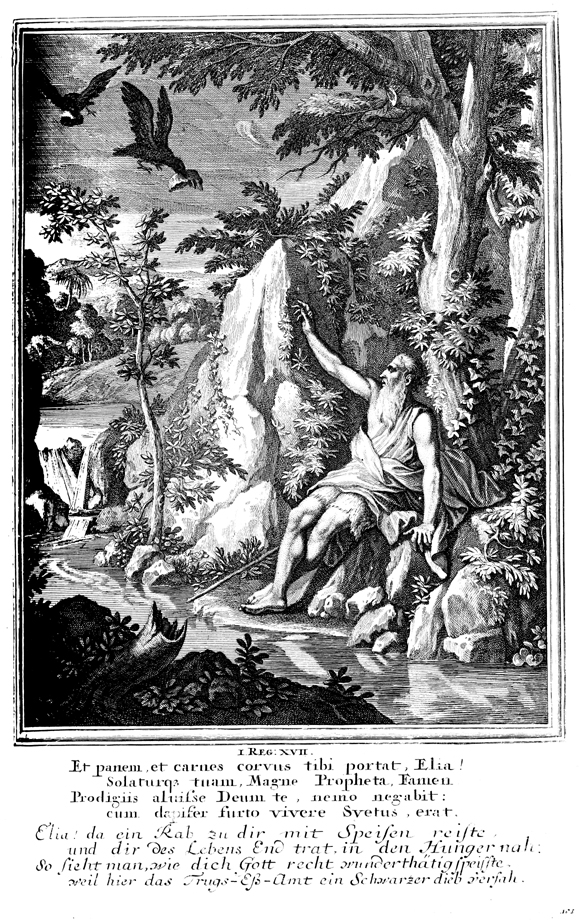
In addition to the importance of the Hanukkiah for its age (London's oldest standing synagogue, Bevis Marks, for example, was built only in 1701) and certain provenance, the work is unusual for its iconography of the Prophet Elijah begin fed by Ravens (I Kings 17:6) a allusion to the patron Elias (Elijah) Lindo. Though the subject is not very common in Jewish art, it was popular during the Baroque period in both Catholic and Protestant lands. For example, there is a late 16th century version by the Flemish painter Paolo Fiammingo (now in San Francisco), and a well known version from 1620 by the Italian artist Guercino (coincidentally, now in London at the National Gallery). A version by Dutch artist
Abraham Bloemaert (1564-1651) was copied in prints of the 17th and 18th centuries. Click here to see an anonymous print of the subject from 1712. Such printed works probably influenced Ruslen's design.

Read the full story as reported from ArtDaily.org (presumably from a press release). The Jerusalem Post ran the story almost verbatim, read it here.