Friday, May 9, 2014

USA: America's First Post-WWII Expressionist Synagogue? Erno Fabry and Texas (Jewish) Modernism

Fort Worth,  Texas. Beth-El Congregation, 2nd building (1920).  Interior redesigned by Erno Fabry, 1946-47.  Photo: Courtesy of the Beth El Congregation Archives

America's First Post-WWII Expressionist Synagogue?  Erno Fabry and Texas (Jewish) Modernism
by Samuel D. Gruber

One unexpected Texas treat was finding at the stunning recent (2000) Beth-El Congregation in Fort Worth a careful and considerable effort to preserve many elements from the congregation's previous building, erected in 1920 and substantially rebuilt after a devastating fire in 1946.   This is evident even before one even enters the new building complex. Large limestone menorahs that adorned the old brick building are now affixed to the exterior of the new building, flanking the entrance gates.  Inside, there is also a history alcove that preserves parts of the earlier stained glass, the entire ark from the remodeled synagogue, and other building memorabilia.

Ft. Worth, Texas. Beth-El Congregation, 2nd building (1920).  Photo courtesy of Hollace Weiner, Beth-El congregation Archives.

Ft. Worth, Texas. Beth-El Congregation, 3rd building.  Hahnfeld Hoffer  Stanford Architects (2000). Photo: Samuel D. Gruber 2014

This ark, like the other elements of the 1946 redesign, was the work of Jewish émigré designer Erno Fabry (born Erno Fay Friedmann) in what is now Košice, Slovakia, in 1906 (or 1907 or 1908).  Fabry had recently set up an office in Dallas, and he was already an active furniture and interior designer in Texas.  He was an important modernist who designed in the post-World War II decades.  I don't know if his work is included in the new exhibition Designing Home: Jews and Midcentury Modernism at the Contemporary Jewish Museum in San Francisco, but it should be.

The Beth-El synagogue interior redesign combined Art Deco, expressionist and modernist features that would shortly be developed more fully in the architecture of Erich Mendelsohn and others.  Košice, where Fabry was raised, was then Kashau, part of the Austro-Hungarian empire, but Fabry, the son a middle-class Hungarian Jewish family, came of age during a period of Czechoslovak political nationalism and artistic modernism including Czech cubism and expressionism, and wide-spread adoption of Bauhaus principals.


Bratislava, Slovakia. Orthodox Synagogue, Heydukova Street. Artur Szalatnai, architect, (1923).  An example of Czechoslovak expressionist design, probably known to Fabry.  Photo: Samuel D. Gruber 2005

Freidmann changed his middle name to Fabry and he graduated from the Czech Technical University in Prague in 1930, at which time he was already proving himself as a designer of furniture and interior design.  He was also a strong graphic artist and involved in theater design.  Fabry's father was in the wood milling business, and presumably that is where Erno got his early training in wood - a material he favored all his life.  This early part of Fabry's career is traced in the valuable catalog to an exhibition of his work at the Evergreen Museum & Gallery at The Johns Hopkins University in 2009.

Fabry's ark wall for Temple Beth-El is of reddish Colorado Travertine (not wood as mistakenly reported in the Evergreen catalog).  Fabry allowed the grain to create a design of undulating vertical lines that subtly reinforces the lines of the ark.  The ark itself from Fabry's 1946-47 redesign is of luminous Colorado travertine and delicate but dynamic metal work for ark door.  Today, it is installed in the history room at the new Beth El, where its monumental character is emphasized.  The ark door has served as a model for the new gates to the synagogue. The stone frame of the ark recalls Art Deco examples, but the bent lintel also echoes the playful expressionism found in Czech cubist designs. 

Ft. Worth, Texas. Beth-El Congregation, 3rd building (2000). History room. The ark is from Fabry's 1946-47 redesign of the ruined 1920 synagogue.  The stone and metal work emphasize the monumental character of the ark.  The Ark door has served as a model for the new gates to the synagogue (see above).  Photo: Samuel D. Gruber 2014

 
 Ft. Worth, Texas. Beth-El Congregation, 3rd building (2000).  Photo: Samuel D. Gruber 2014

Friedmann came to the United States in 1938, apparently to work at the American Wood Council, possible on a grant on because he won a competition.  Soon he was also working for leading designer Norman bel Geddes, assisting with designs for the 1939 New York World's Fair.  His family, left behind in Košice, perished in the Holocaust. In 1942 Friedmann volunteered for the U.S. Army, and attained U.S. citizenship.  He participated in the North African and Italian campaigns, and the invasion of Normandy.  Around this time he adopted Fabry as his last name.

After the war, for reasons unknown, Fabry was attracted to Texas, where he established an office in Dallas and found work developing displays and product lines for the American Furniture Company, a home furnishing business founded in 1935 by fellow Czech Jewish émigré, Emanuel Blaugrund.  In 1949 Fabry designed a seven-story store for Blaugrund in El Paso.  Fabry also worked for the Dallas-based Jewish-owned Neiman Marcus department store, and for Meacham's in Fort Worth. in the following years his business grew to include big stores in Kansas, Wisconsin and the Fort Worth furniture maker A. Brandt Company.

According to Beth-El archivist Hollace Weiner, Fabry "did work in El Paso for the Amstatter brothers. They bought Meacham’s in Ft Worth, moved to FW, and joined the Temple.  Because of the Amstatters, the Temple approached Fabry, or so I was told."   Weiner thinks that he probably renovated Meacham’s Department Store the same time he was working on Beth-El, though the exact dates of work would have to be compared.  This type of multi-tasking for architects was common, especially when working on less remunerative commissions like synagogue designs.  For example, Henry Hornbostel worked on Pittsburgh's Rodef Shalom while he engaged building Carnegie-Mellon and Detroit's Albert Kahn used the same workmen (and many of the same details) on the the Fisher Building and the contemporary Temple Beth El

Given Fabry's local success, it is not surprising that when Fort Worth's Beth El Congregation decided to rebuild its synagogue interior after a devastating fire in August 1946, they chose Fabry to do it.  Besides the Ark wall, the most distinctive feature of the interior redesign was the ceiling, where a large Jewish star floated in an undulating opening, lit from the sides.   A Jewish star inscribed in a synagogue dome was nothing new.  There are many examples from the 1920s, such as the one I show here from the East Midwood Jewish Center in Brooklyn, so it is impossible to identify the inspiration for Fabry or the Beth El building committee.  It is a big stretch, but I would like to think that Fabry might have been aware of the important modernist synagogue in Zilina, Slovakia, designed by Peter Behrens in 1928 (I am sure Erich Mendelsohn knew it).  The comparison may not seem obvious, but Behrens erected a big floating dome, decorated by a star design (now being restored).  Fabry's "dome" was  flat, too.  Fabry seems to have done something similar in his interior for Meacham's.  The edge of the recessed dome is just visible in an old photo, shown below. 

Brooklyn, NY. East Midwood Jewish Center.  Louis Allen Abramson, architect (1929).  Recessed/raised stained glass window with Jewish Star was common at the time. Photo: Samuel D. Gruber 2007
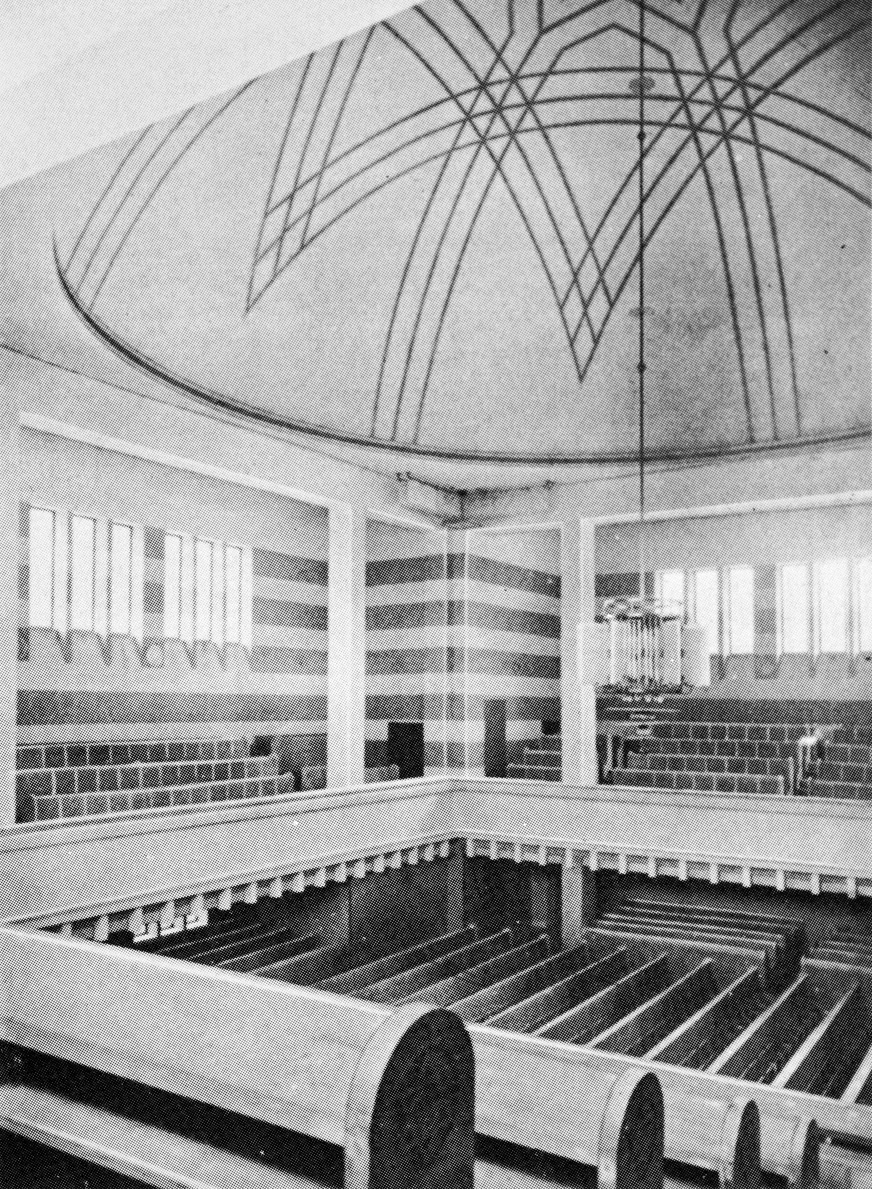
Zilina, Slovakia. Neolog synagogue. Peter Behrens, architect (1928). Photo: before 1939, from Krinsky, Synagogues of Europe, p 309
Ft. Worth, Texas. Meacham's Department Store, redesigned women's shoe department by Erno Fabry, ca. 1946. 
Photo from Modernism at Evergreen: Erno Fabry (2009)
 Ft. Worth, Texas. Beth-El Congregation, remodeling of earlier synagogue (1946-47).  Ceiling decoration (destroyed).  Erno Fabry, architect. Photo courtesy of Beth-El Congregation Archives.

Recessed lighting dotted the rest of the ceiling in a seemingly irregular pattern , perhaps emulating night sky stars.  Since this style of lighting is more typical of the 1960s, its dating needs to be confirmed.  Elegant aluminum menorahs were fastened to the ark wall.

In 1950, Fabry moved permanently to New York, where he founded Fabry Associates, Inc. in 1950, and in 1952 his glass-topped walnut table was included in the Museum of Modern Art's  permanent design collection.  Fabry closed his studio in 1971, after which he focused on sculpture and painting until his death in 1984.  

Thanks to Hollace Weiner who made me aware of Fabry's contribution, and has kindly made some necessary corrections to this account.


Thursday, May 8, 2014

USA: A New Synagogue for the Dell Campus in Austin, Texas

Austin, Texas. Temple Beth Shalom.  Entrance.  Photo: Samuel D. Gruber 2014

USA: A New Synagogue for the Dell Campus in Austin, Texas
by Samuel D. Gruber


A new synagogue, the Reform congregation Beth Shalom, has opened on the expansive – and expanding - Dell Jewish Campus in Austin, Texas.  The building, designed by Austin architect Arthur Andersson of Andersson-Wise Architects, has been in use since December 2013.  It  joins the notable Conservative Agudath Achim Synagogue, designed by Lake/Flatow (and featured in my 2003 book American Synagogues: A Century of Architecture and Jewish Community) to anchor the Dell Center, which since its founding in the 1990s, has become the hub for almost all things Jewish in Austin.  When I was in Austin in April, Austin Federation head Jay Rubin kindly showed me around the campus, and I stayed for evening services at Beth Shalom. 

Beth Shalom congregation was founded in 1999 by a small group that wanted to create a Reform congregation on the Dell Campus.  Austin's main Reform congregation Beth Israel, chartered in 1879, had chosen not to move to the campus from its building complex at Shoal Creek Boulevard, where they moved in 1957, with their sanctuary dedicated in 1967.  Beth Shalom founders, therefore, saw an opening for a Reform presence at Dell, where the JCC and the Austin Jewish Academy were built (1997), and where the Conservative Agudath Achim was completed in 2001 to much acclaim, by which time Beth Shalom had built a  membership of 72 families meeting in the JCC Community hall for High Holiday services.  Beth Shalom applied for membership in the Union of Reform Judaism and after negotiating for a location on the campus, in 2005 began in earnest the long process of building a permanent home.  Eight years later the result is an elegant but modest modern building, that strives to blend with its site, with land and plan to grow.

The Beth Shalom architect and building committee sought to combine a building that had not merely a “feeling of permanence. But really would be able to last a thousand years or more.” In fast growing Austin, however, one wonders if any building can last even a hundred years, and certainly Texas synagogue buildings, like most American synagogues, are not known for their longevity. According to the architect Anderson, “thoughts of permanence and making a sacred, fortified place were combined with an equally important desire to build a worship space that was flexible.  The congregants wanted a room that would be intimate for a group of three hundred, but accommodate nearly three times that many for the High Holy days worship."  

The result is a room with flexible seating, and a large wooden wall on one side that opens up to expand the room side as needed.  There is also a small balcony that adds seating, too. Texas limestone walls recall the Kotel in Jerusalem, but because the stone is local it is cheaper - but also speaks to the rootedness of the Texas Jewish community.  Though the congregation is new, Jews have been in Texas for a long time.  Indeed, in a twist on the idea of permanence and migration, the state's oldest standing synagogue - B'nai Abraham in Brenham, Texas - will be moved across the state later this year to a new site a stone's throw from the newest synagogue - Beth Shalom.  The transplanted B'nai Abraham will serve a traditional Orthodox minyan on Shabbat (as it was built to do), but will be open for other life cycle events to the entire community (I'll be writing a lot more on this - my ancestral synagogue - in the coming months).


Austin, Texas. Temple Beth Shalom.  Santuary.  Photo: Samuel D. Gruber 2014


 Austin, Texas. Temple Beth Shalom.  Santuary.  Photo: Samuel D. Gruber 2014

Architect Andersson writes: “The scale and ceiling height of the foyer commons leads to an intimately scaled arrival into the worship space.  As one walks into the sanctuary, the stone walls rise to a canopy of articulated plaster ceilings recalling a traditionally tented Tabernacle.  Natural light filters in along the edges and top of this solemn room, creating an atmosphere suited to worship and prayer…” Typically, this congregation wants it every which way: fortified yet intimate, permanent and still recalling the very temporary structure of the Tabernacle, designed to accommodate the wandering Israelites.   Considering these demands, and a relatively modest budget for a building of this size, the architect has delivered with an attractive, contextual, flexible, well-lit worship space that also includes some of the now-requisite architectural symbols (temple and tent in a green setting) for new synagogues worldwide.   In all, the three-story 21,000 square foot building includes, beside the sanctuary, a social hall, administrative wing, family room, full kitchen, 1,200 square foot foyer, and eight multipurpose rooms.  The present building is L-shaped forming two side of what one day could become a central court.

Austin, Texas. Temple Beth Shalom.  Exterior and parking.  Photo: Samuel D. Gruber 2014

See also:


Cone, Tonya, “Temple Beth Shalom Breaks Ground on New Home,” The Jewish Outlook (May 1, 2012).

Cone, Tonya, “Temple Beth Shalom to Dedicate Long Awaited New Home (Dec.6-8),” The Jewish Outlook (November 1, 2013).
http://www.thejewishoutlook.com/index.php?option=com_content&task=view&id=1203&Itemid=53

Temple Beth Shalom Sweet Home, Building Dedication Weekend (December 6-8, 2013).  Commemorative Issue (Austin, TX: Temple Beth Shalom, 2013).

Wednesday, April 30, 2014

Happy Birthday Herbert Ferber (1906-1991)

 Millburn, NJ.  B'nai Israel Synagogue.  Herbert Ferber, sculptor (1951).  Photo: Samuel D. Gruber (2008)

Happy Birthday Herbert Ferber (1906-1991)
by Samuel D. Gruber

Today (April 30th) is the birthday of Herbert Ferber, a leading abstract sculptor of the second half of the 20th century, and a pioneer in the introduction of abstract sculptural decoration to synagogue design.  Ferber, who was also a practicing dentist for much of his adult life, began his studies as an artist in the late 1920s, and emerged as a member of what became known as the Abstract Expressionist Movement in the mid-1940s. He showed he work at the Betty Parsons and Kootz Galleries.

 Herbert Ferber
Herbert Ferber in his studio, 1976. Photo: Russell Lynes.  Russell Lynes papers, 1935-1986, Archives of American Art.

Though Ferber never considered his synagogue commissions to be among his best or most representative works, they remain among among his best remembered.  Ferber's best known Jewish commission is probably still his first - the large animated relief "And the Bush was not Consumed" created for B'nai Israel Synagogue in Millburn, New Jersey in 1951.  The work was show at the Jewish Museum in an exhibition in 2010 that also showed work by Robert Motherwell and Adolph Gottlieb commissioned for the synagogue. I've spoken of this project before, and wrote of it together with work by Ibram Lassaw in a blogpost here.

 St. Paul, Minnesota.  Temple of Aaron (1956).  Percival Goodman, architect. Sculpture by Herbert Ferber.  Photo: courtesy of Julian Priesler.

Ferber made notable works for Temple Aaron in St. Paul, Minnesota in 1956 and Temple Anshe Chesed, Cleveland, Ohio in 1957 and also had many public commissions in the 1960s, including several at Rutgers University.

Allowing their work to be used in public commissions was hotly debated among the abstract artists of the periods - most of who were outsiders to the art establishment and were frequently reviled by critics and public alike.  Ferber spoke about these disagreements as part of his long 1968 interview with Irving Sandler conducted for the Archives of American Art.

Oral history interview with Herbert Ferber, 1968 Apr. 22-1969 Jan. 6, Archives of American Art, Smithsonian Institution.
".... Perhaps because even in those days he [Ad Reinhardt] had a kind of purist idea about it. I know he was very much opposed when I made my first architectural sculpture in 1951 for Percy Goodman for a synagogue. He was very much opposed to the idea that I should do anything as commonplace and public as a sculpture for an architect. Barney Newman, on the other hand, encouraged me. This really sounds ridiculous now but at that time this was really an ethical question that we faced and tried to solve. I think of it as being naive now but it was then a very serious problem. Since we had certainly been rejected by the largest part of the public, and that included the museums and the collectors, we felt considerable antagonism to the outside world as we looked at it. So that when an architect such as Percy Goodman, who was really the first architect in America to face up to the problem of using abstract art on his buildings, when he came along everybody began to discuss it as if it were a questionable thing to do. And various strong sides were taken. I won't forget a cafeteria lunch at which Tomlina and Ad Reinhardt and Barney Newman and Rothko and I, and perhaps Motherwell, were present where Ad said, " You just can't do that kind of thing." and Barney Newman said, "The only way to do it is to get your art out in the public, I mean in the public eye." At any rate, I must admit that my reason for doing it was very simple. The only chance I had to make a large sculpture was for a place that was set aside for it. And I was so enthusiastic about it that although I had been asked and given a fee for making a six-foot sculpture. I made a twelve-foot sculpture for the same price. And what moved me really was the possibility, the chance of making a large sculpture so that it would be give a home and could be seen. I think we all felt at that time that museums were a kind of tomb, that once a think became a museum property it lost a good deal of its vitality and became simply another object in a collection.
Later in the interview,  Ferber came back to this topic: 
[Paul] Mocsanyi was always a kind of a thorn. He attended those forums int he early fifties and one of the things that he couldn't tolerate was when I did the sculpture for the synagogue, which was in 1951. Actually it was commissioned earlier, I think in 1949 or 1950. I spent a year making models and drawings and another year making the sculpture, so I suppose it was about 1949. And when he finally saw the sculpture he said, "How could you as an abstract artist do a sculpture called The Burning Bush?" And I said, "Mocsanyi, it's not called The Burning Bush. That's what it was named." And that's true. I had done and I can prove with drawings that I had done some sculptures quite similar to it motivated, it's true, by plant forms such as cactus and so on and made use of those drawings to make a sculpture which somebody wanted to call The Burning Bush because it was going on a synagogue.


Monday, April 28, 2014

USA: Alexandria, Lousiana Mid-Century Modern Synagogue Listed on National Register of Historic Places


   Alexandria, Louisiana. Gemiluth Chassodim Synagogue. Sanctuary. Photo: Jonathan and Donna Fricker

 
Alexandria, Louisiana. Gemiluth Chassodim Synagogue. Exterior, north wall of sanctuary. Photo: Jonathan and Donna Fricke
 
USA:  Alexandria, Louisiana Mid-Century Modern Synagogue Listed on National Register of Historic Place
by Samuel D. Gruber

The mid-century modern Gemiluth Chassodim Synagogue in Alexandria, Louisiana, designed by Jewish architect Max J. Heinberg (1906-1982) (of Barron, Heinberg and Brocato) has been listed on the National Register of Historic Places.  The modern synagogue is one of scores - maybe hundreds - of notable modern religious buildings from the 1950s and early 1960s that are now over fifty years old, and thus eligible for nomination and listing. 

National Register designation offers an excellent opportunity for congregations to learn about the history of their buildings and to assess building conditions, and to better educate congregation members and the larger community about the architectural and aesthetic decisions behind their modern-style buildings, and to discuss architectural and liturgical merits that might be forgotten or overlooked, especially as congregations seek to upgrade their facilities for the next half century of use.  In some states, such as New York, National Register listing can also make some repairs to the historic fabric of buildings eligible for private and public grants (For those considering listing of their own synagogues, I can sometimes help).

 
Alexandria, Louisiana. Gemiluth Chassodim Synagogue. The skylight at the east end of the sanctuary, what the Frickers have dubbed "the latern.". Photo: Jonathan and Donna Fricker

According to the NR designation, "The sanctuary is exemplary of two major trends in architecture of the period:  abstractionism and the veneration of Frank Lloyd Wright.  It is Alexandria’s most abstract piece of architecture from the period and a particularly notable example of Wrightian influence.  The period of significance corresponds to the second period of construction:  1960-61."  To Wright, I would also emphasize the influence of Percival Goodman, though Gemiluth Chassodim includes some expressive elements of the type that Goodman, too, looking over his shoulder at Frank Lloyd Wright, would also adopt in the 1960s.

According to Jonathan and Donna Fricker of Fricker Historic Preservation Services, authors of the NR nomination, little is known of architect Max Heinberg, but he was apparently a member of the congregation.  He was born in 1906 and graduated with a Bachelors in Architecture from Tulane University in 1928. In 1943, he and Errol Barron organized the firm that came to be known as Barron, Heinberg and Brocato.  Based on the design of this synagogue, the firm's work deserves some more attention. We also know that New Orleans modernist Edward M.Y. Tsoi worked as a draftsman for Heinberg, early in Tsoi's career.  

The Frickers report, "Congregation Gemiluth Chassodim traces its history to the establishment in 1852 of the Hebrew Benevolent Society of Rapides Parish, formed to provide for a Jewish cemetery.  The first synagogue was completed in 1871, the second in 1908.  Both were located in downtown Alexandria.  The congregation purchased the land upon which the present synagogue is located in 1946."

This process of the moving from an older pre-World War II building to a new suburban site was very common throughout America from the late 1940s especially through the early 1960s, with the last wave of Jewish urban flight taking place in the late 1960s.  Though there is some difference in migration and building patterns between north and south, overall, the pattern holds true nationally.  This is true too, for the architecture style of the new synagogue.

You can read the designation report by Jonathan and Donna Fricker, from which I quote or paraphrase, and see more photos here: http://jewishtemple.org/nat-l-historic-register.html

Gemiluth Chassodim is a brick, single story structure located about a mile southwest of downtown Alexandria. According to the report "The facility was built in two stages: the first from 1952-53 and the second, 1960-1961" with greater architectural significance in the second phase.  The first building had an overall L-shape footprint with one end of the L given over to an auditorium that also served as the worship space and social hall.  The other leg of the L served as classrooms and offices.  This type of development - building a synagogue complex in phases was common in the post World War II period, and remains so today. The second phase of construction filled in the original L, creating two courtyards, by adding a second range of classrooms on the north and the present sanctuary with foyer. Construction is of simple materials, mostly brick for walls and brushed aluminum for windows, without extra finish.  This was common practice in the 1950s synagogues of Percival Goodman and contemporaries.

Alexandria, Louisiana. Gemiluth Chassodim Synagogue. Sanctuary. Photo: Jonathan and Donna Fricker

 
 Alexandria, Louisiana. Gemiluth Chassodim Synagogue. Sanctuary.  Photo: Jonathan and Donna Fricker

Like many synagogues of its time, the design combines simple, geometric forms that are almost that appear mostly functional in their geometric simplicity - which can border on banality.  This sort of arrangement often defines classroom spaces, with are low, add-on affairs of the simplest concrete, cinder block or brick construction.  At Gemilluth Chassodim, however, the low classroom wing is given elegant exterior articulation with "a striking screen of redwood-stained vertical boards, approximately one foot apart, suspended from the eaves to a low brick chain wall."

 
 Alexandria, Louisiana. Gemiluth Chassodim Synagogue. Classroom wing.  Photo: Jonathan and Donna Fricker

Gemiluth Chassodim's architects and building committee saved their big statement - and higher budget - for the sanctuary.  The interior is a simple rectangular space that is enlivened by a variegated ceiling heights and angles, and a variety of windows types, especially by a large decorative window screens made of vertical panels of concrete and colored art glass, traversing both side of the sanctuary space.  This wall is dramatic and attractive inside and out giving varied texture and colored light to the interior space. Further dramatic lighting is given to the ark and bimah.  The ceiling over the bimah is raised and houses a large skylight with a mix of clear and colored rectangular panes.  Light pours into this - probably especially in the late afternoon - and suffuses the east end of the sanctuary.

The Fricker's describe the sanctuary this way: 
"Various architectural and artistic devices come together to form the singular space that is the sanctuary interior.  Chief among these are the varying ceiling types and heights; the varying textures of the wall surfaces; the art glass panels; and the dramatic effect of the sun trap created by the lantern.  Entering the worship space from the lobby one steps into a circulation area running the width of the sanctuary with a glass wall to the right (looking out onto a courtyard).  The ceiling is flat and fairly low in comparison to the lofty heights of the great angled roof covering the seating for the congregation (the architectural device of compression and release so beloved and used by Frank Lloyd Wright).  A central aisle bisects the fixed auditorium style seating (original).   The floor slopes slightly toward the bimah, a raised platform where the pulpit is located.  The ceiling, as it approaches the bimah, is lower and angled toward the rear.  The focal point of the bimah (and indeed the sanctuary) is the Ark housing the Torah scrolls, in this case a tall wooden cabinet with an angled top.
On each side, the upper gable of the main roof is inscribed with a broad pentagon-shaped  window of clear glass.  Each window features a large stylized menorah (as previously noted).  Below the windows are the previously noted panels of art glass and concrete.  The broad sections of art glass panels dominate the side walls of the sanctuary.  They are recessed from and set off by contrasting brick walls to each side.  Luminous honey-colored wooden wall sections marking the back circulation area and accenting the bimah provide additional contrasting color and texture.
Outside, more expression is given to the east end, where "its massive walls (with no openings) come together at a broad angle to create a stark and strong impression.  The roof (the back part of the lantern) registers as a pair of angled planes joined at the same broad angle.  The lines of the standing seam metal roof energize the abstract composition."