Showing posts with label Commemoration. Show all posts

Monday, February 6, 2017

Germany: Multiple Memorials for Berlin's Munchener Strasse Synagogue

Berlin, Germany. Image of the former Münchener Straße 37 on view in the Bayerischer Platz U-Bahn station. Photo: Samuel D. Gruber 2016
Germany: Multiple Memorials for Berlin's Munchener Strasse Synagogue
by Samuel D. Gruber

In November 2016, I was in Berlin for a few days and had the chance to visit more Jewish and Holocaust-related historical and commemorative sites than usual. I've already posted about the Jewish cemetery on Grosse Hamburger Strasse and the monument and burial section at the Weissensee Cemetery for Jewish soldiers who died in World War I. Here's information on a lesser known commemorative site.

The domed synagogue at Münchener Straße 37 in the Schöneberg section of Berlin, designed by Jewish architect Max Fraenkel (1856-1926), was dedicated in 1910 and was at the center of a heavily Jewish neighborhood around Bayerischer Platz.  It was looted but not burned on Kristallnacht (November 9, 1938), but was subsequently damaged by aerial bombing during the war years, and  torn down in 1956. The synagogue, which was a transitional structure between historicism and modernism, was notable for its large dome, and as one of the more architecturally distinctive buildings in the largely residential neighborhood. The composer Kurt Weill had a job as the synagogue choir conductor for a few months in 1921. 

Today, there is a part of a school building on the synagogue site, but the synagogue is remembered in the neighborhood in various ways. Each memorial corresponds to a particular phase of Berlin's facing the past and acknowledge the Shoah. There is an official abstract street level monument (1960s), a student-built collaborative memorial (1990s) and recently an extensive photo exhibit underground in the nearby U-Bahn station.

At the school, the original synagogue outline is remembered through garden design and in 1994-95 students erected a memorial brick wall on the school grounds to remember local Jews who lived in Berlin-Schöneberg. According to school officials,"the idea was based on the artist Horst Hoheisel from Kassel who gave stimulus on his "memorial from down below" in the framework of the 6th grade teaching lesson "National Socialism".
Berlin, Germany. Löcknitz Primary School on site of the synagogue at Münchener Straße 37. Photo: Samuel D. Gruber 2016.
In front of the school and near the street is a more traditional monument, designed in a cubist style by Gerson Fehrenbach in 1963. It declares: "Hier stand der 1909 erbauten synagoge der jüdischen Gemeinde" (Here stood the Synagogue of the Jewish Community built in 1909).

Berlin, Germany. Monument to destroyed at synagogue at Münchener Straße 37. Gerson Fehrenbach, arch., 1963. Photo: Samuel D. Gruber 2016.
Berlin, Germany. Monument to destroyed at synagogue at Münchener Straße 37. Photo: Samuel D. Gruber 2016.
A plaque beneath gives further information about the fate of the building.  

Hier stand von 1909-1956 eine Synagoge. Sie wurde während der Reichspogromnacht
am 9. Nov. 1938 wegen ihrer Lage in einem
Wohnhaus nicht zerstört.
Nach der Vertreibung und Vernichtung
der jüdischen Mitbürgerinnen und Mitbürger
durch die Nationalsozialisten verlor sie
ihre Funktion und wurde 1956 abgerissen.”

In the nearby U-Bahn station there is a extensive photo exhibition on the history of the neighborhood. Since it was a heavily Jewish district in the interwar period, there is are many images of the synagogue and of prominent Jews who lived nearby. When I visited the station in November 2016, the former synagogue - already destroyed once - was suffering the indignity of having a temporary construction barrier interrupting the view of its full facade.
 
Berlin, Germany. images of the former Münchener Straße 37 on view in the Bayerischer Platz U-Bahn station, with a construction barrier further "destroying" the synagogue today. Photo: Samuel D. Gruber 2016

Berlin, Germany. Image of the memorial wall constricted by local students on the site the former Münchener Straße 37. Photo on view in the Bayerischer Platz U-Bahn station. Photo: Samuel D. Gruber 2016
Berlin, Germany. Image of the memorial wall constricted by local students on the site the former Münchener Straße 37. Photo on view in the Bayerischer Platz U-Bahn station. Photo: Samuel D. Gruber 2016.
Bayerischer Platz neighborhood, including Münchener Straße, is also the location of the noteworthy "Places of Remembrance," (Orte des Erinnerns) project designed by artists Renata Stih and Frieder Schnock and installed in 1993.  The memorial, which consists of 80 signs which flatly state the dates and essence of laws promulgated by the Nazis in the 1930s to curb the rights of Jews.  This project remains one of the most thought provoking Holocaust commemorative installations anywhere - if one takes the time to look.

Berlin, Germany. Bayerischer Platz and "Places of Remembrance," (Orte des Erinnerns) project designed by Renata Stih and Frieder Schnock. Photo: Samuel D. Gruber 2016.
ABerlin, Germany. Bayerischer Platz and "Places of Remembrance," (Orte des Erinnerns) project designed by Renata Stih and Frieder Schnock. Photo: Samuel D. Gruber 2016.
Berlin, Germany. Bayerischer Platz and "Places of Remembrance," (Orte des Erinnerns) project designed by Renata Stih and Frieder Schnock. Photo: Samuel D. Gruber 2016.


Thursday, October 29, 2009

Two Grubers on Holocaust Memory in Eastern Europe

Two Grubers on Holocaust Memory in Eastern Europe

Ruth Ellen Gruber has written an overview article for JTA about Holocaust accountability in Europe in the 20 years since the fall of Communism. Click here read column: "In Eastern Europe, advances toward accountability but more to do," by Ruth Ellen Gruber (October 28, 2009).

Ruth interviewed me for the article. Its a topic that we discuss frequently. In looking over my extended comments (which Ruth herself could have made since due to our shared experiences our views are very close) I thought them worth sharing. As always, I appreciate, readers' reactions and comment.
Interview with Samuel Gruber about Holocaust Memory After Communism (Oct 20, 2009):

REG: Which [former Communist] states have made most progress coming to terms with this?

Sam Gruber: When talking about Holocaust recognition and commemoration, all progress is relative. Some countries are much further along the path to historical accountability and sincere commemoration than others, but many have had further to come. Some countries are deeply divided with more liberal and internationally leaning political movements ready to discuss crimes of the past, while more right wing and nationalist parties feel that to do so is a form of self-hatred and near treasonous behavior.

In all former Communist countries it has been necessary to overturn a half century of misinformation, and in many cases outright denial of many of the most basic facts of the Holocaust. Those countries which suffered the most under the Nazis - especially Poland and the Czech Republic - were most ready to accept the worst about them, and to acknowledge of horrors of the Holocaust. Those countries where wartime governments collaborated with Germany - such as Latvia and Romania have had a harder time, for to acknowledge Nazi crimes was in effect to acknowledge their own complicity. In the Baltic it has been even more complex, since throughout the decades of Soviet occupation the Nazis continued to be seen as liberators against the Russians by nationalists in Estonia, Latvia and Lithuania. Holocaust history was mostly irrelevant in the years of anti-Communist nationalists.

Thus, to say it is difficult to say who has made the most progress. A small movement to recognize the historic truth of the Holocaust and to commemorate victims in a place like Latvia, and to acknowledge local collaboration, is to me as much progress, as has been done on the monument at Rumbula, is to my as much progress a large monument being erected in Poland, where all Poles see themselves as victims of the Nazis, and most are ready to accept the Jews as victims, too...albeit not always as a separate case.

REG: What are the problem areas and why?

Sam Gruber: There are problems on three levels.

First, there is the problem of obtaining and confirming information about the Holocaust in particularly places. The more the local resistance to accepting the Holocaust as fact; the more important it is to be precise in the information that is presented.

Second, there is the problem of disseminating information. For the most part the hardest populations to reach - and these are also sometimes the very ones that harbor traditional stereotypical notions of Jews (and others) - are those that only communicate in their local language. These populations tend to be the most traditional, the most parochial, the least educated, the least traveled and probably the most religious, where religion has retaken a hold. It has been slow going for international Holocaust education groups to prepare and disseminate materials in local languages, or to do it enough to combat the abundance of locally produced anti-Semitic and Holocaust denial material in these same countries. Local leadership is very important in acknowledging and commemorating the Holocaust. Mayors, teachers, priest, national leaders really can set the tone and established a better climate for education and dialogue.

REG: What are some of best practice examples?

Sam Gruber: I think the monument at Buchenwald in Germany, which tells the story of the Little Camp fully, and in sharp evocative language, and in many languages, is very successful. Because the monument was designed by a survivor of the camp it has special power. Its simplicity is a virtue. The monuments at the killing fields of Rumbula and Bikierniki Forest outside of Riga are also very moving, and very well done. Meanwhile, however, there are inadequate markers at sites within the city itself. I still find the Umschlagplatz monument in Warsaw very moving, though it requires some previous knowledge of the history of the site. The cemetery monument at Kazimierz Dolny, built in the 1980s, and the extensive monument at the Death Camp of Treblinka; also continue to serve well, though it may be time in both cases to add more explanatory and educational material. Not immediately as part of the artistic monuments, but nearby.

Usually monuments that are destinations can be more symbolic, since it is usually assumed the visitor knows something or otherwise would not have come. Markers that appear in unexpected places, on buildings and streets, need to provide more information. Monuments such as that in Bratislava are, as I have previously written, unsuccessful because they mark a place but do not tell a story. They can serve as backdrops for scheduled commemorative events, but otherwise they serve little purpose. This is always the danger of the most official monuments – government sponsors always prefer to be vague – and not to alienate any constituency.

REG: Have some states taken the right steps only to reverse them?

Sam Gruber: It has to be understood that education is a slow process, and that changing inherited and accepted concepts and beliefs is a difficult task in any context. In this light, I think we can look at amazing progress over the past two decades. At the very time that most former Communist countries were grappling with them most challenging problems of nation building, identify, democratization and economic transformation, they have also changed many attitudes about the Jewish past in general, and the events of the Holocaust. In many of these places, even the concept of a Holocaust separate from the devastation of the Great Patriotic War [World War II] had previous been unknown. The greatest willingness to consider, and even accept a basic history of the Holocaust has been greatest in those countries most closely associated with the West. It has been part of the process of granting democratic rights and religious freedom. It has also been the result of Eastern governments yielding to pressures from American a Europe if they wanted NATO and EU status. Thus Poland has been among the most receptive to Holocaust education, while UkraineBelarus have been much slower.

REG: Some of your own personal experiences negotiating and monitoring Holocaust commemoration projects?

Sam Gruber: After the problem of funding, the hardest part of getting monuments and memorials erected not been getting some kind of general consent, it has been working the specifics of design and especially of language. Most older memorials have been very general in their language – so much so that it is often hard to even figure out what events are being commemorated, and rarely can one learn about who did what to whom, and when. This began to change in the 1990s.

In my experience with the US Commission [for the Preservation of America’s Heritage Abroad], it has always been part of the mission that monuments should be not only be symbolic, but that they must help tell a story. Hey need to be witness – clear voices in languages that local people can understand – and they must be as forthright and truthful as possible. Sometimes one could do this in Hebrew, Yiddish or English…local officials didn’t mind. But increasing there has been a push to get truth told in local languages, and that has meant sharp clashes with local Holocaust deniers, or with those who want to protect local reputations. These conflicts have slowed many monument projects…but ultimately they are very good…because it makes the education and commemoration process an active and forceful one, not just a passive act.

In Latvia, at Rumbula, it took the personal intercession of the President of Latvia to make sure language was included on the inscription that mentioned Latvian collaborators. Another problem is using numbers – as in 10,000 Jews were killed. Frequently initial drafts of monument texts are changed to avoid that level of specificity. It is feared that if a number is contested and even disproved, even just by a bit, that such misrepresentation could be used to discredit the entire project, and by extension to paint an entire massacre, or even the entire Holocaust, as false.

The installation of local monuments is often the most touching, since many non-Jews are eager to participate. The older people remember – and one can never by sure what exactly it is that they remember. The younger people are often eager to learn. Usually, the slower the project, and the more it is the result of a continuing dialogue and planning process that is inclusive of local people, the more successful the result, because local people have a proprietary stake in the project. Monuments that are erected without local involvement, but only through the time and money of “outsiders” – even if they are descendants of those murdered in the town – can be more controversial.

REG: How important is this all, 65 years after the fact?

Sam Gruber: Understanding the history of the Holocaust, including acts of complicity and acts of resistance; remains extremely important in this part of the world. Of course, it is important to Jews who want recognition of Jewish suffering, and acknowledgment of the extent of the destruction of an entire civilization. But it is equally important for the individuals and governments of those countries themselves since only by wrestling with their often contentious and convoluted histories can they reduce the likelihood of a future similar to the past. These are still fledgling democracies. Some have a vague memory of pre-Communist democratic institutions and objective historical research. Most, however, have been shaped by rigid ideology for most of a century. Thus it is one thing for Czechs - so close to Austria and Germany, to be attuned to political and historical revisionism of reconsiderations of the recent decades, but it is very different in Ukraine, which was never really independent, and has been under Tsarist and Communist rule since the 19th century. And those areas of - like Lviv - which were more international and multi-cultural before the Holocaust, are today incredibly homogeneous, with populations mostly drawn from the Ukrainian countryside, resettled in Lviv after World War II. For the most part they are not aware of any objective history, including their own. In Ukraine, Holocaust education must be part of a larger package of education about European history overall.

People sometimes suggest that I write a book about Holocaust memory and monuments - mixing the political and the practical; aesthetics and altruism. It has been a nearly a generation since James Young published his important book Texture of Memory (New Haven: Yale University Press, 1993). That book was a primer for me, but James and I come to the subject from very different perspectives - in this case he as a critic and academic, while I am an activist and work with closely with Jewish communities. At the moment though I may have the focus to write such a book, I don't have the (almost greater) energy needed to seek out a publisher. But if any of my readers want to pursue this...by all means, let me know.

Thursday, May 14, 2009

Poland: Commemorative Marker Installed on former Krasnik Synagogue


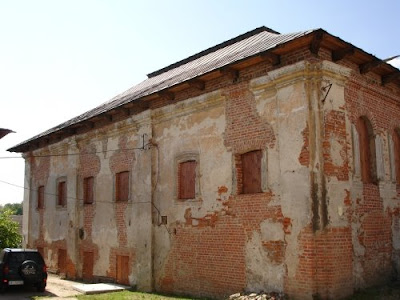
Krasnik, Poland. Former Synagogue Complex and new Commemorative Plaque.
Photos:
Foundation for the Preservation of Jewish Heritage in Poland

Poland: Commemorative Marker Installed on former Krasnik Synagogue


(ISJM) On May 4, 2009, an inscribed memorial marker was dedicated in Krasnik, Poland (located south of Lublin). The tablet is attached to the outer wall of the former synagogue in Krasnik and commemorates the Jews of Krasnik who were victims of the Holocaust. The memorial was financed by the Friends of Krasnik Society of France. On the day of the dedication ceremony students of the local Middle School No.1 met with young Jews from England. Together, they toured former Jewish sites in Krasnik and helped to clean the local Jewish cemetery. Both events were organized by the Foundation for the Preservation of Jewish Heritage in Poland.


For photos of the dedication ceremony click here


Since 2007, the Foundation has been developing a project of revitalization of the historic synagogue complex [click here for more photos]. The municipal government and the Ministry of Culture and National Heritage are lead partners in this effort. The Foundation is the owner of both Krasnik synagogues in the complex: the larger, 17th century Baroque style building that still contains fragments of polychrome decoration inside, and a smaller synagogue, called “the Talmudic house”, probably built in the 19th century.


To read more about he Jewish history and sites of Krasnik download the brochure Krasnik: The Chassidic Route.


According to the Foundation, plans call for the smaller synagogue building to host a modern multimedia library (a library and a lecture room), joined with the multimedia Museum of Jews of Krasnik and the Krasnik Area. The larger building will perform multiple functions: it will host a center for the local culture-oriented non-governmental organizations, and a grand hall for concerts, conferences and exhibitions. One of the women’s courtyards (second floor of the larger synagogue), will serve as a workshop room for art courses.

Other partners in the project are the local authorities of Krasnik, the Town Library, the Culture and PromotionCenter and the non-governmental organizations: the Krasnik Society of Knowledge Lovers and the Center of Volunteers. These partners participated in the preparation of the functional concept of “Our Multicultural Center” and will be its co-hosts, developing its cultural offer along with the Foundation for the Preservation of Jewish Heritage in Poland.

Wednesday, May 13, 2009

Poland: New Monuments erected in Gdansk on Anniversary of Kinderstransport

Poland: New Monuments Erected in Gdansk on Anniversary of Kinderstransport

(ISJM) Foundation for the Preservation of Jewish Heritage in Poland reports that on May 6-7, 2009, the 70th anniversary of the Kinderstransport (evacuation of Jewish children from Germany, Austria, the Free City of Danzig (Gdansk), Czechoslovakia, Latvia, Estonia and Poland to England between 1938-1939) took place in Gdansk. The Kinderstransport saved the lives of about 11 thousand Jewish children just in the months before hte outbreak of the Second World War and the onslaught of the Holocaust. About 130 children came from Gdansk (formerly Danzig) in four transports.

A monument to the Kindertransports was unveiled in Gdansk as well as new matzevot (gravestones) in the cemetery marking the graves of Rabbis Elchanan Ashkenasi and Meir Posner.

Tuesday, April 28, 2009

Barbara Kirshenblatt-Gimblett to lecture in NYC about Museum of the History of Polish Jews

Barbara Kirshenblatt-Gimblett to lecture in NYC on May 6th about Museum of the History of Polish Jews
by Samuel D. Gruber


(ISJM) New York University Professor Barbara Kirshenblatt-Gimblett will speak at Temple Emanuel in New York City at 6:30 pm on May 6th about "Creating the Museum of the History of Polish Jews: A Work in Progress " Barbara is head of the international core exhibition planning team the long-awaited Warsaw Museum, where groundbreaking took place in 2007 and which is expected to open in 2011. She will discuss the challenges and methods for creating a narrative for this important museum.


I had the opportunity to hear Barbara speak twice about the new museum at conferences last fall, and to share a seven-hour car ride with her (and Sergey Kravtsov) from Poland to Ukraine. I was impressed with the vision for the new museum’s presentation, and with the apparent competence with which it is being implemented. Barbara is a great story teller, and I am sure in her New York lecture she will inform and entertain.

The museum site is in the area of the former Warsaw Ghetto, immediately across from the Warsaw Uprising Monument, designed by Natan Rapoport. Currently, there is a large blue tent – the OHEL – on the spot, as a site of small exhibitions and educational programming.


Amazingly, that grand, simple and now iconic monument continues to be the most visible and expressive source of information and misrepresentation about Jewish history in Poland’s capital (I say this in no way to denigrate the position and thoughtful efforts of the Jewish Historical Institute, but only to recognize that public role of the Uprising Monument).


The stated purpose of the museum is to preserve "the lasting legacy of Jewish life in Poland and of the civilization created by Polish Jews in the course of a millennium." In short, the museum must convey everything (well, at least some of) the rich and complex and long and contradictory material the Monument avoid. This is to be done in a number of innovative ways. Many of the exhibitions have to be composites, synopses or surrogates – since the Jewish history of Poland is so vast and deep. The Museum must balance the documentary and the material, and the stories of a culture and civilization’s building, and its destruction.

One of the intended installations in which I am most interested is the plan for one gallery to be surmounted by an 80% scaled replica – or recollection – of the panted wooden ceiling of Gwodziec (Ukraine), now well know from Thomas Hubka's book Resplendent Synagogue. This ceiling is to be hand-built in eight sections, each to be crafted and assembled in a different region of Poland, each in a former (alas, only masonry) synagogue space. According to Kirshenblatt-Gimblett, it is the process of collectively remaking, and of learning the skills that were lost, that will literally raise the rebuilding effort to a new level. The craft work will be overseen by the talented Handshouse Studio of Massachusetts, in partnership with Polish woodworkers. The methods will be taught to new apprentices, the project will be filmed. As performance, it will be as much a part of the resurrection of the Jewish past in Poland as any permanent museum exhibition in the country – past or future (For more on the persistence of memory through Wooden Synagogues see my previous blog and article on Nextbook.com)

Most difficult, The Museum must combat the combination of still profound ignorance and misconception about Polish-Jewish history within Poland, and in the Jewish community worldwide. I continue to be amazed as I lecture and teach at the extraordinary historical ignorance I encounter. The public (Jewish and non-Jewish) prefers being comforted by repeated stereotypes and myths (good and bad) than to be challenged to confront and absorb new information. I am sure that no matter what the content of the final exhibitions that Prof. Kischenblatt-Gimblett and her colleagues will be the subject of both praise and verbal brickbats for their efforts.


Kirshenblatt-Gimblett is professor of performance studies at the Tisch School
of the Arts (NYU) and an affiliated professor of Hebrew and Judaica Studies.

The program is free. Temple Emanu-El is located at 1 East 65th St, New York City
.

Wednesday, December 24, 2008

Poland: Plaque Installed at Site of Destroyed Synagogue in Barcin

Poland: Plaque Installed at Site of Destroyed Synagogue in Barcin

On December 18, 2008, a memorial plaque commemorating the site of the destroyed synagogue was unveiled on a building located at 4 Stycznia St. in Barcin (kujawsko-pomorskie province). The ceremony was organized by the Foundation for the Preservation of Jewish Heritage in Poland. The simple text on the plaque reads "Synagoga w latach 1837 -1939," and in Hebrew "Beth Kenesset."

Click here for photos of the plaque and ceremony
.

Last year (November 2007), a memorial tablet commemorating the local Jewish community was unveiled at the Jewish cemetery in Barcin. The ceremony was co-organized by the Foundation for the Preservation of Jewish Heritage in Poland.

It is always an important step when the site of a synagogue or cemetery is commemorated, and more systematic effort still needs to be done in Poland and elsewhere. As is well known, my own preference is also for signage that is both commemorative and didactic. It is mistake to assume that every one knows that fate of a synagogue and community just be view seeing the date 1939. Some narrative text should be included, as well as a picture of the destroyed site when possible. New signage materials now make this fairly easy.

Monday, November 24, 2008

Czech Republic: Jewish Memorial in Liberec

Czech Republic: Jewish Memorial in Liberec

The Prague Daily Monitor has reported that a memorial to Holocaust victims was installed in the Czech town of Liberec, 90 kms NNE of Prague, on the 70th anniversary of Kristallnacht. The Renaissance-Revival style synagogue of Liberec, built in 1889 was set afire by the Nazis in 1938 and then demolished. Before the Holocaust 1600 Jews lived in Liberec. Only 37 survived.

The new memorial is located in the former ceremony hall of the Jewish cemetery, built in 1900 and used as a storage space until this restoration (which cost 7 million Czech crowns, about 250,000 euro). The cemetery, opened in 1865 and expanded in 1896, has also been restored in recent years. In addition to graves of local Jews, the cemetery also has graves of many World War I era refugees from Galicia, and a mass grave of 11 women prisoners from the labor camp in Bílý Kostel n. Nisou.

According to the Prague Daily Monitor, Czech Senate chairman Premysl Sobotka said such memorials must be built for people not to forget about the past and not to allow anything like this to repeat.

For the restoration of the cemetery hall and the creation of the memorial, the municipality contributed 4.75 million crowns, the regional authority provided 2.5 million crowns. The remainder came from private donors and the Holocaust victims foundation.

For more information on Czech Jewish sites, the best comprehensive source remains Jiří Fiedler's Jewish Sights of Bohemia and Moravia (Prague: Sefer, 1991). I hope that Jiří, who is curator of documentation at the Prague Jewish Museum, is considering publishing a new edition updated to include all of the important restoration and commemoration work done in the Czech Republic in the past 20 years. In my experience, the Czech Republic has led the way in the scope and quality of their work in protection, preserving and presenting Jewish heritage.

Wednesday, October 15, 2008

Belarus: Press Release about Commemoration Events in Minsk

Belarus: Plans for Commemoration of Annihilation of Minsk Ghetto on 65th Anniversary

Following is a press release sent to me from the Embassy (which?) of Belarus. I have not worked on any projects in Belarus for many years, so am not current with developments about Jewish sites and Holocaust memorials. This report mentions the inauguration of some new commemorative plaques and stones as well as host of other activities. I welcome information, comments, reports and photos from readers about this and other news from Belarus.


Main commemorative events dedicated to the victims of the Minsk Ghetto are to be held in Minsk on the state level


Press-Release


On October 20 – 23, 2008 the main events dedicated to the 65th Anniversary of Minsk Ghetto annihilation will be held on the state level in the capital of Belarus – Minsk – with the participation of citizens of Israel - survivors of ghetto and veterans.

The dates of the events are coordinated by the Belarusian Government with the leaders of the Jewish community of the country. The events include:


– mourning meeting in honour of the 65th Anniversary of Minsk Ghetto annihilation at the memorial “Yama”;
– funeral procession within the territory of the Ghetto in memory of the Holocaust in Belarus;
– public gathering dedicated to the 65th Anniversary of Minsk Ghetto annihilation and policy of genocide on the territory of the Republic of Belarus.
– inauguration of the memorial plate at a place of annihilation of the 5000 prisoners of Ghetto;
– inauguration of the memorial stone at a place in memory of deported and annihilated Jews from Keln;
– book exhibition about Holocaust on the territory of Belarus in the National Library.
– inauguration of the exhibitions dedicated to the Minsk Ghetto;

Starting from October 15 in Minsk (Museum of the Great Patriotic War) the exhibition dedicated to the Minsk Ghetto will take place;


For the October 17 in Minsk-city Palace of young people and children is planned the awards ceremony of the schoolchildren-winners of the contest “Holocaust. History and present”


Israeli survivors of ghetto and veterans will be represented by Association of Immigrants from Belarus; Association of Concentration Camps and Ghetto Survivors; Union of Partisans, Underground Fighters and Ghetto Rebels; Union of Veterans of the Second World War – Fighters Against Nazism; Association of Disabled Veterans and Partisans of Fight Against Nazism.


The planned events are named “main” due to the fact that they conclude the series of steps commemorating the Feat and the Catastrophe. These steps Belarus undertakes during the whole year under the auspices of the Government of Belarus.


The Government of Belarus established the Organizing Committee in charge of holding the commemorative events dedicated to the 65th Anniversary of Minsk Ghetto Annihilation. It unites the representatives of more than 20 state and public bodies.


In Israel commemorating event dedicated to the 65th Anniversary of Minsk Ghetto annihilation was held on June 22, 2008 according to the initiative of the Embassy of Belarus in Israel and Yad Vashem Holocaust Martyrs' and Heroes' Remembrance Authority. Among the participants of the event were Minister of Pensioners Affairs, Members of Knesset, natives of Belarus.


In the second largest ghetto on the territory of the former USSR organized by Nazis – in Minsk 65 years ago were killed about 100 000 people.


About 10 000 Jews escaped from Ghetto mainly with the assistance of Belarusians and joined partisans movement.


The Nazis did not succeed in sowing the seeds of anti-Semitism on the occupied territory of Belarus. There are 680 Belarusian Righteous Among the Nations now. If only the thorough search of the citizens of my country who saved the lives of their neighbors-Jews, had continued in 1967 not in 1990 (the period of absence of the diplomatic relations between USSR and Israel) Belarus would have been the leader in the number of Righteous Among the Nations.


Mutual aid of Belarusians and Jews during the Second World War is an integral part of the unique friendly neighborhood of two peoples which counts six centuries.


During past six centuries Jewish people felt more secure in Belarus in comparison with the countries of the region. There were almost no pogroms (massacres). Belarusians had never initiated pogroms. This position is confirmed by museum of Jewish history and culture, created by Jewish community of Belarus.


The World War II is common sorrow and common ordeal both for Belarusians and for Jewish. It is terrible but even these horrible figures we have in common: during the WW II was killed every third Belarusian and every third Jew.


Press Service
Embassy of Belarus