Showing posts with label synagogue art. Show all posts

Monday, January 23, 2017

Women at Wilshire Boulevard Temple (As Seen in the 1929 Mural Cycle by Hugo Ballin)

Los Angeles, CA. Wilshire Boulevard Temple. Warner Memorial Murals by Hugo Ballin (1929). Detail of Four Matriarchs on south wall. Photo: Samuel D. Gruber 2017. A better picture is here.
Los Angeles, CA. Wilshire Boulevard Temple. Warner Memorial Murals by Hugo Ballin (1929). Detail of Sarah on south wall. Photo: Samuel D. Gruber 2017.

Women at Wilshire Boulevard Temple (As Seen in the 1929 Mural Cycle by Hugo Ballin)
by Samuel D. Gruber

The Warner Memorial Murals by American Jewish artist Hugo Ballin are among the most spectacular works of synagogue art of the 20th century.  Ballin (1879-1956) was a classically trained painter who came of age in New York in the era of the American Renaissance (at the turn of the 20th century he was painting in the Donatello Studios in Florence, now used by Syracuse University).  In 1913 he gained fame for his extensive mural program at the Wisconsin State Capitol, but a few years later he began work as a designer for silent films, and soon moved to Hollywood and developed a successful career as art director, writer, and director of many silent films - often starring his wife Mabel Ballin. After the advent of talkies in 1927 he stopped making his own films and returned to fine art to become one of the country's leading muralists. In 1929, he was head of art at Warner Brothers and was hired to the task of decorating the new Wilshire Boulevard Temple. His  extensive historical, allegorical, and symbolic representation of Jewish history was financed by three of the Warner Brothers in memory of their siblings and parents, and was planned together with Rabbi Edgar Magnin. .  

I first saw and wrote about the murals for my 2003 book American Synagogues: A Century of Architecture and Jewish Community.  They hhave recently been meticulously conserved and restored by Aneta Zebala Paintings Conservation company as part of the larger restoration of the entire Temple, led by Brenda Levin, and the ongoing expansion of Wilshire Boulevard Temple facilities. The transformation is impressive and the murals are spectacular ... a unreeling saga in technicolor when films were still only in black and white.

Earlier this month, however, I was fortunate to have a morning to look at the murals in detail. Even more time is needed; the paintings are packed with historical vignettes, scenes, and symbols. They exhibit a wide range of design and painterly approaches and flourishes. The mural is brash and bold and executed with brio. The expressive, dramatic, and cinematic nature of the unreeling narrative was already remarked upon in 1929, and again most recently by Mackenzie Stevens, who sees the highlighting of the scenes as similar to the lighting techniques of the silent film era. New photos by Tom Bonner, published in the book Wilshire Boulevard Temple and the Warner Murals: Celebrating 150 Years by Tom Teicholz (ORO Editions, 2013, allow attention to detail that is not even possible on site where visibility of the high lunettes is still hampered by original (and inadequate) lighting. Caroline Luce also explores some aspects of the mural in her informative website about Ballin's extensive mural work in the LA area.

I look forward to writing more about the murals and other aspects of Ballin's career elsewhere, but right now I want to draw attention to just one aspect of the mural which is rarely mentioned, and that is the inclusion of many images of women in the narrative. This includes a prominent depiction of the Four Matriarchs of Judaism, shown seated as a group on the sanctuary south wall opposite the Ark and bimah, and set beneath the balcony and over the main door through which one passes on existing the sanctuary.  To my knowledge this is the first such representation of the four Matriarchs anywhere in the history of art.


Los Angeles, CA. Wilshire Boulevard Temple. Warner Memorial Murals by Hugo Ballin (1929). Detail of Rebecca on south wall. Photo: Samuel D. Gruber 2017
Los Angeles, CA. Wilshire Boulevard Temple. Warner Memorial Murals by Hugo Ballin (1929). Detail of Rachel  and Leah on south wall. Photo: Samuel D. Gruber 2017.
Today, among egalitarian Jewish congregations, the most widely accepted and popular  addition to traditional liturgy is the includion of the names of the  Matriarchs in birkat avot (the blessing of the ancestors), which opens the Amidah: "Praised are You, Adonai our God and God of our ancestors, God of Abraham, Isaac, and Jacob [Sarah, Rebecca, Rachel and Leah], great, mighty, awesome, exalted God who bestows lovingkindness, Creator of all. You remember the pious deeds of our ancestors and will send a redeemer to their children's children because of Your loving nature."  But in 1929, I think this inclusion of the matriarchs in such a prominent prayer would have imaginable to only the most progressive Jews (perhaps one of my readers - more familiar with the history of Jewish feminism would know more about the early advocacy for this change).

The four women strike poses familiar from classical and Renaissance art.  Based on form alone, they could be Greek or Roman matrons, or even goddesses, muses, allegorical virtues, or sybils - as painted  by Ballin earlier in his career. There is nothing quite like this in Jewish art since Edward Bendemann painted The Mourning Jews in Babylonian Exile a century earlier in 1832 and now in the Wallraf-Richartz Museum in Cologne, which depicts too mourning Jewish women seated next to a chained Jewish man.

Edward Bendemann, The Mourning Jews in Babylonian Exile, oil on canvas, 1832. Wallraf-Richartz Museum, Cologne.
Hugo Ballin, The Sibylla Europa Prophesying the Massacre of the Innocents, 1906. Courtesy of the Smithsonian American Art Museum

Hugo Ballin, Window in Tomb, Brooklyn, NY. Architectural League Exhibition Catalogue, 1907.

Rabbi Magnin, who had much to say about many of the Patriarchs and Prophets, said nothing about the women. But Dr. Luce speculates about their significance and also finds Mabel Ballin's presence here:
Like the female figures in his early paintings, Ballin placed the Matriarchs in a pastoral setting, removed from the realities of everyday life.  Nevertheless, their positions and poses suggest aspects of their characters and experiences as "Mothers" of the nation Israel.  On the left, Sarah, the wife of Abraham, looks down, perhaps disconsolate over her long period of childlessness or over the near loss of her only child, Isaac, at the hand of his father. Rebecca, wife of Isaac and mother of Jacob and Esau, holds a pitcher representing her hospitality at the well.  Rachel, beloved wife of Jacob, opens her arms in an embracing manner.  On the right, Leah appears disconsolate as well, perhaps because she is the unloved wife of Jacob. 

Confounding any interpretation of symbolism of the women is the fact that each of the women also resembles Ballin's wife, Mabel, suggesting that this portion of the mural is in some ways an expression of his love and admiration for his wife. Indeed, soon after his marriage, some observers noted that “traces of certain singularly attractive feminine features [were] asserting themselves more and more in his canvasses,” guessing that it might be because he, “unconsciously reproduces her [Mabel's] features in his work."1 Ballin likely felt that Mabel embodied the qualities of each of these mothers and may have aimed to honor her contributions to his household by including the "Four Mothers" in his mural.
Mabel Ballin in Motion Picture Magazine (1920 or 1921)
Mabel Ballin in Judge (Dec 11, 1920)
Full human figures were not often represented in Jewish art, but there are many more examples than usually assumed. Images of women, however, are scarce. Before the turn of the 20th century we find representations of Judith on Hanukah lamps, but few other examples. This began to change when social artists such as Maurycy Minkowski, Abel Pann and others frequently included images of women (often holding children) in scenes of refugees from pogroms. 

Maurycy Minkowski, Po pogromie (After the Pogrom), 1905. Oil on canvas. (Tel Aviv Museum of Art)
At the same time, the first generation of Zionist artists more frequently included images of Biblical women, including Judith, often in heroic poses.  Boris Schatz created a number of relief sculptures with women subjects, and around 1908 Lesser Ury painted a striking representation of Rebecca at the Well (see illustration) which bears comparison to Ballin's Rebecca at Wilshire Boulevard Temple .

Boris Schatz, A Hebrew Mother, 1904, terracotta relief, 80x50cm. From Boris Schatz Father of Israeli Art

Boris Schatz, Judith, 1905, plaster relief.  From Boris Schatz Father of Israeli Art

Lesser Ury (German, 1861-1931), Rebecca at the Well, c. 1908, oil on canvas, Stiftung Jüdisches Museum, Berlin.

Teicholz notes that prominent placement of the matriarchs reflected attitudes within the congregation, where mixed seating of men and women was first adopted in the 1860s. Women were later counted in the minyan and before the 23rd amendment granted women the vote in American governmental election, women at Wilshire were made full members with an equal vote on synagogues matters.

These four are not the only women represented in the mural - there are several other generic women shown as wives and mothers.  Women are also represented in "The Messianic Age" in the western lunette.  In the spandrels over the east arches, there are scenes representing the sacred books, and the Book of Proverbs is shown with female figures, one weaving and the other giving drink to the thirsty, representing the passage about "A Woman of Valor." The Song of Songs is interpreted as a sensual love poem rather than an allegorical one, and it is represented by a beautiful and somewhat exotic woman seen in profile at the western end of the arches. With her feather headress, bangles, and chic loose outfit dropping in vertical folds to the ground, she might have felt as at home in a 1920s Paris nightclub as on the wall of synagogue.

Likewise, the image of Beruriah, the ancient Talmud-scholar wife of Rabbi Meir, is shown as a young and comely woman, looking over her husband's shoulder - either commenting upon or guiding his work. The large full-length image of Maimonides is shown before a supplicating woman and child.

Los Angeles, CA. Wilshire Boulevard Temple. Warner Memorial Murals by Hugo Ballin (1929). Detail of Bururiah and Rabbi Meir. Photo: Samuel D. Gruber 2017.
In the spandrels over the west arches are scenes of Jewish festivals and women are shown at both the seder celebration and lighting the Sabbath lamp. There is a decidedly pre-modern feel to these. The hanging lamp is one of the German Judenstern type, widely recognized as a Sabbath standard by it frequent appearance in the scenes by Moritz Daniel Oppenheim in the 19th century.

Los Angeles, CA. Wilshire Boulevard Temple. Warner Memorial Murals by Hugo Ballin (1929). Detail of seder scene. Photo: Samuel D. Gruber 2017.
Los Angeles, CA. Wilshire Boulevard Temple. Warner Memorial Murals by Hugo Ballin (1929). Detail of Sabbath lamp lighting. . Photo: Samuel D. Gruber 2017.

Thursday, January 20, 2011

Poland: New Booklet About Lancut

Lancut,Poland. Above: Synagogue (restored), Below: Lubomirska/Patocki Palace near the synagogue. Photos: Samuel D. Gruber (1993)


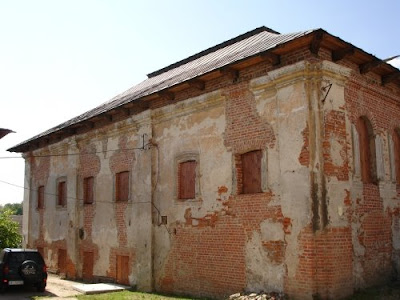
In November 2010 the Foundation for the Preservation of Jewish Heritage in Poland released the English language version of the booklet 'Chassidic Route. Lancut', part of the organization's ongoing series of publications documenting the properties under its care, and the histories associated with those places. Together these sites have been linked as the Chassidic Route project, though often the Jewish history of specific places predates the rise and success of Hasidism, and includes non-Hasidic 18th-20th century components. Many of these places still have imposing remains of central synagogues - usually used by the entire community. The smaller shtibls and shuls where often the daily activity of Hasidic religious communities took place are long gone.

So far the Foundation has published brochures about
Chelm, Jaroslaw, Krasnik, Lesko, Lezajsk, Ropczyce, Rymanow, Sanok, Ustrzyki Dolne and Zamosc. They are all available in Polish and in English in online versions and hard print copies. Online versions can be downloaded from the "About Us" and "Heritage" sections, and can also be found at POLIN - Polish Jews Heritage web portal at www.polin.org.pl.

Lancut is one of the most impressive remaining Polish synagogues and it is also one of the best preserved, having successfully survived demolition attempts by both Nazis and Communists. The survival of the building is due to the foresight and courage of just a few individuals. The interior is remarkable for its fine central bimah (of the bimah-support" type), its womens' gallery above the entrance and opposite the Ark wall, and its exceptional and much discussed symbolic painted wall decoration.

After the fall of Communism restoration and care for the building became more popular. I first visited the synagogue in 1990, and I post some previously unpublished photos of the restoration of the building underway at that time.


Lancut, Poland. Synagogue under restoration. photos: Samuel D. Gruber (1990)

Like many important Jewish sites the synagogue was recognized as an architectural and artistic site of historic significance in the late 19th century, and was first restored in 1896 and again in 1909-10. During German occupation of Poland, the Germans attempted to set the synagogue on fire. The thick masonry wall survived, but the wooden women’s gallery, window frames and interior furnishings were destroyed. The fire was put out following the intercession of the local noble Alfred Antoni Potocki, who made an appeal to the German authorities. After the liquidation of the Łańcut ghetto, the Nazis turned the synagogue into a grain storehouse, and it was used as a warehouse until 1956 when the Communist-era the Town National Council moved to demolish the building.

This plan was courageously protested by Dr Władysław Balicki, who forced the council to withdraw its decision. Dr Balicki, along with the head of the Cultural Department of the National Council in Rzeszów, Jan Mincal, then allocated a fairly large sum of money for the renovation of the synagogue and organized an exhibition of Judaica inside it, a rare occurrence in Poland at that time. From 1973 on the synagogue was maintained by the Łańcut Castle Museum.

The building underwent major renovations in the 1980s and 1990s. Since 2009, it has been the property of the Foundation for the Preservation of Jewish Heritage in Poland.

There are also two Jewish cemeteries in Łańcut: the old and the new. The first reference to the old cemetery, located in today’s Moniuszki St, dates back to 1671, but early all matzevot were removed and destroyed by the Germans during World War II. The cemetery is still however visited by Jews from all over the world, who pay tribute at the ohelot of Tzadik Naft ali Tzvi Horowitz of Ropczyce and Tzadik Eleazar Shapiro.

The new cemetery was founded around 1860 in today’s Traugutta St. During the war, all gravestones were removed from it by the Germans. A memorial plaque commemorating the site of the execution of Łańcut Jews in 1941-44 is installed on the site. There is also a surviving mikvah at Ottona z Pilczy St, built in 1908-10.

Additional information about the Jewish history of Lancut can be found in the booklet.

Monday, November 30, 2009

USA: Exhibition by New Haven's Orchard Street Shul Cultural Heritage Artists Project

USA: Exhibition by New Haven's Orchard Street Shul Cultural Heritage Artists Project

Last week I wrote about the 1925 Orthodox Beth Israel synagogue in New Haven, Connecticut, popularly known as the Orchard Street Shul. I mentioned the upcoming exhibition at the John slade Ely House Center for Contemporary Art in New Haven organized by the artists' group known as the Orchard Street Shul Cultural Heritage Artists Project. The exhibition opens next week and continues through January, with a rich program of associated events.

The Public is Invited to the Opening Reception for the Participating Artists, on Sunday, December 6, from 12:00 Noon to 5:00 pm. To set the mood for the launch of “The Orchard Street Shul Artists Cultural Heritage Project”, the Joseph Slifka Center for Jewish Life at Yale for Jewish Life at Yale will host a Jazz jam session on December 5 at 7:30, celebrating the swing dance music of 1924 and beyond, when the cornerstone of this Synagogue was put in place in a ceremony attended by Mayor Fitzgerald and much of the entire New Haven community.

The John Slade Ely House Center for Contemporary Art is open W-F, 11:00 am to 4:00 pm, and weekends 2:00 pm to 5:00 pm. Schools and other organizations who would like to arrange a group visit outside of regular hours may do so by sending an email to: arts@orchardstreetshul-artistsproject.org.

Below is more information about the synagogue, the project and the exhibition provided to ISJM by Cynthia Rubin, one of the Project and exhibition organizers. Cynthia explained to me that the Project overall was inspired by the many instances of contemporary art installed within or inspired by historic synagogues in Europe. In the case of the Orchard Street Shul, the group wanted to draw attention to the historic, architecture and preservation needs of the congregation while still respecting the fact the building remains as dedicated house of worship. Thus, the exhibition is being help elsewhere (also to save on the winter heating bills for the near-destitute congregation) , and certain parameters were placed on the art created for the event. The art pieces must be somehow relevant to the specific location, history, art and architecture of the Orchard Street Shul and its location, and it must be respectful of the congregation.

"Respect" of course is a subjective term...as I have previously written in my accounts of archaeology of cemeteries in Spain and in other contexts. Still, I believe that for art as for all types of public discourse and behavior, context is everything. When context is understood, than respect should be a natural result - and when it is not, it is usually the result of deliberate and often provocative disrespect. In art, there is often a place - and an important place - for intentional disrespect and shock value. In community building (and that is what is part of the goal in New Haven) the same disrespect and shock can be counter productive.

My preliminary review of the art in this exhibition - through photos and description only- shows that much of its interesting, much is innovative and clever. I appreciate the organizers' decision to encourage thought, but not to shock.

Orchard Street Shul Cultural Heritage Artists Project

During the months of December 2009 and January 2010, The John Slade Ely House Center for Contemporary Art in New Haven, Connecticut will come alive with memories, recollections, and recreations of an important community heritage site, in an innovative group installation designed to both stimulate reflection on the legacies of past generations and engage the public in dreams for the future.

The Orchard Street Shul Cultural Heritage Artists Project is an art exhibition, a history lesson, a point of cultural exchange, and meeting place for dreamers, both nostalgic and visionary. Artists, researchers, and scholars have joined together to celebrate an important historic New Haven landmark which was once central to the life of a large Jewish immigrant population in the Oak Street neighborhood.

Urban changes in the last 50 years have all but erased evidence illustrating the importance of the Oak Street neighborhood in the lives of the newly arrived immigrants and migrants who populated much of the area now known as the "Oak Street Connector", Route 34. Where some see open space, or a new hospital, or a school, or a parking lot, others with longer memories see shops bustling with activity, voices shouting in Yiddish and Italian, sprinkled with a variety of accents from elsewhere, including near and distant regions within the USA.

Contributions to the installation offer a range of approaches. Some artists researched the history of the Orchard Street Shul and its neighborhood, uncovering multiple stories of this community: stories of women working together to aid refugees, stories of hard-working fathers and mothers who dedicated themselves to making a better life for their children, and stories of teenagers who giggled and mingled on the steps of the Shul. Others built on their own experiences, reaching into their hearts to create depictions of the Shul that are evocative of deeper connections with history and community. Still others focused on the issues of urban renewal, making real the shifts in our urban landscape that are difficult to imagine as we visit the site today.

Included in the Project are presentations by researchers from Yale University who developed innovative ways to document the building, including virtual reconstructions exploring new digital methods, ground-breaking research by computer scientists that promises to change the ways that cultural heritage sites will be documented in the future. Some contributing artists used this digital data in their creative work.

The Orchard Street Shul Cultural Heritage Project is organized by Cynthia Beth Rubin, a New Haven based artist, in collaboration with participating artists and researchers: Nancy Austin. Meg Bloom, Donnamarie Bruton, Jeanne Criscola, Roz Croog, Linda Drazen, Paul Duda, Gonzalo Escobar, Maya Escobar, Alan Falk, Greg Garvey, Shalom Gorewitz, Jaime Kriksciun, Leslie J. Klein, Beth Krensky, Seth Lamberton, Mary Lesser, Lisa Link, David Ottenstein, Bruce Oren, Robert Rattner, Cynthia Beth Rubin, Holly Rushmeier, Janet Shafner, Frank Shifreen, Suzan Shutan, Sharon Siskin, Christina Spiesel, Yona Verwer, Julian Voloj, Laurie Wohl, Chen Xu, and Howard el-Yasin. The group includes artists from California, Florida, Utah, Missouri, Rhode Island, Massachusetts, and New York, who traveled to New Haven to contribute to the project alongside artists from the region.

A Project Book is being published in conjunction with the exhibition, including essays by Hasia Diner, the eminent scholar of Jewish immigration history, Walter Cahn, renowned historian of art and and architecture, and Hana Iverson, known for her remarkable multi-media installation "View from the Balcony" that was instrumental in helping attract attention to the renovation project of the Eldridge Street Shul. The book will also feature photographs of the works in the exhibition and memories of the Orchard Street Shul, with commentary by Karen Schiff. The innovative book design is by Criscola Design.

An exciting series of public events includes:
Saturday, December 5, 7:30
Music from the 1920s-1930s jam session
Joseph Slifka Center for Jewish Life at Yale

Sunday, December 6, noon - 5:00
Opening Reception with the Artists
The John Slade Ely House Center for Contemporary Art

Wednesday, December 9, noon
Lunch and Learn, in Partnership with the Jewish Historical Society of Greater New Haven
The John Slade Ely House Center for Contemporary Art

Sunday, December 20, 2:00 pm
Panel Discussion
Memoirs and Remembrances
The John Slade Ely House Center for Contemporary Art

Sunday, January 10, 2:00 pm
Panel Discussion: Documentations: Photography, Recordings and Recreations
The John Slade Ely House Center for Contemporary Art

Sunday, January 17, 2:00 pm
Informal Community Conversations
The John Slade Ely House Center for Contemporary Art

Thursday, January 21, 4:00 pm
Presentation by Yale Computer Science Graphics Group on
The Orchard Street Shul: Case Study in Three - Dimensional Digital Representations of Culture Heritage Sites.
The John Slade Ely House Center for Contemporary Art

Sunday, January 24, 2:00 pm
Panel Discussion: Art and the Echoes of Spirituality
The John Slade Ely House Center for Contemporary Art


Sunday, January 31, 2010
Open Forum:
Artists Reflect on Cultural Heritage Project as Process
Closing Party
The John Slade Ely House Center for Contemporary Art

====================================
The John Slade Ely House Center for Contemporary Art:
Hours
Wednesday - Friday, 11am - 4pm
Saturday & Sunday, 2pm - 5pm
(203) 624-8055

For directions and information on the John Slade Ely House visit:
http://www.elyhouse.org
For information on the Orchard Street Shul Cultural Heritage Project visit:
http://orchardstreetshul-artistsproject.org
contact:
arts@orchardstreetshul-artistsproject.org
Contact:
Cynthia Beth Rubin, Project Director
Orchard Street Shul Cultural Heritage Artists Project
arts@orchardstreetshul-artistsproject.org
Paul Clabby, Curator
The John Slade Ely House Center for Contemporary Art
203-624-8055

Tuesday, June 2, 2009

USA: Continued Progress for Restoration of Virginia, Minnesota Synagogue

USA: Continued Progress for Restoration of Virginia, Minnesota Synagogue

(ISJM) The May 2009 Newsletter of the B’nai Abraham Museum and Cultural Arts Center in Virginia, Minnesota reports great progress on the project to restore the 1910 synagogue in is centennial year. Matching fund have been raised form many private donations to secure the $48,500 grant from the Minnesota Historical Society. Work is now under way to complete the restoration of the sanctuary and several other important building features. The Friends of B’nai Abraham has also received a new matching planning grant of $5,957 from the Midwest Office of the National Trust for Historic Preservation from the Jeffris Heartland Fund. Fund will be used to plan the remaining phase of the restoration, which will include a serving kitchen in the social hall; restoration of the balcony area for storage and additional seating and walkway access form the street to the handicap lift. After planning, additional fund will still be needed to implement work.

The brick synagogue dedicated in 1909 is the last intact Jewish house of worship on Minnesota’s Iron Range, in the far north of the state. The 100th Anniversary and re-dedication of the B'nai Abraham Museum and Cultural Arts Center will be during the summer of 2010. ISJM member Marilyn Chiat has been an active participant in this project since its inception.

With its beautiful stained glass windows, it was described as “the most beautiful church (sic) on the Iron Range., ” in the local press at the time of its dedication. B’nai Abraham was listed on the National Register of Historic Places in the 1980s and is the only Minnesota included. It remained in active use through the 1990s.

Extensive updates with photos of restoration work can be found on the Friends of B’nai Abraham website. Photos of the stained glass windows, and various Judaica items associated wit the synagogue are also posted.

These other synagogues once also stood in Iron Range towns:

The Hibbing synagogue, Agudath Achim founded in the former Swedish Evangelical Emanuel Lutheran Church in 1922, which it had it moved from North Hibbing to 2nd Avenue West, was turned into apartments after the congregation disbanded in the 1980s.

The Eveleth synagogue, Agudas Achim, founded in a reconfigured Catholic Church that was purchased in 1909 and then moved to a new location and remodeled for Jewish use was transformed back into a church when the congregation disbanded in the 1970s, and was subsequently demolished.

The Chisholm synagogue, B'nai Zion, built in 1913, was sold to a church in the 1960s and was then demolished to make way for the pastor’s house.

Thursday, May 14, 2009

Poland: Commemorative Marker Installed on former Krasnik Synagogue


Krasnik, Poland. Former Synagogue Complex and new Commemorative Plaque.
Photos:
Foundation for the Preservation of Jewish Heritage in Poland

Poland: Commemorative Marker Installed on former Krasnik Synagogue


(ISJM) On May 4, 2009, an inscribed memorial marker was dedicated in Krasnik, Poland (located south of Lublin). The tablet is attached to the outer wall of the former synagogue in Krasnik and commemorates the Jews of Krasnik who were victims of the Holocaust. The memorial was financed by the Friends of Krasnik Society of France. On the day of the dedication ceremony students of the local Middle School No.1 met with young Jews from England. Together, they toured former Jewish sites in Krasnik and helped to clean the local Jewish cemetery. Both events were organized by the Foundation for the Preservation of Jewish Heritage in Poland.


For photos of the dedication ceremony click here


Since 2007, the Foundation has been developing a project of revitalization of the historic synagogue complex [click here for more photos]. The municipal government and the Ministry of Culture and National Heritage are lead partners in this effort. The Foundation is the owner of both Krasnik synagogues in the complex: the larger, 17th century Baroque style building that still contains fragments of polychrome decoration inside, and a smaller synagogue, called “the Talmudic house”, probably built in the 19th century.


To read more about he Jewish history and sites of Krasnik download the brochure Krasnik: The Chassidic Route.


According to the Foundation, plans call for the smaller synagogue building to host a modern multimedia library (a library and a lecture room), joined with the multimedia Museum of Jews of Krasnik and the Krasnik Area. The larger building will perform multiple functions: it will host a center for the local culture-oriented non-governmental organizations, and a grand hall for concerts, conferences and exhibitions. One of the women’s courtyards (second floor of the larger synagogue), will serve as a workshop room for art courses.

Other partners in the project are the local authorities of Krasnik, the Town Library, the Culture and PromotionCenter and the non-governmental organizations: the Krasnik Society of Knowledge Lovers and the Center of Volunteers. These partners participated in the preparation of the functional concept of “Our Multicultural Center” and will be its co-hosts, developing its cultural offer along with the Foundation for the Preservation of Jewish Heritage in Poland.

Monday, May 11, 2009

Synagogues and Cemeteries by Shirley Moskowitz Gruber


Top: Shirley Moskowitz. Interior of Synagogue, Pinczow (Poland) and
Below: Cemetery, Rymanow (Poland). Monotypes, 1993.
Collection of Jacob W. Gruber.


Synagogues and Cemeteries by Shirley Moskowitz Gruber
by Samuel D. Gruber

It’s a day after Mother’s Day, but I would like to say something about my own mother, the artist Shirley Moskowitz Gruber (1920-2007). She was a great person and a great mom, but for the purposes of this blog (Jewish art and monuments) I’ll mention some of her artwork. Though she was best known for her landscapes and cityscapes – and especially her work in Italy from the 1970s until shortly before her death in 2007, she also over the years produced a significant number of works devoted to Jewish themes. Shirley was an artist who was Jewish – but not ostensibly or exclusively a Jewish artist. In fact, she never, as far I can recall created any Jewish ritual art or had much interest in it. She did over the years, however, produce several works the subjects of which were Jewish ceremonies. A good example of this is the lino-cut print of children in a Simchas Torah procession made in the early 1960s. This work, like much her output in those years centered on children – especially her own.

Shirley Moskowitz (n.d., early 1960s) Simchath Torah. Lino-cut print.
Collection of Samuel Gruber & Judtih Meighan)

Much later, beginning in the 1990s, she came back to Jewish themes because of the work of two of her children – my sister Ruth and I. In June 1993, she took a break from her work in Italy and traveled with Ruth by car through the Czech Republic and Slovakia to Poland, on her way to surprise me there (where I was leading a tour with Carol Herselle Krinsky sponsored by the World Monuments Fund). Along the way Ruth and Mom stopped at a lot of cemeteries and synagogues which Mom sketched or photographed, and then when she returned to her press in Morruzze (Italy), she produced a series of vivid monoprints recording and interpreting these scenes. A few year later, a visiting friend from Poland saw some of these works and insisted they be shown in Poland, and that began a ten-year traveling itinerary for the works organized by the Jewish Cultural Center in Krakow, that ended at the then-new Jewish Museum in Galicia.


These works have now returned to the family, but I thought I would show some of them here. Today, these scenes and many like them are well-known, but in 1993 they were still a representation of a lost and mostly forgotten world. Its importnat to me that Shirley viewed the remains with a sense of loss, but she also treated them as parts of the landscape as she did the ruins of Italy (or derelict buildings in Philadelphia) which she often painted.

For those who would like to know more abut the life and art of Shirley Moskowitz Gruber, the family has recently created a website. On this you can read an essay about her work that I wrote in 1996 for a retrospective exhibition on the occasion of her 75th birthday. There is also a lovely eulogy by Rabbi Laura Geller, and a memorial essay by Ruth Ellen Gruber. This is a work in progress – we are gradually locating her work and having it photographed. If any of my readers have memories of Shirley or her work, we invite you to contribute these to the site.

Wednesday, December 17, 2008

Exhibition: Romania Synagogue Photos in NYC January 6-9

Exhibition: Romania Synagogue Photos in NYC January 6-9

I am happy to post the following to announce a showing of Christian Binder's Romania Synagogue photos in New York next month. Contributors who would like to see this work continued should contact me. ISJM has put together a proposal to allow Christian and Julie to keep working on this project...modest funding is needed.

-- Sam

Photo-Documentary Exhibition: "Synagogues of Southern Transylvania"
Photography: Christian Binder
Curator: Julie Dawson

Congress for Jewish Culture, 25 East 21st Street, ground floor
January 6 - 9, hours 11:00 - 4: 00 pm

Opening night January 6: Doors open at 6:00 pm, introduction and Carpathian klezmer music with Jake Schulmann-Ment and Benjy Fox-Rosen at 7:00 pm

In the wake of the Holocaust and subsequent mass migration of the vast majority of Romania's Jewish population, countless synagogues fell into various stages of disrepair and decay. This photo exhibition aims to capture the transitional stage in which Romania now finds itself. With the entrance of foreign investors and NGOs, some synagogues are being restored, turned into cultural centers or finding alternative uses. Others remain abandoned, assuming a central location in the town's center and representing an evocative, stubborn reminder of the recent and troubled past.

The questions are numerous - what will become of these buildings now that they can be used again? Will their respective towns take responsibility for their upkeep? How can they be integrated into a long-term plan for urban or rural renewal? And how can the countless still decrepit synagogues, many of significant historical or architectural value, be incorporated into a systematic and far-reaching plan to commemorate and celebrate a culture which used to play a considerable role in Romania's vibrant multi-cultural existence?

Friday, December 12, 2008

Obama's Chicago Jewish Neighborhood


Obama's Chicago Jewish Neighborhood
by Samuel D. Gruber


On election day I wrote about presidents and synagogues, but at the time I didn't realize that then candidate and now president-elect lives in a former Jewish Day School, and lives immediately across the street from one of my favorite synagogues, Temple Isaiah - K.A.M. in Chicago, the quintessential Byzantine Revival synagogue designed by Chicago Jewish architect Alfred Alschuler in 1924. I featured this synagogue in my 2003 book (American Synagogues: A Century of Architecture and Jewish Community), but I never realized when I stood facing and photographing the facade that I had my back to the Obama home. I'm thinking that since the synagogue has a chimney disguised as a minaret, maybe that's where the story of Barack being a Muslim started. But its not the Muslim call to prayer one hears on Greenwood Ave., and certainly now not "Barack Who?," but rather the Baruch hu.


Charles B. Bernstein and Stuart L. Cohen have researched the history of the Hyde Park house which could become the Chicago White House (unless they sell when they move to DC, as many speculate they will), and presented their findings in the Chicago Jewish News. They write that " Indeed, the title history of the Obama house shows it has a rich Jewish history, one that encompasses both of Chicago's rival communities, the Reform Hyde Park German Jews and the Orthodox West Side Russian Jews." The house was built around 1908, and was bought by the Hungary-born Max Goldstine, its first Jewish owner in 1919. By the 1940s, a small but active group of Orthodox Jews were living in Hyde Park in 1947 they established the Hebrew Theological College (a yeshiva) in the former Goldstine House. In the late 1940s, the house was also the home of the South Side Jewish Day School. When Hyde Park's Orthodox population dwindled, the Yeshiva sold the property to the Hyde Park Lutheran Church in 1954.


Click here for the full and highly detailed story

Another story ran in the Forward about the affect of the Obama election congregation KAM-Isaiah Israel, which has found itself in the middle of a high-security zone. Marissa Brostoff writes that the congregation seems to be taking it all in stride - they have long been familiar with the Obamas for many years. Most congregants find that the excitement of Obama's victory far outweigh the security hassles.
The following account of Temple Isaiah is adapted from American Synagogues:
Temple Isaiah dedicated in 1924 was inspired by the 6th-century Byzantine churches of San Vitale in Ravenna and Hagia Sofia in Istanbul. The octagonal plan synagogue is topped by a low tile dome. According to the architect, “We have not designed a Byzantine building but have endeavored to produce in concrete, stone, brick and steel, the mental picture developed by the study of this style modified by its contemporary influences and co-ordinated with the proper spirit and functioning of modern Jewish synagogues.”

Alschuler maintained, in much the manner of Arnold Brunner, that his style was more truthful to early synagogue architecture than other forms. There is some basis for this claim, as there were synagogues throughout the Byzantine Empire. Alschuler wrote of how he incorporated motifs of “fragments form an ancient Hebrew Temple recently unearth in Palestine.”


Alschuler was somewhat disingenuous, however, as no known central plan synagogues like Temple Isaiah had ever been found. The inclusion of a tall thin minaret-like tower next to the main sanctuary to mask the facility’s tall chimney is a particularly unusual, albeit picturesque, addition. One critic, obviously unfamiliar with Jewish tradition, but full of love for the exotic, wrote:


"It is a beauty and a joy, surrounded by a spacious lawn, trees and a dwelling house environment. Its low, flat dome and horizontal lines are delightfully accentuated by the tall slender chimney, reminiscent of a minaret from which the faint, intoned voice of the musessin would complete the picture of beauty. It is one of those structures that we return to, always eager to get our feel of its beauty of form and color."


Others found the mosque analogy puzzling, and even offensive. But preoccupation with the mosque detracts from the real elegance Alschuler’s geometric solution – an octagonal space surmounted by a high dome supported on vaults that spring from eight massive free standing piers. There is a semicircular balcony included to increase seating in close proximity to the bimah and Ark. The supporting piers are close to the walls to keep the sanctuary space uncluttered. The dome was made of Guastavino tile, like that of Rodeph Shalom in Pittsburgh. The tile was both structural, but also covered wall areas to improve acoustics. The use of Guastavino tiles allows other attractive details, such as the sinuous stairs the twist up to the balcony from either side of the vestibule.


Overall, the building maintains two levels of decoration. The first derives solely from the careful mix of materials and combination of soft earthy colors in the tile and brick. The seconds is an extensive overlay of explicit Jewish symbols, which crescendo as one progresses through the building. The stylized Decalogue is set over the main entrance, and a more traditional Decalogue sits within the arch above the Ark, designed as a large Syrian arch – a motif known from Byzantine Palestine. In the ornate vestibule there are Emblems of the Twelve Tribes of Israel. The Star of David of prominently depicted in inlaid brick in each of the four great pendentives of the interior vault and in a large roundel at the apex of the dome. The six-pointed star also stands out in a roundel at the apex of the architectural composition of the Ark wall. Stars are embedded throughout the building, including on the impost blocks set above ornate capitals in the Byzantine manner. Large freestanding menorahs flank the Ark.


Perhaps the most remarkable decorative element in Temple Isaiah is not architectural. It is a large figurative stained glass window representing Moses. This tall image of the Prophet holding the tablets of the law is set in the balcony level, and is not easily visible form the sanctuary below. The depiction of figures, even of Moses, was still unusual in synagogue art, but by the 1920s not entirely uncommon in Reform Temple.

For those visitors to the Chicago’s south Side who cannot pass the congregation KAM – Isaiah Israel security cordon, there are still other opportunities to visit historic and architectural distinctive synagogues. I’ll be writing about two of these soon – one designed by Dankmar Adler and the other by Alschuler. Both are now churches, and are well-maintained and welcoming to visitors.

Photos: Congregation KAM - Isaiah Israel, Samuel D. Gruber