Showing posts with label England. Show all posts

Monday, November 7, 2011

UK: Last East London Jewish Hospital Demolished

Last East London Jewish Hospital Demolished

By Renee Ghert-Zand

Despite opposition, the last remaining Jewish hospital building in London’s East End will be torn down to make way for a five-story housing development. The Tower Hamlets council agreed for the Jewish Maternity Hospital on Underwood Road, Whitechapel, to be demolished because it does not have landmark status. It is neither listed by English Heritage, nor does it fall within a Conservation Area, according to a report in the East London Advertiser.

Those opposed to the demolition, including cultural and political leaders, are especially upset that the cottages next door to the hospital are also set to be taken down. They say that they are large single-family homes in good shape. “The Director of Jewish Heritage UK, Sharman Kadish, also wrote to Peabody [the real estate developer], saying the social and historic significance of the cottages next to the main hospital building have been overlooked while urging the trust to convert the cottages into residential use,” the article in the Advertiser said.

The developer contends that keeping the cottages would negatively affect the number of housing units needed to be built and would make its plan financially unfeasible.

The Jewish Maternity Hospital operated between 1911 and 1947 and had an attached midwifery school. It was built as a two-story building containing three maternity wards, an operating theater and several annexes and offices. Of its 12 beds, 4 were reserved for patients who could not pay for medical care. The building quickly became too small, and eventually additional wings were added on. The hospital also added on many other services, including pre-natal and post-natal care clinics.

Since WWII, and after the hospital moved to another site, the building has served as a nursery and childcare center, and more recently as a family welfare association for local residents in Tower Hamlets.

Friday, April 23, 2010

Great Britain: Possible Medieval Synagogue in Northampton

Great Britain: Possible Medieval Synagogue in Northampton
by Samuel D. Gruber


(ISJM) Marcus Roberts of National Anglo-Jewish Heritage Trail (JTrails) in Northampton, England has presented evidence for the possible - even likely - identification of a site in that town as the remains of a medieval synagogue.

A survey using ground penetrating radar, carried out in partnership with Birmingham University, has identified stone walls and what appears to be a stairway and entry, possibly confirming known descriptions of the former Northampton synagogue which according to Roberts is recorded as a sunken building, entered by steps (‘and a fair and stately hall’) in an account of Northampton buildings before the Great Fire of 1674. An illustration in a bird’s eye view map of 1634 appears to show the same building where we detected the sub-cellar remains.

A survey of land underneath Kebabish (a kebab shop) and The Bear Public House, both in Sheep Street, Northampton, has identified what may be the remains of a synagogue which would date to the period before the expulsion of Jews from England in 1290.

Roberts told the Northampton Chronicle & Echo (April 9, 2010): " It ...showed what appears to be two walls going down 14 feet underneath cellar level. There was also a square or rectangular structure next to it which may well have been a stairway going down into the synagogue." Roberts further told me that "the very substantial building was a sunken structure in the medieval period, an adjacent wall in the pub cellar appears to be an up-wards extension and adjacent structure to the sub-cellar finds, which could thereby be a visible remnant of the synagogue wall or an adjacent Jewish building and is at least six feet thick."

Last year, an archaeological survey in Northampton discovered what Roberts believes is the site of a 12th century Jewish cemetery of the city. In the case of the new find, Roberts and project partner Caroline Sturdy Colls, a PhD archaeology student at Birmingham University, both warned they could not be certain of the nature of the remains without excavating the site. Based on the historical and documentary evidence, Robers is confident that Sheep Street was once home to a medieval Jewish settlement and synagogue. But even if the identified remains are part of a former Jewish street, much more evidence would needed to prove they were also part of a synagogue. One remembers that controversy and disagreement on the identification of the massive Romanesque structure excavated in Rouen (France). That episode is a lesson that despite the lack of many many large Jewish communal structures of the period surviving today, there may have been more than we presume. Not every significant building in a Jewish quarter or on a Jewish street need have been a synagogue.


But Roberts told the local paper "But we thought we would find the synagogue there and what we have found is an extremely substantial medieval sunken building."

To date there are no confirmed remains of medieval synagogues in England. In the 1990s a small structure with built-in benches was excavated in Guildford and was quickly identified as a likely synagogue, but experts now disagree over its original use. Excavations in London in recent years have revealed remains of houses of local Jews and of mikvot, but no synagogue.


For further reading see:


Alexander, Mary, 1997. “A possible synagogue in Guildford,” in G. De Boe & F. Verhaeghe, ed.s: Religion and Belief in Medieval Europe – Papers of the Medieval Europe Brugge 1997 Conference, vol. 4, 201-212, I.A.P. Rapporten 4, Zellik, 1997.


Blair, Ian; Hillaby, Joe; Howell, Isca; Serman, Richard; and Watson, Bruce, 2001. “Two Medieval Jewish Ritual Baths – Mikva’ot – found at Gresham Street and Milk Street in London,” Transactions of the London and Middlesex Archaeological Society, Vol. 52 (2001), 127-137.


Isserlin, Raphael M.J., “Building Jerusalem in the ‘Islands of the Sea’: The Archaeology of Medieval Anglo-Jewry” in S. Kadish, ed., Building Jerusalem: Jewish Architecture in Britain. Vallentine Mitchell, London and Portland, Or., 34-53.

Tuesday, December 22, 2009

Jewish Archaeology in Europe: Upcoming Conference and an Overview


Lorca, Spain. Medieval Synagogue (15th century?) and three of the dozens of handing glass oil lamps excavated, as reconstructed. Photos: Samuel D. Gruber, 2009.

Jewish Archaeology in Europe: Conference and Overview
By Samuel D. Gruber

A major conference about the archaeology of Judaism in Europe has been organized in Paris by Paul Salmona of the Institut national de recherches archéologiques préventives (INRAP). The conference will be held at the Musee d'art et d'histoire du judaisme on January 14-15, 2010.

INRAP was founded in 2002 under the French Law on archaeology of January 2001. It replaces Association for the national archaeological excavations (AFAN), established in 1901. INRAP is administered jointly by the French Ministries of Culture and Research.

The full program can be consulted at the INRAP website or downloaded here.

This conference comes on the heels of another big conference “Medieval Jewish archaeology in the Iberian Peninsula,” for archaeologists about recent excavation of Jewish sites in Spain held in Murcia in February, 2009. The 133-page proceedings of the conference can be accessed at:
http://www.lucesdesefarad.com/images/preactas.pdf

Both conferences are signs of the quickening pace of “Jewish archaeology” in Europe, and the increasing variety of sites encountered, and conflicting views on their excavation, interpretation and presentation.

The systematic and planned archaeology of Judaism in Europe is a relatively new phenomenon that has evolved from several trends that even today are not always easily reconciled. Since I will not be able to attend the Paris conference, and I doubt that many of readers will be there either, Ipresent here a brief overview of the topic of "Jewish Archaeology."

Jewish Archaeology in Europe: History

The roots of “Jewish Archaeology” lie in the 19th and early 20th century German scientific study of Judaism (Wissenschaft des Judentum), an academic movement that advocated intensive study of ancient, medieval and post-medieval source material and created more nuanced history of Jewish settlement and community. The movement mostly saw traditional Judaism as an historic relic, rather than as a dynamic religion, and was thus rejected by most observant Jews. The Wissenschaft movement was particularly attentive to texts, but was also cognizant of the possibility of the new field of archaeology in providing new information.

A similar movement developed in England, led by the Jewish Historical Society of England (founded 1893), that identified Jewish settlement sites in England from before the expulsion of 1290, and details about the names, occupations and wealth of many Jewish individuals. This effort has continued for more than a century and recently led to archaeological excavations in York, Guildford and London. Nearly contemporary with the Jewish Historical Society was the publication by Israel Abrahams (1858-1925) of Jewish Life in the Middle Ages, a work about the everyday life of Jews as much as about religion. It gave extensive coverage to material culture.

Along with the development of “Biblical Archaeology” in the Near East, Jewish scholars supported excavations in Europe. Archaeological investigation into ancient Judaism was deliberately developed in the Holy Land, first by Europeans in the late 19th century. In the early 20th century Jews resident in Palestine supported this work, and continued after 1948 the new state of Israel. The Israel Exploration Society (originally Society for the Reclamation of Antiquities) was founded in 1914. Among many discoveries – that continue today – are the remains of synagogues and Jewish villages of late antiquity. Parallel to this, were accidental discoveries in Europe of signs of ancient and medieval Judaism in the form of inscriptions and synagogues. One of the earliest was the uncovering of the Jewish cemetery of the rue de la Harpe in Paris in 1847 (thanks to Max Polonovski for this information).

In the second half of the 19th century Jewish scholars joined the study of texts and material culture by studying Jewish funerary epitaphs, including those from the catacombs in Rome, but also cemeteries dating from the 12th through 16th centuries in Worms, Prague, Vienna, Lvov and many other cities.

In Palestine there was a growing interest and professionalism in “Jewish archaeology,” while in Europe there was growing evidence – but not widespread interest – in the potential of archaeology to expand historical horizons. Unfortunately, many finds explicitly linked to the European Jewish past have languished in storage and the potential link to Jews and Judaism of other finds have received little scrutiny. One of the few publicly accessible collections of medieval Judaica in Europe was that of the Musee Cluny in Paris, assembled in the mid-19th century by Joseph Isaac Strauss (1806-1888) who displayed 82 items at the Universal Exhibition in the Trocadero Palace in Paris and exhibited part of the collection at the Anglo-Jewish Historical Exhibition in London in 1887. The collection, which is mostly comprised of synagogue and household ritual objects was later purchased by Baron Nathaniel de Rothschild and presented it as a gift to the French nation.

Archaeology of Judaism in Europe as we know it today developed directly out of the destruction of European cities in the Second World War. Post-war urban renewal developed opportunities for archaeological excavation in bombed out city centers. Documentation of standing Jewish structures – mostly synagogues – had begun in earnest in Germany and Poland during the interwar years, but most of these buildings were subsequently destroyed in the Holocaust. After 1945, however, remains of extensive medieval Jewish settlements in German cities could be fully exposed and investigated. These sites – previously known mostly through documentary evidence – gave a new physical dimension to the medieval presence in Europe. Unfortunately, limitations of archaeological technique as well as post-War political issues, financial constraints, and pressure for urban rebuilding, restricted the results of excavation and analysis. Otto Dopplefield’s work at Cologne was the most extensive; where he revealed the remains of a medieval synagogue that he dated to the 11th century. An impressive multistory mikveh (ritual bath), a monument of early medieval engineering was also revealed. New excavations carried out by the City of Cologne on the site since 2007 have confirmed much of Doppelfield’s analysis, but has conclusively pushed the date of synagogue and mikveh back to the Carolingian period and most likely – at least for the synagogue – to late antiquity. Other excavations took place in Worms and Speyer.

Cologne, Germany. Medieval Mikveh, looking up. Photo: Samuel D. Gruber

The aftershocks of the destruction of Jewish communities in the Holocaust continued to influence Jewish scholarship in Europe. Two generations of scholars were lost – precisely those great teachers and their promising students who were most interested in the medieval Jewish past. Those that survived moved to American and Israel, far from the physical remains of European Jewish culture. Jewish medieval studies became again concerned almost totally with texts and movable objects. The methodology of the Center for Jewish Art at the Hebrew University, for example, emphasized iconography over physical context.

Jewish Archaeology in Europe: Contemporary


Nowhere was there any planned effort to identify Jewish sites, nor to further exploit of the opportunities afford by unexpected finds. Throughout the Jewish world “Jewish archaeology” became almost synonymous with the uncovering of ancient Jewish remains, primarily in Israel, but also throughout the Mediterranean littoral, where a number of finds such as those from Ostia (Italy), Sardis (Turkey) and Stobi (Mecedonia) attested to Judaism’s widespread acceptance in the ancient world.

Medieval archaeology itself as a serious discipline with its own rationale and developed methods continued to evolve, especially in Britain (where the influence of the “New Archaeology” was strongest), and in Germany and Italy. Many of the favored archaeological conceptions such as urban archaeology and regional settlement surveys that should have brought more attention to the medieval Jewish component, however, tended to ignore it completely. A close reading of the archaeological literature from Europe between 1960 and 1990 would suggest that Jews were hardly present on the continent – despite their ubiquity in religious, historical, and legal sources as well as historical toponyms in many countries. Thus historians and archaeologists have different perceptions of the place and role of Jewish in the European Middle Ages.

From the 1960s through the 1990s most identification of Jewish materials in Europe was almost entirely accidental. The most spectacular instance was the discovery of a massive Romanesque structure in Rouen, France, in 1976, that may have been a synagogue, but was more likely a yeshiva (Talmudic school) and possibly a scriptorium. In 2002, excavations in Lorca, Spain uncovered the entire plan of a 15th-century synagogue as well as remains of eleven houses of the Jewish quarter, where previously no Jewish settlement was known. Houses contained distinctly Jewish features, including ceramic Hanukah oil lamps. The synagogue included original architectural and decorative features and fragments of more than 50 glass hanging lamps – previously only known from manuscript illuminations and later similar types from North Africa.

Archaeology of Jewish sites has centered on religious and ritual sites. These were the most prominent structures of Jewish communities, especially synagogues and mikvot (ritual baths), building types that are also most likely to incorporate distinguishing features allowing them to be identified as Jewish. These structures have usually been found in the course of building renovation or construction, or as part of other excavations. Recently, as in Regensburg (Germany) and Vienna (Austria), large planned excavations have been carried out at sites where ancient synagogues were known have existed before they were deliberately demolished, and the remains of those buildings and adjacent structures have been exposed. Similar excavations have been advocated for other known sites, such as the medieval synagogue in Budapest.

Vienna, Austria. Preserved remains of the medieval synagogue after excavation and creation of the Judenplatz Museum. Photo: Samuel D. Gruber

In Spain, a more sensitized archaeological profession is now more adept at identifying Jewish sites discovered by accident, and historians and archaeologists are also seeking Jewish remains. A rich array of documentary sources, as in Jaén, can help locate former Jewish settlements in towns and cities throughout Iberia, where medieval juderie are still remembered in local lore and toponyms.

For centuries, traces of many Jewish cemeteries have been found, mostly sites which Jews were forced to abandon during periods of expulsion, or which were expropriated from them by authorities. Commonly, inscribed stone gravestones (matzevot), often in only fragmentary condition, have been found; mostly discovered in locations of re-use, incorporated in later structures, roads, city walls, river embankments, etc. where they served as ready building material. This is true in Spain, Italy, Germany and elsewhere in Europe.

In a few cases, such as York (England), Prague (Czech Republic) and Lucera and Tarrega (Spain) previously forgotten and long unmarked Jewish cemeteries have been discovered in the course of urban development. In the past, such cemeteries might have been entirely destroyed without careful examination. Now, such finds are usually reported to cultural heritage authorities and they are carefully excavated by trained archaeologists. In some cases their Jewish character has been perceived when excavations began, but archaeologists did not consult with present-day Jewish communities. In almost all cases when the burials were identified as Jewish – either before or after excavation – some Jewish organizations, especially representative of Jewish religious communities, have protested the excavation and especially the exhumation of human remains as a violation of Jewish religious practice and law. In cases where the location of medieval Jewish cemeteries is known, Jewish communities have generally encouraged non-intrusive archaeological methods as a means of investigation. Jewish communities and archaeologists are still developing procedures to lessen conflict over cemeteries. So far, in some places, there seem to be irreconcilable differences of opinion and approach.

Maribor, Slovenia. Fragments of medieval Jewish gravestones now in Municipal Museum.
Photo: Ruth Ellen Gruber


Medieval treasures have been uncovered, mostly as accidental discoveries. The two most famous medieval treasure “hoards” are those of Colmar, discovered in 1863 and one from Erfurt found only in 1996. These hoards of money and precious objects were probably hidden in time of persecution and mass murder of Jews, and not recovered. The Colmar treasure contained an elaborate early 14th century wedding ring. Nothing is known of the individuals or groups who hid the treasures other than their apparent wealth, but it is assumed that they died in the massacres of 1348. Similar accidental discoveries of caches of documents and many artifacts of everyday life have been found in genizot, (plural of genizah), storage spaces in synagogues used for discarded texts and ritual items. But with the exception of the famous Genizah of the Ben Ezra Synagogue in Cairo, whose documents have helped rewrite the Jewish and economic history of the Mediterranean region in the Early Middle Ages, these genizot have produced materials only from the 18th century on. In the case of genizot, after a series of accidental discoveries in the 1980s an 1990s in former synagogue south German synagogue buildings, more systematic investigations have been undertaken.

Note: The above text is adapted from two larger articles on “Jewish Archaeology” in press and preparation. I always appreciate new information – historic or contemporary – about all types of investigation of Jewish heritage sites.

Wednesday, November 4, 2009

Call for Papers: 'The Image and the Prohibition of the Image in Judaism',

Call for Papers: 'The Image and the Prohibition of the Image in Judaism'

(ISJM) Scholars of Jewish art and visual communication will want to note what may prove to be an important gathering in Southampton, England next September.

Call for Papers:
The Image and the Prohibition of the Image in Judaism,
British Association for Jewish Studies (BAJS), Southampton,
5-7 September, 2010

Call for Papers:
The theme of 2010 BAJS Conference (Sunday 5th - Tuesday 7th September 2010) is 'The Image and the Prohibition of the Image in Judaism'. Topics may cover any time period from antiquity to the contemporary, and any place or cultural context relevant for Jewish Studies. The 'image' may be interpreted broadly to include the non-visual (e.g. literary representations and conceptual images) as well as the visual. The expectation is that papers will explore different aspects of the acceptance and the rejection of images in Jewish thought and practice from the Bible to the modern world. Topics may include the secular as well as the religious sphere.

Proposals for papers (and panels) in the following areas are especially welcome:

* biblical traditions and their interpretation
* notions of 'the image of God'
* Jewish art and Jewish symbols
* idolatry and iconoclasm
* the prohibition and acceptance of images in Holocaust representation
* representing Jewishness in film and television
* Jewish/non-Jewish relations and the second commandment

Practical details:
Single paper proposals should be no longer than 250 words and panel proposals need not exceed one page. Please email proposals to Dr Sarah Pearce (s.j.pearce@soton.ac.uk) with 'BAJS 2010' in the subject line. The deadline for paper abstracts and proposed panels is 31 May 2010. Registration details will be circulated soon.

Please note the September date for this meeting instead of the usual July date. This change was made for 2010 in order to avoid clashes with the July 2010 conferences of the European Association of Jewish Studies (Ravenna) and the UK Society for Old Testament Studies (Sheffield).

Please note that though the conference is open to all (see details below), anyone wishing to present a paper who is not a member of BAJS must join by the time of the conference. Membership is open to anyone interested in an academic approach to Jewish studies. For membership enquiries and applications, please write to: Dr James K. Aitken, Lecturer in Hebrew, Old Testament and Second Temple Studies, Faculty of Divinity | West Road | Cambridge CB3 9BS | UK. Email: jka12@hermes.cam.ac.uk BAJS Website : http://britishjewishstudies.org/about/join-bajs/

There are three categories of membership of BAJS:

1. Ordinary Members
Ordinary membership is open to scholars concerned with the academic pursuit of Jewish Studies.

2. Student Members
Student membership is open to graduate students working for a higher degree in the field of Jewish Studies.

3. Associate Members
Associate membership is open to (a) those outside the United Kingdom and the Republic of Ireland who have a serious academic interest in Jewish Studies, and (b) those within the United Kingdom and the Republic of Ireland with a serious academic interest in Jewish Studies but who are not professionally involved in the subject. Members of all categories are welcome to attend the annual conference and to present papers at it (subject to acceptance via the Call for Papers process).

Monday, August 31, 2009

UK: Synagogues and Historic Sites Nationwide Open Doors For European Day of Jewish Culture

UK: Synagogues and Historic Sites Nationwide Open Doors For European Day of Jewish Culture


London, England, UK. Two of the synagogues open to the public on September 6th. Above, the magnificent Victorian-era New West End Synagogue designed by George Audsley and built form 1877-79 and below the Fieldgate Street Great Synagogue, actually a simple East End Synagogue, built in 1899 and still in use. Photos: Samuel D. Gruber.


Manchester, England, UK. Visitors will be welcome at the Higher Crumpsall & Higher Broughton Hebrew Congregation, built 1928-29 (above) and at the Manchester Jewish Museum in the former Spanish and Portuguese Synagogue, designed by Edward Salomons and built 1873-4 (window dtl from 1913, below). Photos: Samuel D. Gruber

Across the United Kingdom Jewish organizations, institutions and congregations are joining forces for the tenth straight year to open their doors to the broad public as part of European Days of Jewish Culture and Heritage. The annual event was first organized in 1996 by the B'nai B'rith Lodge in Strasbourg, France. It has now spread to 27 countries, and approximately 200,000 people participate each year. In the UK, B'nai B'rith UK is the primary organizer, with support from Jewish Heritage UK and dozens of local organizations. This year, over 90 events are offered, including open synagogues and tours, historic and architectural walking tours, concerts, exhibitions and lectures. It is impossible for one individual to take advantage of more than a handful of activities, but the organizers have wisely spread events over the period of more than an entire week, beginning September 6th with some events offered as late September 16th.

London, England, UK. The former Spitalfields Great Synagogue on Brick Lane was built as a Huguenot Chapel and is now a Bengali Mosque. A visit is scheduled on a walking tour of the Jewish East End.

If you live in are are visiting the UK have always wanted to visit a particular synagogues - this is your chance. If you can't decide, then take a look at the popular guidebook Jewish Heritage in the England: An Architectural Guide. Or better still, try on of nine different walking tours offered in London on September 6th, or tours in Richmond or York. In addition to 12 synagogues open in London on Sunday, September 6th, you can also visit synagogues in Bangor, Bradford, Brighton, Bristol, Chatham, Cornwall, Lincoln, Liverpool, Manchester, Ramsgate, and Reading.

Click here for full UK program

For links to events in other countries click here.

Friday, July 24, 2009

UK: London Jewish Museum Must Purchase Lindo Hanukkiah on Display for 70 Years

UK: London Jewish Museum Must Purchase Lindo Hanukkiah on Display for 70 Years
by Samuel D. Gruber (based on news reports)

The London Jewish Museum reports that it is close to raising funds needed to purchase the famous 18th century Lindo hanukkiah (click here for photo) which it has displayed for seventy years - since the museum was founded. The silver hanukkiah was commissioned from artisan John Ruslen in 1709 to honor the marriage of Elias Lindo to Rachel Lopes Ferreira. Descendants of the "donors" to the museum want to sell the renowned object, and the museum must raise £300,000 to avoid the work leaving public view to most likely enter a private collection.

Unless the family is really hard up for money or to pay taxes, it seems disgraceful and extortionary that the family should ask for money for the work generations after it was put on display. Are they taking advantage of the Museum's reopening - knowing that this is a central object of the collection, one that the Museum can not afford to lose? One would think that the work is de facto the property of the museum after all these years.

The Museum has raised £250,000, including £145,000 from the National Heritage Memorial Fund (NHMF), £75,000 from the independent Art Fund, and £30,000 from the MLA/V&A Purchase Fund; £50,000 are still needed. This purchase is on top of the £14 million raised for the expansion of the museum’s Camden Town facility (including £4.2 million from the Heritage Lottery Fund), scheduled to reopen in early 2010.

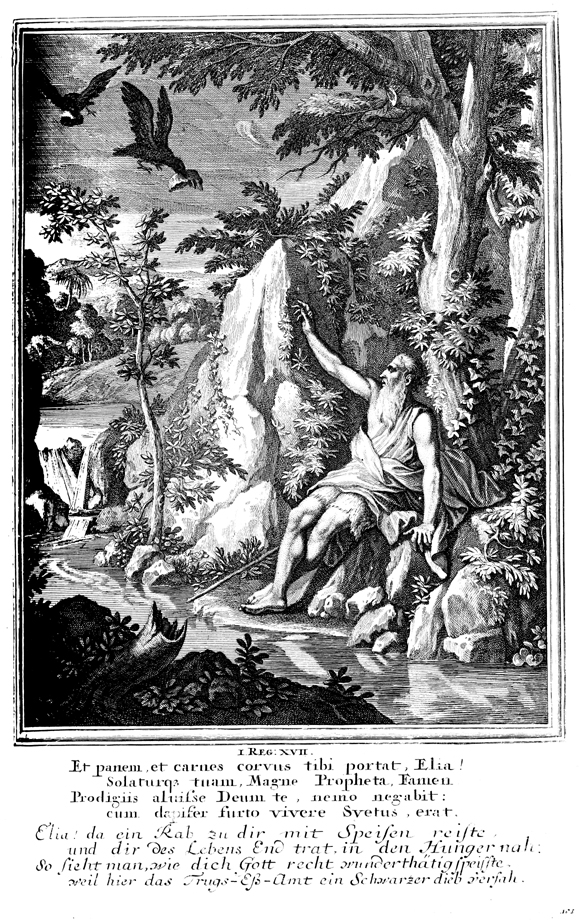
In addition to the importance of the Hanukkiah for its age (London's oldest standing synagogue, Bevis Marks, for example, was built only in 1701) and certain provenance, the work is unusual for its iconography of the Prophet Elijah begin fed by Ravens (I Kings 17:6) a allusion to the patron Elias (Elijah) Lindo. Though the subject is not very common in Jewish art, it was popular during the Baroque period in both Catholic and Protestant lands. For example, there is a late 16th century version by the Flemish painter Paolo Fiammingo (now in San Francisco), and a well known version from 1620 by the Italian artist Guercino (coincidentally, now in London at the National Gallery). A version by Dutch artist
Abraham Bloemaert (1564-1651) was copied in prints of the 17th and 18th centuries. Click here to see an anonymous print of the subject from 1712. Such printed works probably influenced Ruslen's design.

Read the full story as reported from ArtDaily.org (presumably from a press release). The Jerusalem Post ran the story almost verbatim, read it here.

Monday, June 15, 2009

UK: Synagogue in Sunderland by Marcus Kenneth Glass For Sale

UK: Synagogue in Sunderland by Marcus Kenneth Glass For Sale

The last intact synagogue by Anglo-Jewish architect Marcus Kenneth Glass is for sale. The 1928 synagogue on Ryhope Road (Hendon) in Sunderland (Northeast England) has been vacant since 2006 when the dwindling congregation ceased using the large vaulted structure for regular worship. The building was listed as a Grade II historic structure in 1999 which has helped stave off the wrecking ball, and now the Jewish charitable trust which bought the building from the congregation has but it on the market for what it hopes will be a sensitive adaptive reuse.

Sharman Kadish treats the Sunderland Synagogue at length in her Jewish Heritage in England : An Architectural Guide (English Heritage, 2006, pp. 182-185 with 6 pictures). She describes the interior - the part of the synagogue most likely to be compromised by any reuse, as "spanned by a deep barrel vault over the central aisle, which was originally painted to imitate a star-spangled sky. The gallery runs around three sides carried on slender iron columns with palmette capitals. The plasterwork Ark canopy is highly decorative, painted and gilded. It is classical in form but features decoration of Islamic and Byzantine origin, especially the cushion capitals to the columns and the chevron patterns on the shafts..." In other words, Glass's design is highly eclectic and colorful, typical of the what Kadish calls a "cinematic art deco style." It it is hoped the however purchases the building will keep the large sanctuary space intact, including the fine stained glass.

The asking price price is £295,000 to buy or £27,500 annual rent.

Two other synagogues designed by the still little-known Newcastle architect have been substantially altered in recent years. In 2006, only the facade of the Clapham Federation Synagogue (1931-32) in London was saved (see Kadish, 31). In Newcastle Upon Tyne, The Jesmond Synagogue on Eksdale Terrace, designed by Glass in 1915, has been transformed into a school, but its exterior has been conserved, including its facade stained glass windows (see Kadish, 187-88).

For a photo and to read more see the story by Jane O'Neill in the Sunderland Echo (June 8, 2009).

Wednesday, June 3, 2009

UK: London's Sandys Row Synagogue Receives Large English Heritage Grant


Sandys Row Synagogue. Photos courtesy of and copyright Sandys Row Synagogue, 2009.

UK: London's Sandys Row Synagogue Receives Large English Heritage Grant
by Samuel D. Gruber (based on reports from Sandys Row Synagogue and English Heritage)

(ISJM) In another sign that Jewish heritage is now taken seriously in the UK, English Heritage has awarded its second significant grant this year for synagogue restoration. In March English heritage and the Heritage Lottery gave funds for restoration work at the London's Victorian high style New West End Synagogue. On May 12, 2009 The English Heritage - Heritage Lottery Fund Places of Worship Scheme announced an every larger award £254,000 to Sandys Row Synagogue, the oldest Ashkenazi Synagogue in London, and one of the oldest in the country, for major repairs to the roof and exterior water handling system. The award was part of a package of grants worth £7 million for essential repairs to 56 Grade II listed places of worship across England. London received £1,007,000 for the restoration of seven houses of worship. The other London recipients were historic churches.

Sandys Row Synagogue, which is listed as Grade II historic monument, is deemed the most important site in Britain, still in use, with a direct link to the mass immigration of Jews in the 19th century. It is one of the few synagogues still active in the East End, once the epicenter of Ashkenazi Jewish life in London.

According to Sharman Kadish in (her essential history and guide) Jewish Hertiage in England (p. 10), "Sandys Row Synaoggue is one of the earliest surviving examples of a chapel conversion for Jewish worship in Britain. The building started life as a Hugeunot church, L'Eglise de l'Artillerie, in 1766. From the Huguenots, the church passed through a series of Protestant groups - the Universalist Baptists, the Unitarian Baptists, theScottish Baptists and the Salem Chapel - before it reached Hevrat Menahem Avelim Hesed v'Emet ('Comforters of the Mourners Kindnessand Truth Society") in 1867."

The sanctuary retains 18th-century architectural features, including the original roof. An additional building was erected on Sandys Row itself as part of the re-orientation when the synagogue was consecrated. The 19th-century interior, with its galleries, is essentially intact.


Repair of the building is desperately needed. According to Anthony Walker, the conservation architect who has led the synagogue’s team of advisers, “Last September, in the course of detailed research by conservation surveyors, we discovered that two of the four corner roof supports were completely rotten. The entire Huguenot structure was being held up by the 18th-century ceiling plasterwork.” Jack Gilbert synagogue Board member, spokesperson and a prime mover of this project, said, “Within days, the Synagogue Board were able to implement emergency temporary support structures to prevent an imminent collapse but without this grant the future would be bleak.”

According to Gilbert, "Without the grant, this unique link back to the great Jewish migration of the 19th Century would be in danger of physical collapse. Now the Huguenot roof and walls can look forward to their 250th anniversary in 2013 and beyond! This marks a major milestone for the Sandys Row Synagogue community, as we build a vibrant program of religious and cultural activities, and develop a greater role in celebrating Jewish East End heritage. It is a fantastic starting point — and there is much more we need to do!"

Gilbert credits personal letters of support for the project and the grant application sent by Chief Rabbi, Sir Jonathan Sacks, and Henry Grunwald QC, President of the Board of Deputies. The rabbinic support is a sign of continuing thaw within the organized English Jewish community toward working with preservationists to save historic Jewish sites. Only little more than decade ago, there was resistance to outsiders and non-Jews involving themselves in the protection and care of Jewish heritage. Gradually through education and outreach, and also several scandals about the deterioration and demolition of historic buildings, a more production relationship has evolved.


According to Gilbert, the award comes at a time when Sandys Row Synagogue is considering the feasibility of creating an East End Heritage educational center and alongside the Monday-Thursday lunchtime minyan (prayer group), fortnightly Shabbat services and regular tours, they will shortly be adding a women’s minyan and evening cultural activities.


Dr Simon Thurley, Chief Executive of English Heritage, said, “English Heritage is delighted to be announcing these repair grants for historic places of worship – particularly on the day that the government launches ‘World Class Places’. Historic buildings connect us to our past and enhance our enjoyment of the places in which we live, work and worship. These beautiful listed buildings are at the heart of our communities and they must remain in active use. We are especially pleased that buildings used by such a broad range of religious groups."


Friday, May 29, 2009


London, England, New West End Synagogue. Photos: S. D. Gruber

England: English Heritage Grant for Repairs at London's New West End Synagogue

In March 3, 2009 English Heritage and the Heritage Lottery Fund announced more than £15.5 million in grants to 150 Grade I and II (Monument) listed places of worship in the UK as part of the joint Repair Grants for Places of worship scheme.

Seven Grade buildings in London received a total of over 1 million pounds in awards, and one of these was the great Victorian New West End Synagogue, which was elevated to Grade I status in 2007, and received a grant of £108,000 for roof repairs. The Bayswater synagogue was designed by George Audsley and dedicated in 1879 is one of only two Grade I Jewish sites in the UK, the other begin Bevis Marks Synagogue, England's oldest standing synagogue, built in 1701. Audsley also built the Princes Road Synagogue in Liverpool, which shares some features with the New West End Synagogue. The Liverpool synagogue was elevated to Grade I status in 2008 when it also received a grant of £112,000 to help with desperately needed roof repairs.


Click here for some history of the New West End Synagogue.
(with a link to photo galleries and various articles)

Look at photos of the synagogue by Sarah Lee for The Guardian.
(much better photos than mine!)

London, England, New West End Synagogue.
Seats in Women's Gallery. Photo: S. D. Gruber

It is only in recent years that English Heritage has so readily recognized the historical and architectural significance of synagogue in the UK. Part of this is due to the greater development of a politics of cultural pluralism in England, but much of the credit for this progress must go to Dr. Sharman Kadish of the University of Manchester who as Director of Jewish Heritage UK has forged a productive partnership with English Heritage to document and list Jewish sites. Significantly English Heritage published Kadish's excellent architectural guide Jewish Heritage in England [ISBN 10-1 905 624 28 X] in 2006.

Kadish's success is on both sides of the issue. Not only has she gained the interest of national culture arbiter for Jewish sites, she has gradually led Jewish leaders to trust non-Jewish culture agencies more. Of course, the reality of significant grant money now demonstrates the virtue of this partnership, and the success of the program should only encourage more synagogue congregations to step forward to apply for Heritage Lottery Fund support.

England: Survey begins of Medieval Cemetery in Northampton


England: Survey begins of Medieval Cemetery in Northampton
by Samuel D. Gruber

Seventeen years after the collapse of a culvert in Midlands town of Northampton, England reveal five skeletons that were almost certainly associated with a medieval Jewish cemetery, the site is finally being surveyed. An article this month in the Northampton Chronicle and Echo reports that Marcus Roberts, Anglo-Jewish researcher and founder of JTrails, a network of Jewish heritage routes in the UK, is leading the project in conjunction with forensic archaeologists from Birmingham University. The paper quotes him as saying "This is potentially the last unexcavated known Jewish cemetery in the country and perhaps the only one accessible for study, so it is a site of huge national importance." The cemetery was situated in what is now Lawrence Court (in what is now the center of town) between 1259 and 1290.

There are no plans to excavate here. Only non-intrusive means methods will be used to glean as much information as possible about the history and plan of the site. Northampton officials must be aware of the heated controversies that surrounded the excavation of what turned out to be the medieval cemetery of York, and the ongoing debates about how to best treat long-forgotten medieval Jewish cemeteries in Spain.

According to information about the cemetery on the JTrails website, which offers virtual Jewish tour of Northampton, the cemetery site was identified found by Mr. Roberts in 1992

by profiling the typical site factors of the other known medieval Jewish cemetery locations in England, to create a typical location profile, in terms of factors such as the typical distance from the Jewry, relation to roads and access, drainage, enclosure type and size. This was then matched to the known historical facts about the cemetery, i.e. that it had been out side the north gate on St Andrew’s Priory land. The final element of the deduction was the use of a surviving highly detailed 17th century map, which accurately showed all of the former St Andrew’s land and enclosures. From this it was clear that only one location, a tiny poorly drained enclosure could be the site which was eventually developed into Temple Bar and Paradise Row. It was possible to move from the medieval enclosures to the modern street plan as virtually all of the streets ran on the former field boundaries in order to maximize developments within the individual field plots.

The confirmation of the identification came by chance months later in 1992, on the eve of the Day of Atonement, when a deep culvert collapsed revealing interments. The finds were in a hole in the roadway itself, close to the junction of Temple Bar with Maple Street. The general area of the cemetery is Temple Bar itself, and a former row of house forming Paradise Row. It is now an area of grass, and young trees immediately adjacent, to the north of the street.

The skeletons comprised of three to five individuals. The three main individuals identified consisted of a female, aged 40-44 years, and two males. Unfortunately little more could be deduced from the remains, except that one of the males suffered an arthritic condition. Later, Carbon dating revealed that dating range of the remains was almost exactly that of the period that cemetery existed and was in operation. Also archaeological research was able to eliminate the possibility it was some other cemetery and it is now identified in the archaeological record as a Jewish cemetery.

The archaeological report on the find, while recognising the relict enclosure argument, argues that the siting factor was waste land behind a medieval ribbon development of houses along the high-way, though both positions are not in reality mutually exclusive.
In its day the cemetery would have had a substantial wall, with a gate, surrounded by a deep ditch. The cemetery also had a house for funeral rites, and lodging for a watchman. The house probably lay on the highway, fronting, and concealing, the cemetery behind. There was probably a narrow entry to the gate off the side of the house. The burials would have been in neat rows, with male and female burials kept separate. Most burials would have had tombstones set facing outwards at the foot of the grave.

This spot today is admittedly unprepossessing, but one should remember that in olden days the cemetery had an essentially rural location, surrounded by fields, partly fronted by medieval suburban dwellings along the then King's Highway. .."

Mr. Roberts points out that if the site had not previously been suggested as that of the Jewish cemetery "it is likely that the site would have been declared an unofficial 17th-century non-Conformist burial ground, as had been assumed when the bones were first uncovered and not accorded any protection as an archaeological site."

Also in 1992, Roberts identified a gravestone in the collection of the Northampton Central Museum as coming from the cemetery. The matzevah remains the only medieval Jewish gravestone yet discovered in England. In form it resembles examples from the Rhineland.

A full account of the gravestone can be found in a report by Marcus Roberts in Medieval Archaeology 36 (1992), 173-178, also avaialable on-line.

The matzevah (see feature) is now a permanently on view, as part of a museum display about medieval Jewish Northampton. According to Roberts, it is made of "Barnack Stone brought all the way from the Barnack quarry near Stamford."

Photos of the cemetery site, the matzevah, the musuem exhibit and other Jewish sites in Northampton can be viewed in JTrails.com photo show.

The results of this survey will be very interesting, and if successfully informative will give impetus for the adoption of similar respectful methods elsewhere in Europe. Also of great interest and importance is how the site will be treated in the future.

Sunday, November 23, 2008

England: Synagogue Textile Exhibit at London's Bevis Marks Synagogue

England: Synagogue Textile Exhibit at London's Bevis Marks Synagogue

The Friends of the Jewish Museum of London has opened “Hidden Treasures- Sacred Textiles,” an exhibition of rare textiles from the collections of the Spanish and Portuguese Congregation (Bevis Marks Synagogue) and the Montefiore Endowment, at the Bevis Marks Synagogue. Bevis Marks, built in 1701, is the oldest extant synagogue building in the British Isles.

Some of the Bevis Marks Torah mantles have been in the possession of the Congregation for three centuries.

The exhibition shows off other textiles, many of which have been conserved for the first time in years. Funds were raised from private sources for conservation, and more remains to be done.

Exhibited textiles include mappot, used to cover the scroll during interludes between reading, and a gilded linen jacket believed to have worn by the Reverend David de Sola at his circumcision at the end of the 18th century. A Torah mantle donated to Ramsgate Synagogue in 1833 was made from the wedding dress of Judith, Lady Montefiore, wife of Sir Moses. The gift was apparently in gratitude to God for her marriage. The use of cast off but still valuable clothing for materials for synagogue textiles was common in the pre-modern era (The Jewish Museum in Rome, for example, has a Torah mantle made from a dress that once belonged to Queen Christina of Sweden.)

Another mantle bears the initials of Moses Lopez Pereira, the first Baron Aguilar, who grew up in a family descended from conversos (forced converts to Christianity) but who reverted to Judaism in Vienna in 1722. He came to London with his 14 children in 1757. A decorated tefillin bag has special interest For Bevis Marks curator, Maurice Bitton: it has been handed down through his family from 18th century Morocco. "Every boy in the Bitton family," he said, "has used it on his barmitzvah down the generations."

For more on the exhibition click here

The exhibition runs until 15 March 2009.
Hidden Treasures, Sacred Textiles is open until mid-March from 11 am to 1pm on weekdays, and 10.30 am to 12.30pm Sundays