Museum as Memoryscape: The Virtual Shtetl Portal of the Museum of the History of Polish Jews
Pauline Sliwinski, Museum of the History of Polish Jews, Poland
http://www.sztetl.org.pl
Abstract
This paper focuses on the Virtual Shtetl Portal of the Museum of the History of Polish Jews. Virtual Shtetl utilizes a Web platform that enables registered users to participate in the sharing of public history and the preservation of Jewish cultural heritage. It aims to transform the passive role of the museum visitor to that of an active stakeholder in the preservation of Jewish heritage closely linked to the Polish landscape.
Keywords: virtual museum, heritage preservation, community, Virtual Shtetl Portal, memory
1. Introduction
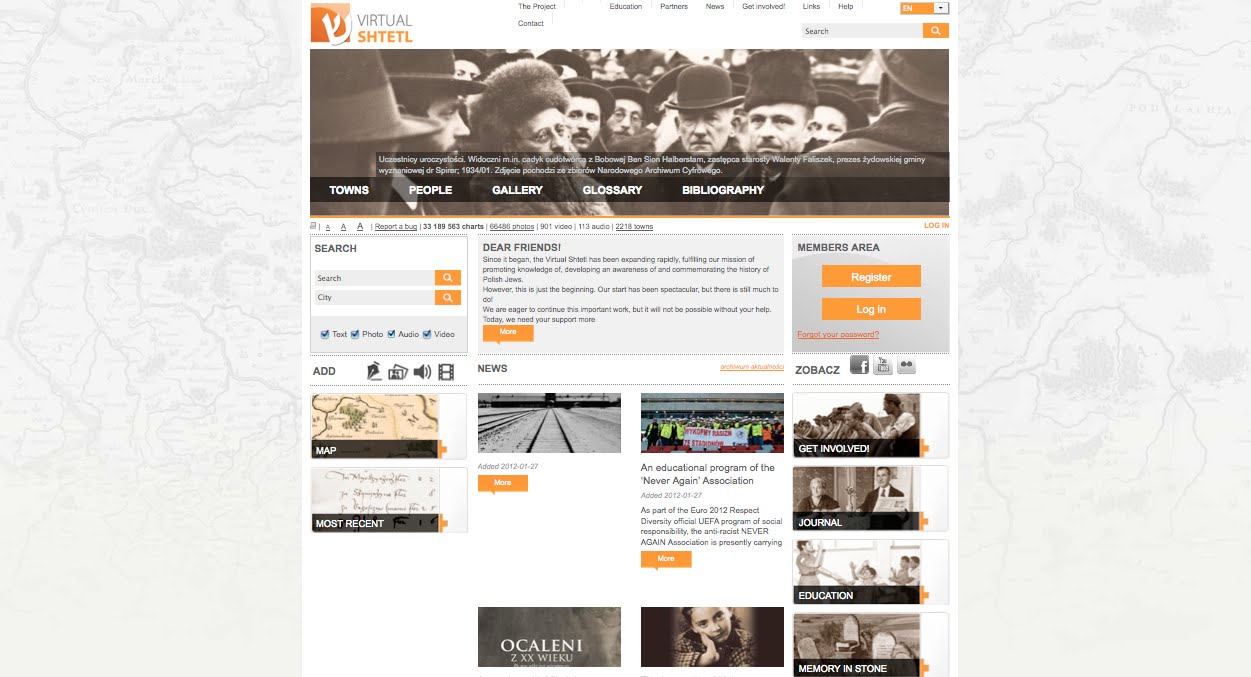
The Virtual Shtetl Portal project (Portal Wirtualny Sztetl, http://www.sztetl.org.pl) is an initiative of the Museum of the History of Polish Jews (Muzeum Historii Żydów Polskich) that was first launched online in June of 2009. The Virtual Shtetl chronicles the history of Polish Jews by providing information about the small towns and big cities where for centuries Jews, Poles and other minorities lived together. The project is constantly growing and improving with the addition of new entries by participating users. Under the guidance of the Museum of the History of Polish Jews, online visitors are helping to create an interactive database of information about Jewish communities from over 2,200 towns across Poland. After its first year, there were more than 40,000 photos and 500 films. As of today there are more than 65,000 photos, 900 films and these numbers are continuing to grow.
From September of 2008 to the launching of the site, I conducted an internship at the Museum and my main responsibility was to assist with the creation of the English version of the site. The major task was to contact volunteers and professional translators who could help to translate hundreds of historical texts written in Polish to English. But more importantly, during this internship, I became not only familiar with the textual content of the project but also I observed and participated in the social network that makes the Virtual Shtetl possible. When the project was officially launched and my internship drew to a close, hundreds of people from across the world were sending their feedback and uploading their own materials to the site. The network of volunteers working on the Virtual Shtetl has expanded since then and the website’s user base has grown considerably to well over 1,500 registered users as of January 2012.
I chose to examine these encounters from a qualitative and cultural theory perspective because of my training in the field of sociology and my introduction to one of the early contributors to the field of memory studies, anthropologist Clifford Geertz (1973). When expanding upon a semiotic approach to the theories of culture, Geertz began to theorize cultures as “webs of significance” that are “spun” by humans. Paradoxically, humans also end up being “suspended” by them (Geertz, 5). I came to understand over the course of my studies that the museum is such a web and that as the visitor, the curator, the volunteer and the scholar, we are all “suspended” in those webs.
The concept of memoryscape serves as an entry point for interpreting the Virtual Shtetl Portal of the Museum of the History of Polish Jews, the memories it sustains and contests, and its stated and less explicit social purpose. A museum itself is a memoryscape, a portal through which societies remember. The Virtual Shtetl Portal is more than a multimedia exhibition that provides a new way of experiencing a museum. It is a place of concentrated cultural practice where public history is being rewritten, where individuals become guardians of historical memory, where the public is empowered by a passion for the subject and the availability of an Internet connection, and where memories and identities are constructed and negotiated.
Read the rest of the paper here: Museum as Memoryscape: The Virtual Shtetl Portal of the Museum of the History of Polish Jews | museumsandtheweb.com
Sunday, April 8, 2012
Pauline Sliwinski Writes About the The Virtual Shtetl Portal of the Museum of the History of Polish Jews
Saturday, March 10, 2012
Poland: Prayer house in Kielce to be Rescued
I'm cross posting this story from Jewish Heritage Europe the new go-to site for information about Jewish heritage sites in Europe. I helped begin and edit this site about six years ago but it fell into stagnation. The Rothschild Foundation and journalist, author and blogger Ruth Ellen Gruber have revived and remade it into something much for appealing - and up-to-date. cehck out the entrie site and subscribe to the Facebook link, too.
Poland — Prayer house in Kielce to be rescued
A dilapidated small Jewish prayer house in the town of Kielce is to be moved from its current position in the back yard of a tenement house to nearby the Jewish cemetery in order to rescue it from falling into total disrepair and to enable development of the tenement site.
A report in a local Kielce newspaper, and quoted by Virtual Shtetl, said that the 54-square-meter private prayer house was built in 1922 at 3 Slowackiego by a local entrepreneur named Herszel Zagajski, who owned a limestone plant.
Monday, October 24, 2011
Poland: Auschwitz’s future secure, preservationists worry about ‘forgotten’ Nazi camps
By Ruth Ellen Gruber · October 12, 2011
ROME (JTA) -- Auschwitz, the most notorious camp in the Nazi killing machine, may soon claim success in its campaign to preserve the legacy of the Holocaust.
The foundation supporting the site in southern Poland has attracted tens of millions of dollars from donor countries, and the camp’s barracks and other buildings seem set to be preserved for decades to come. The museum memorial at the former Nazi death camp attracts more than 1 million visitors per year.
Some fear, however, that the concentration of resources and attention on Auschwitz could overshadow other preservation efforts and threaten the integrity or even the existence of the memorials and museums at lesser-known camps and Holocaust sites in Poland.
"Because Auschwitz is treated as the symbol of the Holocaust and the whole world is supporting only this museum, everybody in Poland, including the government, seems to think that this is enough," said historian Robert Kuwalek, a curator at the state-run Museum at Majdanek, the Nazi concentration camp and killing center near Lublin in eastern Poland. "The problem is deeper because it is the lack of basic knowledge that the Holocaust happened in forgotten sites like Belzec, Sobibor, Treblinka, Majdanek and Chelmno.”
Belzec, Sobibor and Treblinka were the three killing centers of the so-called Operation Reinhard plan to murder 2 million Polish Jews in 1942 and 1943. During that operation, Kuwalek said, "more people were killed in a shorter time than in Auschwitz-Birkenau during the whole period that that camp functioned."
Despite their importance in the history of the Holocaust, these and other sites -- such as the forced labor camps at Stuffhof and Gross-Rosen -- are overlooked by the vast majority of visitors who want to learn about the Holocaust or pay homage to its victims firsthand. All are marked by memorials or even museums. But some are located in remote parts of the country, and most are in serious need of upkeep and preservation.
Read the entire article here.
Monday, September 12, 2011
Poland: Radoszyce Jewish Cemetery Has New Fence and Gate


Radoszyce, Poland. New Wall and gate at Jewish cemetery. Photos courtesy of The Foundation for the Preservation of Jewish Heritage in PolandPoland: Radoszyce Jewish Cemetery Has New Fence and Gate
(ISJM) The Foundation for the Preservation of Jewish Heritage in Poland reports that in 2010-2011 it has built a wall and gate surrounding the Jewish cemetery in Radoszyce, and the access road to the cemetery was renovated. The works were carried out in cooperation with the local Forest Authority (Nadlesnictwo Ruda Maleniecka). Funds were raised by the descendants of Radoszyce Jews from Israel and the USA.
The Jewish cemetery in Radoszyce was established in the 18th century. The grave of Rabbi Issachar Ber Baron, Tzaddik of Radoszyce and disciple of the Seer from Lublin, is located on the cemetery grounds. His ohel is annually visited by his disciples.
Thursday, May 19, 2011
Conference: Mikveh: Space, Function, Law and Motive in Wroclaw, Poland.
Cologne, Germany. Mikveh. Parts of the mikveh date at least to the 9th century. Most of the impressive structure visible today was rebuilt during the Romanesque period. Photo: Samuel Gruber 2007.
Mikveh. Mss. illustration. German, c. 1428. Hamburg Staats und Universitatsbibliothek, Codex hebr 37 folio 79, verso, dtl. This is one of the earliest (the earliest?) known representation of a mikveh.Conference: Mikveh: Space, Function, Law and Motive in Wroclaw, Poland.
The 8th Wroclaw Conference in Jewish Studies is devoted to the them Mikveh: Space, Function, Law and Motive and will take place on May 25th-26th, 2011.
The conference is organized by the Jewish Studies Department of the Wroclaw University . The aim of the conference is to initiate interdisciplinary studies on the mikvah understood as a cultural and architectural space, connected with the tradition as well as the religious and state law. For more information please visit the website of the Jewish Studies Department of the Wroclaw University http://www.judaistyka.uni.wroc.pl/judaistyka
Boskovice, Czech Rep. Mikveh in house basement across from synagogue. Photo: Samuel Gruber (2004)
Cleveland, Ohio (USA). Former mikveh, Morrison Ave. now Morrison Ave. Missionary Baptist Church, built 1925. Photo: Samuel Gruber (1997).The conference language is Polish. Here is the schedule.
VIII Wrocławska Konferencja Judaistyczna
Mykwa – przestrzeń, funkcja, prawo i motyw
25 V 2011 (Instytut Filologii Polskiej, pl Nankiera 15, sala Nehringa)
9.45-10.45 otwarcie konferencji,
słowo wstępne:
Mariola Apanel (Urząd Miasta Wrocławia);
Rabin Icchak Rapoport (Gmina Wyznaniowa Żydowska we Wrocławiu): Mykwa według halachy (prawa żydowskiego i haszkafy (ideologii żydowskiej)
I sesja ( prowadząca Joanna Lisek)
11.00-11.30 Marta Kowalska (Uniwersytet Wrocławski): Rytualne łaźnie żydowskie na przestrzeni wieków
11.30-12.00 Bartłomiej Stawiarski (Uniwersytet Wrocławski): Mykwy aszkenazyjskie w średniowieczu
12.00-12.30 Lara Lempertiene (Uniwersytet Wileński): O biednych niewiastach i białych koszulach (czystość rytualna w czasachWaadu Litewskiego)
12.30-13.00 Ignacy Einhorn (Zawodowe Studium Medyczne w Kłodzku): Uzdrawiająca moc wody – mykwa z punktu widzenia historyka medycyny
13.00-13.15 przerwa
II sesja (prowadząca Bella Szwarcman – Czarnota)
13.15-13.45 Karolina Szymaniak (Uniwersytet Jagielloński): Genderowe odczytanie motywu mykwy w literaturze jidysz
13.45-14.15 Joanna Lisek (Uniwersytet Wrocławski): Problematyka mykw w księgach pamięci
14.15-14.45 Marzena Szugiero (Instytut Historii PAN): Obraz mykwy w reportażach Wandy Melcer Czarny ląd – Warszawa
14.45-15.15 Sylwia Karolak (Uniwersytet Adama Mickiewicza): Uniwersum polskich zobowiązań – o Mykwie Piotra Rowickiego raz jeszcze
15.15-15.45 Anna Małecka: The Mikvah Project - o współczesnym doświadczeniu mykwy
15.45-17.30 przerwa obiadowa
17.30 zwiedzanie synagogi i mykwy wrocławskiej
19:00 film produkcji czeskiej Golet v udoli (1995), reż. Zeno Dostal, scenariusz na podstawie powieści Ivana Olbrachta - Jana Dudakova [Synagoga pod Białym Bocianem]
26 V 2011 (Instytut Filologii Polskiej, pl Nankiera 15, sala Nehringa)
III sesja (prowadząca Agnieszka Jagodzińska)
9.00-9.30 Marek Tuszewicki (Uniwersytet Jagielloński): Cadyk w mykwie - rytuały oczyszczające Chaima Halberstama z Nowego Sącza (1793-1876)
9.30-10.00 Anna Ciałowicz (Gmina Wyznaniowa Żydowska w Warszawie): W mykwie na sadogórskim dworze
10.00-10.30 Piotr Grącikowski (Uniwersytet Wrocławski): Isze, nidde, mikwe - wierzenia, zwyczaje, przesądy ludu żydowskiego związane z menstruacją. Refleksje nad nienapisaną rozprawą Reginy Lilientalowej
10.30-11.00 Hanna Grzesiak (Uniwersytet Adama Mickiewicza): ”Mikwa parties” – ich przebieg i znaczenie w życiu wybranych etnicznych grup żydowskich
11.00 – 11.15 przerwa
IV sesja (prowadząca Karolina Szymaniak)
11.15-11.45 Monika Krawczyk (Fundacja Ochrony Dziedzictwa Żydowskiego): Ochrona mykw w Polsce.
11.45-12.15 Grzegorz Syrek (Pracownia Architektoniczna ASPA), Jerzy Kichler (Gmina Wyznaniowa Żydowska we Wrocławiu): Mykwa przy ulicy Włodkowica 9 we Wrocławiu - przestrzeń zapomniana – przestrzeń odzyskana
12.15-12.45 Agata Rybińska (Uniwersytet Wrocławski): Mykwa niechciana-mykwa zapomniana? - mykwa nieobecna w procesie modernizacji Żydów niemieckich w XIX wieku?
12.45-13.15 Tamara Włodarczyk (Uniwersytet Wrocławski): Przepisy prawne dotyczące mykw w Polsce w okresie dwudziestolecia międzywojennego i ich egzekwowanie na przykładzie powiatu włocławskiego
13.15-13.30 przerwa
V sesja (prowadząca Lara Lempertiene)
13.30-14.00 Bella Szwarcman-Czarnota (Stowarzyszenie „Midrasz”): Źródło Miriam w Torze i literaturze midraszowej
14.00-14.30 Aleksandra Przeździecka-Kujałowicz (Instytut Badań Literackich PAN): Nowe rytuały związane z mykwą.O feministycznym podejściu do tradycji rytualnego oczyszczenia
14.30-15.00 Anna Wiatr: Brud i ‘oko patrzącego’. Żydowski feminizm wobec przepisów ablucji kobiet
15.00-15.30 Artur Kamczycki (Uniwersytet Adama Mickiewicza): Jona w paszczy ryby. Genderowe refleksje nad wodą Zamknięcie i podsumowanie konferencji
Organizatorzy:
Zakład Studiów Żydowskich Uniwersytetu Wrocławskiego
Związek Żydowskich Gmin Wyznaniowych w RP Odział Wrocław
Patronat:
Fundacja Ochrony Dziedzictwa Żydowskiego w Polsce
e-wydawnictwo.eu Portal Publikacji Naukowych
Tuesday, May 17, 2011
Poland: Szczebrzeszyn Jewish Cemetery Restoration Project


Szczebrzeszyn, Poland. Jewish cemetery, new wall in construction. Photos courtesy of The Foundation for the Preservation of Jewish Heritage in Poland (2011) The Foundation for the Preservation of Jewish Heritage in Poland has begun the first stage of the Szczebrzeszyn Jewish cemetery restoration project. The town is just a short drive west from Zamosc. Part of a large stone wall facing the Cmentarna St. is being erected.

The Jewish cemetery in Szczebrzeszyn was established established in the 16th century and was used until the World War II. today, over 2,000 matzevot (gravestone) survive, making it one of the best preserved Jewish cemeteries within the boundaries of modern Poland.
The Foundation for the Preservation of Jewish Heritage in Poland is implementing the 1st stage of the Szczebrzeszyn Jewish cemetery restoration project. Within its framework a part of the fence facing the Cmentarna St. is being erected. The Jewish cemetery in Szczebrzeszyn was established in the 16th century and used until the World War II. Over 2,000 matzevot (gravestones) are thought to survive there, making it one of the better preserved Jewish cemeteries within the boundaries of modern Poland - but everything is relative. Most stones are toppled, and only about 400 were clearly visible before work began, the others are covered with vegetation or have fallen and been covered with years of accumulated debris. Before the restoration began the area was filled with trash. To see pictures before the restoration click here.
Walling or fencing Jewish cemeteries is usually a necessary step to ensure their long term protection and preservation. Buildings wall, however, especially around large cemeteries, is a difficult and expensive endeavor.
See more pictures of the wall construction here.
Wednesday, May 4, 2011
Publication: Ilia Rodov on "Tower-like Torah Arks"
Ilia Rodov has written an important and useful article on medieval Torah Arks, especially those tall tower types well-known from representations in many illuminated medieval manuscripts. The article, “Tower-like Torah Arks, the Tower of Strength and the Architecture of the Messianic Temple,” was recently published in the prestigious art historical Journal of the Warburg and Courtauld Institutes, LXXIII (2010), 65-98.
Rodov's article accomplishes three tasks. First, he has inventoried the number of occurrences and described the variety of known Spanish, Italian and Ashkenazi Arks that meet a broad definition of "Tower-like Torah Arks." These include examples shown in Spanish Haggadot, such as British Library Mss 2884, where the Aron ha-Kodesh is shown as a substantial fortified architectural element; to the tall ornate Gothic-style free-standing cabinet-style Arks illustrated in Northern European manuscripts.
Just bringing all these illustration together is handy. Previously, one could only find most of these illustrations in Thérèse and Mendel Metzger's (still indispensable) Jewish Life in the Middle Ages: illuminated Hebrew Manuscripts of the Thirteenth to the Sixteenth Centuries (1982). Second, Rodov places these Arks in the context of other Ark designs and also, but to a lesser extent, compares them to contemporary non-liturgical and non-Jewish furniture designs (I would have liked to see more on this, especially comparisons with furniture from churches and mosques).
Cabinet style Ark from Modena, Italy, dated 1472, that resembles a rusticated tower. Paris, Musee d'art et d'histoire du Judaisme.
The real purpose of the article, however, is found in Rodov's third task - to find meaning for the use of the tower form for synagogue Arks. He reviews how an early tradition of Ark design and meaning is linked to descriptions of the movable Ark of the Covenant described in scripture. He ultimately links the tower form to well known passage of Proverbs 18, "The name of the Lord is a tower of strength (midgal oz)," which seems a reasonable association. There is much more to his discussion of the Torah Ark as a "stronghold of faith."
I am also grateful to Prof. Rodov for including in the article the identification and translation of the inscriptions form the great four-pillar bimah structure in the 18th century synagogue of Tykocin, Poland. This is a building I refer to often, but am usually so focused on the ornate - almost Rococo - style Ark (built into the wall) that i have forgotten about the significance of the inscriptions on the bimah. Here the presence of Proverbs 18 is an indication that the "tower of strength" has migrated from the place where the Torah is stored to where it is read. See this "bimah-support" structure as a "tower of strength" is natural, since it not only symbolically supports the synagogue, but actually plays an important role in the physical support of the vaults and roof. Rodov refers to the identification and reconstruction of the Tykocin inscriptions in the 1982 Polish article by A. Pakentreger in the Bulletin of the Jewish Historical Institute of Warsaw. Four inscriptions on the bimah cite biblical references to towers (Song of songs 8, Proverbs 18, Song of Songs 4, and Psalms 18).
Although I have some reservations about some minor points and conjectures in this article, these are topics that cannot be resolved and speculation is welcome. Rodov's linkage of the Ark to the rest of synagogue decorative programs and painted inscriptions is very important (and his colleague at Bar-Ilan University Bracha Yaniv is leading the way in examining the extensive wall inscriptions in Polish synagogues). The time is also right to link the manuscript and iconographic tradition to new archaeological finds, and also to renew and further the consideration of medieval Judaica to make view it in both its Jewish context, but also in its European (or north African, or Asian) cultural context.
I will add this article to the reading list for my art and architecture of the synagogue class. Surprisingly, there are relatively few articles the investigate in details the history, design and meaning of the small number of essential synagogue furnishings and decorations.
In English, I refer readers to Bezalel Narkiss, "The Heikhal, Minah, and Teivah in Sephardi Synagogues," Jewish Art, 18 (1992), 30-47, which especially explores the use of a special room for the Aron in Spanish and Sephardi synagogues.
On the bimah, and for something more contemporary, I recommend "The Architecture of the Bimah in American Synagogues: Framing the Ritual" by Lee Shai Weissbach in American Jewish History, 91: 1, (March 2003), pp. 29-51.
Thursday, April 28, 2011
Poland: Synagogue Restorations Garner Awards
Ostrow Wielkopolski, Poland. Former synagogue restored as a performance hall. Photo: Wikipedia Commons.Poland: Synagogue Restorations Garner Awards
The Jewish Telegraphic Agency reports that awards have been given for the recent restorations of two historic synagogues.
According too JTA: "The mainly European Union-funded restoration of the twin-towered synagogue in Ostrow Wielkopolski in south-central Poland was awarded the top prize in the fourth edition of the Facade of the Year contest."
The former "new" synagogue of Ostrow Wielkopolski, was built in the late 1850s, designed by the German-Jewish architect Moritz Lande and will be used as a cultural venue. I don't know much about Lande (1829-1888) but as one of the first generation of German-Jewish architects, he is certainly worthy of further study.
Earlier this month, The Foundation for the Preservation of Jewish Heritage in Poland won the 2011 Conservation Laurel for the recently completed restoration of the Renaissance synagogue in the town of Zamosc, of which I have previously written.
Monday, March 28, 2011
Poland: Reopening of Restored Zamosc with Conference April 5-7, 2011


Zamosc, Poland. Synagogue after present restoration.Photos: Foundation for the Preservation of Jewish Heritage in Poland.
Poland: Reopening of Restored Zamosc with Conference April 5-7, 2011
by Samuel D. Gruber
The restored Renaissance synagogue in Zamosc, one of the finest surviving synagogue buildings in Poland, will reopen on April 5th in conjunction with the conference “History and Culture of the Jews of Zamosc and the Zamosc Region.” The synagogue, unlike the Jews of Zamosc, survived the Holocaust and was used as a public library during much of Poland's Communist period. Unlike many other Jewish communal and religious buildings transformed for new use after World War II, the Zamosc synagogue retained many original features, including its built-in masonry and plastic Aron-ha kodesh (Ark) frame. The building was long recognized as a polish architectural monument and so a wealth of photographic and descriptive information from before 1939 survives informing us about the history, art and architecture of the building.


Zamosc, Poland. Synagogue interior during interwar years from Loukomski, Jewish Art in European Synagogues.

This process begins this week with the conference that is co-organized by the Foundation for the Preservation of Jewish Heritage in Poland and the Polish-Jewish Literature Studies of the John Paul II Catholic University of Lublin. The program of the conference which is in Polish and thus (appropriately) directed to a Polish audience can be seen here.
No doubt, in the future, there will be other meetings, symposia and conferences international in scope.
The synagogue has been restored by the Foundation for the Preservation of Jewish Heritage in Poland within the framework of the project “Revitalization of the Renaissance synagogue in Zamosc for the needs of the Chassidic Route and the local community”. The project received a grant from Iceland, Liechtenstein and Norway through the EEA Financial Mechanism and the Norwegian Financial Mechanism. The restoration of the synagogue is part of the Foundation's broad program of care for otherwise orphaned Jewish historic sites, including its designation as a hub for the "Chassidic Route". Ironically, as is made clear in the text of the informative and lavishly illustrated brochure: “Revitalization of the Renaissance synagogue in Zamosc for the needs of the Chassidic Route and the local community” , Zamosc was never a ccenter of Hasidism. It is really an opportunity to make the point that there was a widespread Jewish presence before and during the Hasidic period that had its own roots and development, and is, i think, much more relevant for defining a Jewish role in the modern world.
I quote from the brochure:
In Poland in the second half of the 18th c. Unlike the smaller communities surrounding Zamość, where Chassidism found many supporters, the capital of the Entail became a significant anti-Chassidic center. Not coincidentally, it was the hometown of Rabbi Ezriel Halevi Horowitz, a major critic of Chassidism and opponent of Rabbi Jacob Isaac Horowitz, known as “The Seer of Lublin” – the famous leader of the Lublin Chassidim. In the first half of the 19th c., there were only two small Chassidic groups in Zamość, consisting of followers of the Tzadik of Góra Kalwaria and the Tzadik of Bełz.Activities at the restored synagogue will also involve local partner the Artistic Exhibitions Agency, the Fine Arts High School, the Karol Namyslowski Symphonic Orchestra, the Zamość University of Management and Administration and the Catholic University of Lublin as well as the Jewish Community of Trondheim, Norway.http://www.blogger.com/img/blank.gif
The community’s rejection of Chassidism was likely due to the attitude of its traditional elite and well-educated rabbis, one of whom was Rabbi Israel Ben Moshe Halevi Zamość. A philosopher and mathematician, he became well-known throughout Europe, and was notably the teacher of Moses Mendelssohn, the famous thinker and precursor of the Haskalah. The Haskalah (Hebrew for “Enlightenment”) was a pan-European movement which evolved in the Jewish circles of Western Europe. Its proponents called for the renouncement of isolationism and the involvement of Jews in the social and political life of the countries they inhabited. At the end of the 18th century, Zamość became one of the most important centers of the Haskalah in the region.
The synagogue will also be available for religious services. Opening hours: beginning with April 8th, 2011 the "Synagogue" Center will be open from Tuesday to Sunday, from 10.00 am to 6.00 pm.
The Holocaust in Zamosc
The fate of Zamosc's Jews in the Holocaust, which will be the main subject of one day of the conferecne on April 7, is briefly described by Stefan Krakowski in the Encyclopedia Judaica:
After a few days of heavy bombardment, which especially damaged the Jewish quarter, the German army entered Zamosc on Sept. 14, 1939. Immediately after capturing the city, the Germans organized a series of pogroms, motivated in part by the desire to loot Jewish property. On Sept. 26, 1939, the Germans left Zamosc and the Soviet army entered, but handed the city back to the Germans two weeks later, in accordance with the new Soviet-German demarcation line. About 5,000 Jews left the city at the time that the Soviet army withdrew. The remaining Jewish population suffered Nazi brutality and persecutions, like the rest of the Jews throughout Lublin province.
In October 1939 the Germans selected a *Judenrat and forced it to pay a "contribution" of 100,000 zlotys ($20,000) and the daily delivery of 250 Jews for hard labor. In December 1939 several hundred Jews expelled from *Lodz, Kalo, and *Wloclawek in western Poland were settled in Zamosc. Early in the spring of 1941 an open ghetto was established around Hrubieszowska Street, and the first deportation from Zamosc took place on April 11, 1942 (on the eve of Passover). The entire Jewish population was ordered to gather in the city's market, whereupon gunfire was directed at the crowd killing hundreds on the spot. About 3,000 Jews were forced to board waiting trains which took them to *Belzec death camp. From May 1 to 3, 1942, about 2,100 Jews from *Dortmund, Germany, and from Czechoslovakia were taken to Zamosc. Almost all of them were deported to Belzec on May 27 and murdered. The third mass deportation started on Oct. 16, 1942. All Jews were again ordered to gather in the city's market, and afterward were driven to *Izbica, some 15½ mi. (25 km.) from Zamosc. Many were shot on the way, and the rest, after a short stay in Izbica, were deported to Belzec and murdered. In this deportation the Jews offered passive resistance and hundreds went into hiding in prepared shelters. The Germans brought in Polish firemen to open the shelters by destroying the walls and removing other obstacles. Several hundred Jews were discovered in hiding and imprisoned for eight days in the city's cinema hall without food or water; then all those who were still alive were brought to the Jewish cemetery and executed.
A few hundred Jews fled to the forests. Most of them crossed the Bug River, made contact with Soviet guerrillas in the Polesie forest, and joined various local partisan groups. After the war some 300 Jews settled in Zamosc (270 from the Soviet Union, and 30 survivors of the Holocaust in Zamosc), but after a short stay they all left Poland.
Thursday, January 20, 2011
Poland: New Booklet About Lancut
Lancut,Poland. Above: Synagogue (restored), Below: Lubomirska/Patocki Palace near the synagogue. Photos: Samuel D. Gruber (1993)
In November 2010 the Foundation for the Preservation of Jewish Heritage in Poland released the English language version of the booklet 'Chassidic Route. Lancut', part of the organization's ongoing series of publications documenting the properties under its care, and the histories associated with those places. Together these sites have been linked as the Chassidic Route project, though often the Jewish history of specific places predates the rise and success of Hasidism, and includes non-Hasidic 18th-20th century components. Many of these places still have imposing remains of central synagogues - usually used by the entire community. The smaller shtibls and shuls where often the daily activity of Hasidic religious communities took place are long gone.
So far the Foundation has published brochures about Chelm, Jaroslaw, Krasnik, Lesko, Lezajsk, Ropczyce, Rymanow, Sanok, Ustrzyki Dolne and Zamosc. They are all available in Polish and in English in online versions and hard print copies. Online versions can be downloaded from the "About Us" and "Heritage" sections, and can also be found at POLIN - Polish Jews Heritage web portal at www.polin.org.pl.
Lancut is one of the most impressive remaining Polish synagogues and it is also one of the best preserved, having successfully survived demolition attempts by both Nazis and Communists. The survival of the building is due to the foresight and courage of just a few individuals. The interior is remarkable for its fine central bimah (of the bimah-support" type), its womens' gallery above the entrance and opposite the Ark wall, and its exceptional and much discussed symbolic painted wall decoration.
After the fall of Communism restoration and care for the building became more popular. I first visited the synagogue in 1990, and I post some previously unpublished photos of the restoration of the building underway at that time.


Like many important Jewish sites the synagogue was recognized as an architectural and artistic site of historic significance in the late 19th century, and was first restored in 1896 and again in 1909-10. During German occupation of Poland, the Germans attempted to set the synagogue on fire. The thick masonry wall survived, but the wooden women’s gallery, window frames and interior furnishings were destroyed. The fire was put out following the intercession of the local noble Alfred Antoni Potocki, who made an appeal to the German authorities. After the liquidation of the Łańcut ghetto, the Nazis turned the synagogue into a grain storehouse, and it was used as a warehouse until 1956 when the Communist-era the Town National Council moved to demolish the building.
This plan was courageously protested by Dr Władysław Balicki, who forced the council to withdraw its decision. Dr Balicki, along with the head of the Cultural Department of the National Council in Rzeszów, Jan Mincal, then allocated a fairly large sum of money for the renovation of the synagogue and organized an exhibition of Judaica inside it, a rare occurrence in Poland at that time. From 1973 on the synagogue was maintained by the Łańcut Castle Museum.
The building underwent major renovations in the 1980s and 1990s. Since 2009, it has been the property of the Foundation for the Preservation of Jewish Heritage in Poland.
There are also two Jewish cemeteries in Łańcut: the old and the new. The first reference to the old cemetery, located in today’s Moniuszki St, dates back to 1671, but early all matzevot were removed and destroyed by the Germans during World War II. The cemetery is still however visited by Jews from all over the world, who pay tribute at the ohelot of Tzadik Naft ali Tzvi Horowitz of Ropczyce and Tzadik Eleazar Shapiro.
The new cemetery was founded around 1860 in today’s Traugutta St. During the war, all gravestones were removed from it by the Germans. A memorial plaque commemorating the site of the execution of Łańcut Jews in 1941-44 is installed on the site. There is also a surviving mikvah at Ottona z Pilczy St, built in 1908-10.
Additional information about the Jewish history of Lancut can be found in the booklet.
Tuesday, December 28, 2010
Poland: New Director at Krakow's Galicia Jewish Museum


Poland: New Director at Krakow's Galicia Jewish Museum
Nowakowski will replace Kate Craddy who has returned to England, to take up an appointment at the Barber Institute of Fine Arts in Birmingham. Craddy herself became director after the death in 2007 of the museum's founder, the British photographer Chris Schwarz. The museum's core exhibition is formed by Chris's photographs of Jewish heritage sites, taken mainly in the 1990s -- they also form the basis for the book Recovering Traces of Memory, with text by Jonathan Webber.
I congratulate Kate on all she has achieved at the museum, and wish Jakub all the best in his new position.
Nowakowski has an MA in History from the Department of Jewish Studies at the Jagiellonian University, as well as a postgraduate diploma in Management and Marketing from the Kraków School of Economics and Computer Science. He also holds a Tour Leader’s License from the City of Kraków.


In addition to its permanent photographic exhibition, the museum hosts traveling exhibitions about history and art, and also has one of Poland's best Jewish book stores and gift shops, and a hospitable cafe that provides a good rest and meeting place in Kazimierz. My family was pleased to donate one of my mother's (Shirley Moskowitz) monoprints from her Polish synagogue series to the museum in 2009, based on her visits to ruined synagogues in 1993. The wntire series had previously been exhibited at the museum.
The Galicia Jewish Museum employs over 20 full- and part-time staff, in Museum Operations; Education and Research; Projects and Publications; External Relations and Communications; and Finances and Administration. New Museum Director Nowakowski is supported by an active Board of Directors in Poland and a Board of Trustees in the UK, led by Chairman Prof. Jonathan Webber (UNESCO Chair of Jewish and Interfaith Studies, University of Birmingham).
Friday, October 8, 2010
Poland: New Memorial with Old Gravestones Erected at Radom Jewish Cemetery


Poland: New Memorial with Old Gravestones Erected at Radom Jewish Cemetery
(ISJM) The Foundation for the Preservation of Jewish Heritage in Poland has announced the upcoming dedication of a new memorial monument at the Jewish cemetery at the central Polish town of Radom. The monument, erected on the cemetery is a raised lapidarium incorporating many of the gravestones scattered on the site and found in other locations. The ceremonial unveiling is planned for November 8, 2010.
The memorial is being built within the framework of the "Tikkun - Repair" project, created by the Polish and Israeli Prison Service with the Foundation for the Preservation of Jewish Heritage in Poland as a partner.
The monument continues a tradition of "gathering of stones" begun with the erection of cemetery memorials by survivors immediately after the Shoah, and then continued in the 1980s and 1990s at places such as Kazimierz Dolny and Wyszków.
Sunday, June 27, 2010
Poland: Recovery of Matzevot from Nowy Dwór Mazowiecki and Protection of Cemetery Site


Nowy Dwor, Poland. Recovery of Jewish gravestones that had been used as the foundation for a sidewalk by the river. Photos courtesy of http://www.nowydworjewishmemorial.com Poland: Recovery of Matzevot from Nowy Dwór Mazowiecki and Protection of Cemetery Site
Beginning last year soil from the construction site of the new Jewish Museum in Warsaw has been brought to cover the many now-exposed bones which are scattered throughout the cemetery. Plans are to fence the site and then to build a memorial incorporating matzevot that have been recovered form sidewalk paving elsewhere in thew town.
Ze’ev Shaked (USA):
210-698-0313
zshaked@sbcglobal.net
David Wluka (USA):
781-784-4400
david@wlukarealestate.com
Yosef Kieliszek (Israel)
(972) 3-503-2461
Keliszak@zahav.net.il
Tuesday, June 22, 2010
Poland: Two Jewish Cemeteries and One Monument Vandalized
(ISJM) The Foundation for the Preservation of Jewish Heritage in Poland reports several recently discovered acts of destructive vandalism against Jewish sites. These are the only details we have atthe moment:
The a section of the fence around the Jewish cemetery in Gdansk (a site previously attacked several times)was seriously damaged.
Jewish gravestones at the Jewish cemetery in Debrzno have been overturned and partially destroyed by unknown attackers. The cemetery was recently cleaned up by the pupils of the Youth Correctional Facility in Debrzno.
Lastly (we hope), The monument at the Jewish cemetery in Suwalki was also vandalized. This same monument was also attacked in 2007.
Monday, June 14, 2010
Poland asks prisoners to care for Jewish cemeteries
(ISJM) Here is a link to a BBC video report about prisoners in Poland providing labor to help maintain Jewish cemeteries.
This may sound a little odd, but remember that in America prisoners routinely are used for roadwork and other public works projects. It is a very old tradition. The bitter irony of course is that in many cases Nazi prisoners - often Jews themselves - were used to destroy Jewish cemeteries by uprooting gravestones during the years of the Holocaust. It should also be noted that many other groups in Poland - including youth groups, scout groups, and church groups carry out cleaning work at Jewish cemeteries.
Wednesday, 9 June 2010
Polish prisoners are helping to clean up some of the country's neglected Jewish cemeteries. Before World War II the graveyards were taken care of by Europe's largest Jewish commmunity. But 90% of Poland's Jews were murdered by the Nazis, and the population now numbers only several thousand.
Adam Easton reports from Warsaw.
(click on link below for video report)
http://news.bbc.co.uk/2/hi/world/europe/10271705.stm
Friday, May 28, 2010
Restitution: US Senator Criticizes Poland on Property Restitution
Polskie Radio has reported that head of the Helsinki Commission for the United States Congress, Senator Ben Cardin, has criticized Poland for delaying the process of dealing with the restitution of Jewish property confiscated during and after WW II.
Read the full article here.
According to the article:
During the session of the Helsinki Commission in Washington, Senator Ben Cardin indicated Poland and Lithuania as the two countries which have done
least to solve the problem. “Successive Polish governments promised that the nissue of compensation will be dealt with. None has done anything about it,” he said.
In March 2001, the Polish parliament approved a law for the restitution of private property, though the right to file a claim was limited to nthose with Polish citizenship as of December 31, 1999. The law was subsequently vetoed by the President of Poland. The Terezin Declaration, a nonbinding set of guiding principles aimed at faster, more open and transparent restitution of art, private and communal property taken by force or under duress during the Holocaust, was approved at the Prague Holocaust Era Assets Conference in June last year. Poland was a signature to the non-binding agreement.
Senator Cardin added he was aware that due to the relocation of borders and massive resettlements of people following the war, property restitution in Poland is a complicated issue. “Solving of the problem is difficult but not impossible” he added.
Friday, May 7, 2010
Poland: White Stork Synagogue of Wroclaw Rededication Ceremonies all this Week
Years of work culminate this week with the formal rededication of the historic White Stork Synagogue in Wroclaw, Poland. I have written about this synagogue, its history and the resotration project before. According to the JTA "Events through May 9... include an inaugural ceremony, concerts, art exhibits, guided tours, religious services and an international conference on Jewish life in the city."
Read more here.
http://www.jta.org/news/
Thursday, March 11, 2010
Poland: Abandoned Jewish Cemetery of Przemysl Returned to Jewish Ownership
(ISJM) Last month (Feb 23) Michael Freund reported in the Jerusalem Post that the long abandoned and neglected "Old" Jewish cemetery of Przemsyl,has been restituted to the ownership of the foundation for the Preservation of Jewish Heritage in Poland (FODZ). The site on is still marked by an impressive stone entrance gate. Only a few gravestones from the cemetery have survived (photos) gravestones on the site which dates to the 16th century, it is believed that the burials remain intact, and the Foundation (FODZ) plans to clean the site and protect it. The carved gravestones were removed by the German occupiers of the town during the Second World War. To date, none have been located, but ti is possible that many were reused nearby for pavements and building material and some may be still be found. A second of "New" cemetery still survives in the town. This has hundreds of surviving stones, including post-1945 burials.
In June 2009, Freund participated in the dedication of a memorial plaque on the former Przemysl New Synagogue (1910), known as the Scheinbach synagogue and now used as a public library. At that time he challenged city officials to return the former cemetery.
Przemsyl, which was once a central Polish town, but is now located near the border of Ukraine, was once at town with a thriving pre-Holocaust Jewish population (estimated at 30% of the total). As the cemetery of a major town it also served, according the FODZ researchers nearby communities of Jaroslav, Pruchnik, Kanczuga and Dynow.
the following information comes from the websites of the Cemetery project of the International Jewish Genealogical Society.
OLD CEMETERY: The Jewish homes were founded outside the walls of the city on the road to Nehrybki between the current ul Wandy and ul Rakoczy. This old cemetery was documented first in 1568 in the privilege issued by King Sigismund Augustus and again in 1571 regarding damage. Since in 1638 King Władysław IV gave the Jews the privilege allowing them to use "the synagogue cemetery: and indicating that the cemetery also served the surrounding cities including Jarosławia, Pruchnik, Kańczugi, and Dynów. Five years later the cemetery area was enlarged. Land also was purchased in 1765. An 18th century fence shows in archival records. During WWII, this cemetery was destroyed, its stone gravestones used for making roads and streets including the barracks on ul Mickiewicz. Without care cemetery slipped into oblivion. Before WWII, archival photographs in the Muzeum Narodowego Ziemi Przemyskiej show that the cemetery had a large group of graves from the 16th century, the oldest being that of a woman named Gitel bat Gershon, who died on September 23, 1574 (8 tiszri 5335). In the mid-19th century, the cemetery occupied two hectares and was almost completely filled. The Jewish Community in Przemysl needed a new cemetery.


