Showing posts with label photographs. Show all posts

Tuesday, December 28, 2010

Poland: New Director at Krakow's Galicia Jewish Museum


Krakow, Poland. Galicia Jewish Museum. All photos Samuel D. Gruber, 2008.

Poland: New Director at Krakow's Galicia Jewish Museum

The Galicia Jewish Museum founded in April 2004 in Krakow's Jewish quarter, Kazimierz, has appointed a new director, Kazimierz-born Jakub Nowakowski. Nowakowski has worked at the museum since 2005, most recently as its education direction. The museum is located in a former mill building (see photo above) on the edge of Kazimierz, the former suburb to Krakow's Old Town where Jews were permitted to live, and where a vibrant Jewish culture developed over a period of five centuries. The mission of the museum is "to challenge the stereotypes and misconceptions typically associated with the Jewish past in Poland and to educate both Poles and Jews about their own histories, whilst encouraging them to think about the future."

Nowakowski will replace Kate Craddy who has returned to England, to take up an appointment at the Barber Institute of Fine Arts in Birmingham. Craddy herself became director after the death in 2007 of the museum's founder, the British photographer Chris Schwarz. The museum's core exhibition is formed by Chris's photographs of Jewish heritage sites, taken mainly in the 1990s -- they also form the basis for the book Recovering Traces of Memory, with text by Jonathan Webber.
I congratulate Kate on all she has achieved at the museum, and wish Jakub all the best in his new position.


Nowakowski has an MA in History from the Department of Jewish Studies at the Jagiellonian University, as well as a postgraduate diploma in Management and Marketing from the Kraków School of Economics and Computer Science. He also holds a Tour Leader’s License from the City of Kraków.


In addition to its permanent photographic exhibition, the museum hosts traveling exhibitions about history and art, and also has one of Poland's best Jewish book stores and gift shops, and a hospitable cafe that provides a good rest and meeting place in Kazimierz. My family was pleased to donate one of my mother's (Shirley Moskowitz) monoprints from her Polish synagogue series to the museum in 2009, based on her visits to ruined synagogues in 1993. The wntire series had previously been exhibited at the museum.

The Galicia Jewish Museum employs over 20 full- and part-time staff, in Museum Operations; Education and Research; Projects and Publications; External Relations and Communications; and Finances and Administration. New Museum Director Nowakowski is supported by an active Board of Directors in Poland and a Board of Trustees in the UK, led by Chairman Prof. Jonathan Webber (UNESCO Chair of Jewish and Interfaith Studies, University of Birmingham).

Saturday, December 18, 2010

Photographer Vincent Giordano, Who Documented Romaniote Life, Dies at Age 58

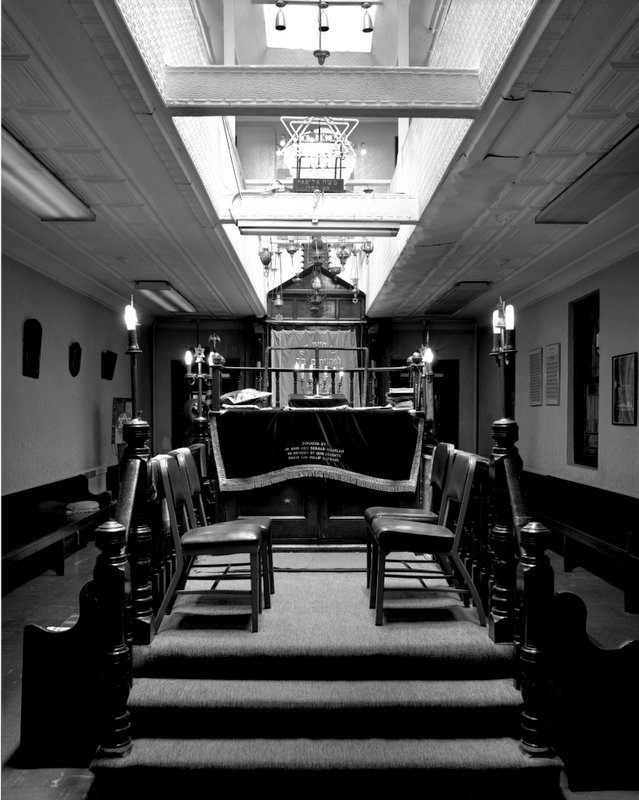
Vincent Giordano in 2005. Photo: Samuel D. Gruber

Vincent Giordano (1952-2010)

by Samuel D. Gruber

Photographer and filmmaker Vincent Giordano died on December 11, 2010. Vincent was an accomplished photographer with an artist’s eye, and a mastery of craft (especially visible in his beautifully handmade palladium prints) and the sensibility of a trained ethnographer. He was a man of warmth, humor, and modesty, but also of talent, ambition and tenacity. These were all qualities he maintained, even when in great pain, until his very last hour.

In recent years Vincent brought these talents together in an intensive investigation of the small community of Romaniote Jews in New York, centered on the synagogue of Kehila Kedosha Janina synagogue on New York’s Lower East Side. Since 2002, soon after he began work in his documentary project Before the Flame Goes Out, he has been a friend and unexpected colleague. What began by my writing a simple cover letter for a grant became a continuing collaboration, with the International Survey of Jewish Monuments serving as a sponsor for Vincent’s work.

Over a period of about six years Vincent created a remarkable series of photos of the building, and many of the people who still call it their religious and cultural home and related community events. What began as a documentation of the synagogue building and its liturgical and historical artifacts evolved into a deeper and more meaningful investigation including photos, film and audio. Vincent found that it was not enough to look at a building without knowing the things inside or to know the objects without understanding their history and use. He believed that knowledge can only come through knowing the people who made these things, and who continue to use and cherish them today. Similarly, he felt he could not see full picture of this Romaniote community without its other half: the community of Ioannina, or what survives of it in post-Holocaust Greece. So the project which at first was quite modest kept growing. And in this process I was always impressed with Vincent’s adaptability, organization skills, diplomacy, patience, tenacity and overriding belief in the integrity and meaning of the task.

Vincent forged excellent ties with the Romaniote community. His photos, which often involved long set up times and exposures, drew many of the synagogue community into his work so that many aspects of Before the Flame Goes Out were collaborative efforts with the community itself. His patience was often rewarded by the stories told by those watching, many of who subsequently became portrait subjects, and he often donated prints of his work to these new friends and the community. Photography developed into oral history that became an important part of the work. Vincent also reached out to historians and other specialists (such as myself) to expand and refine his knowledge of his subject, so that photography and oral history now link with more traditional lines of historical inquiry.

For his work on Before the Flames Goes Out Vincent received grants from the Memorial Foundation of Jewish Culture and he was a Fullbright Scholar in Greece in 2007. His talent was recognized by many generous donors who supported Before the Flame Goes Out. These included The Horace W. Goldsmith Foundation, The Carl and Lily Pforzheimer Foundation, The Lucius and Eva Eastman Fund, The Cahnman Foundation, The Rothschild Foundation, and The David and Goldie Blanksteen Fund.

Vincent received his B.A. from SUNY, Oswego where he majored in history and anthropology, tw0 disciplines he remained dedicated to in his subsequent career. He went on to study photography at C.W. Post College (Glendale, NY), the International Center of Photography, and with Arthur Leipzig. In the 1980s he worked for R/ Greenberg Associates as Head of the Animation Camera and Stills Department, during which time he won seven Clio awards for television advertising campaigns. And the GT Group in New York as head of the still photography department.

For the past 25 years Vincent worked as photographer, filmmaker and technical consultant for scores of book, film and other photo-related projects. In more recent years he took on projects for himself, and developed impressive portfolios of memorable and artistic work, most of which seemed to dwell with modes of memory. A skilled portraitist, he brought that careful steady observant eye to his photos of architecture and landscape. As a New York photographer two of the most meaningful to Vincent were Hidden New York (Rutgers University Press, 2006), for which he was a contributing photographer and remembrance, a book of portraits from September 11, 2001.

Vincent was so often behind the camera there are few photos of him. I include this one snapshot, when I caught him by surprise at Kehila Kedosha Janina back in 2005. The picture captures for me his mix of toughness and playfulness. He combined a no-nonsense attitude of getting the shot, with humor and constant enthusiasm for his subject.

Vincent will be missed by his many friends and colleagues, and especially by his loving wife Hilda and his step-children Elizabeth and Thomas, and grandchildren, Matthew, Analisa and Rachel. A memorial gathering takes place today in New york at the Museum of Biblical Art where Vincent’s work was exhibited in 2008. A celebration of his life and art will also be scheduled in 2011. I will shortly post a gallery of some of Vincent's photos. You can also see images on the website http://www.romaniotelegacy.org/

Here are four photos which show a mix of his work with 8 x 10 negatives, and two shots from Greece done "on the fly" with a 35mm camera. These are low-res digital copies. The originals are especially gorgeous.


Monday, September 20, 2010

Exhibition: Looking Back, Jewish Life in Morocco

Meknes, Morocco. Bet Ha-Knesset Rabbi Y'hoshua Berdugo, built 1927. Photo: Isaiah Wyner (Isaiah Wyner/WMF 1989)

Looking Back: Jewish Life in Morocco

An exhibition: "Looking Back: Jewish Life in Morocco," will have its Opening Program and Reception on October 14, 2010 at the Center for Jewish History in New York City. Produced by the American Sephardi Federation, the exhibition will focus on the history of the Jewish people and Jewish life, as it once was in Morocco. The event will launch a year-long series of programs on "2,000 Years of Jewish Life in Morocco: An Epic Journey" including an international Symposium, a concert, and individual lectures. Dr. Norman A. Stillman, the Schusterman-Josey Professor and Chair of Judaic History at the University of Oklahoma, will present the keynote address.

For more information contact: exhibition curator Shelomo Alfassa at 001 917-606-8262

Jews have lived in what is today Morocco for millenia, and Jewish culture has been influenced by the Berbers, the Spanish, the Arabs and the French. This exhibition will provide an overview demonstrating the presence and flourishing of Jews in the ancient and modern Kingdom of Morocco.

According to the organizers: "The exhibition will be presented through the implementation of artistically designed textual displays, documents, pull quotes, non-photo images (e.g. lithographs and engravings), historic photos, captions, replications of historic documents, and other visuals which demonstrate the life of the Jews living throughout this North African country."

ASF holds the photo archive of the documentary expedition carried out in 1990 for the World Monuments Fund by Joel Zack and Isaiah Wyner. I remember fondly the great assistance given to that project by the late Prof. Yedida Stillman, wife of Norman Stillman. I hope that the exhibition is imbued with Yedida's joyous spirit.

Wednesday, December 9, 2009

Romania: More on Piatra Neant Synagogue Restoration

Piatra Neamt, Romania. Interior of Cathedral or Baal Shem Tov Synagogue (before restoration). Photo by Janos Kalmar, published in Synagogues by Samuel Gruber (NY: Metrobooks, 1999)


Romania: More on Piatra Neant Synagogue Restoration
by Samuel D. Gruber

As a follow up to Monday's post about the completed restoration of the 19th century Baal Shem Tov Synagogue in Piatra Neamt, Romania, I post the above photo by esteemed architectural photographer Janos Kalmar (Kalmar photographed many of the synagogues of Central Europe in 1990s - these photos really needed to collated and published as a group).

Also, I have learned that restoration of the synagogue was entirely organized by the Romanian Ministry of Culture, which allocated approximately 300,000 euro of government funds to the project from 19907 through 2009. The work was overseen by Romanian preservation architect Constantza Carp. The project got its start with a modest planning grant from the Jewish Heritage Program of the World Monuments Fund in 2001-2002.

Unfortunately, given the state of the Romanian economy, we are not likely to see considerable spending on Jewish monuments - or perhaps any monuments - in the near future. Still, the situation for many historic and beautiful Romanian synagogues remains severe. Private funds are need for many worthy projects. For many other sites future use is uncertain, so preservation efforts are mostly postponed. In some cases modest spending on building maintenance and security can protect them from more expensive repairs in the future.

I welcome information about individuals, foundations, businesses, government agencies and organizations that would like to help. The International Survey of Jewish Monuments can make introductions to needy projects, or Gruber Heritage Global can provide more detailed and comprehensive planning and funding information.

Monday, November 2, 2009

Publication and Video: Laszlo Regos Photographed Dohany Synagogue in Budapest

Budapest, Hungary. Dohany Street Synagogue, ceiling detail. Photo: Courtesy of Laszlo Regos.

Publication and Video: Laszlo Regos Photographed Dohany Synagogue in Budapest
by Samuel D. Gruber

(ISJM) Anniversaries are the occasion for celebration, commemoration and publications. The 150th anniversary of the Dohany Street Synagogue in Budapest is no exception, and following last months celebrations, there is a new publication of ravishing photographs of the building by Hungarian-born American photographer Laszlo Regos.

The book, published by the Hungarian publisher Alexandra, was just presented in Hungary and I have not yet seen a copy, but Laszlo has posted a beautiful video presentation of many of the images, accompanied by a sound track of Kol Nidre sung by the late Sandor Kovacs, the chief cantor of the Dohany Street Synagogue. Regos is an accomplished commercial and architectural photographer based in Detroit, Michigan. His previous book The Opera House (Pecs: Alexandra, 2006) documented the Budapest Opera House, designed by Miklos Ybl, and opened in 1884. Regos also contributed many superb photographs of American synagogues to Synagogue Architecture in America by Henry Stolzman (Images Publishing, 2006)

Laslzo has been working on the Dohany book for as long as I have known him. He told me about his commitment to photographing the building, "I gave my soul. It took me eight years to do it." Because of his emotional attachment to the building he did not approach it "just as an architectural photographer," though his skill is evident in the photographs.

For more about Regos and his work you can see my review of his 2004 New York exhibition.

This is the second recent book about the Dohany Synagogue. Rudolph Klein published a book last year. For those interested in a deeper history of the Jewish and Budapest context in which the synagogue project was conceived and realized, and the vicissitudes of the building over its 150 years, I also recommend the essential work Jewish Budapest: Monuments, Rites, History, edited by Geza Komorockzy (Budapest: Central European University, 1999)


Monday, June 15, 2009

Italy: New website about Cherasco (Piedmont) Synagogue Restoration

Italy: New Website about Cherasco (Piedmont) Synagogue Restoration
by Samuel D. Gruber


(ISJM) Ruth Ellen Gruber has posted links to a new web site of the De Benedetti-Cherasco 1547 Foundation, dedicated to the Jewish heritage of Cherasco, in northern Italy's Piedmont region, and in particular its elegant little synagogue, located in the heart of the former ghetto, which was reopened in 2006 after a full restoration. The site's photo galleries have extensive documentation of the entire restoration process, which was sponsored by the Foundation.

The Foundation will open the synagogue to the public on the following scheduled dates.

  • Sunday 7, 14, 21, 28 June 2009
  • Sunday 30 August 2009
  • Sunday 6, 13 September 2009
  • Sunday18, 25 October 2009
  • Sunday 1 November 2009
Opening hours: from 14.30 to 18.30

The 18th-century synagogue has a beautifully carved Ark and bimah, with the spiral columns typical of the region. The small synagogue is perhaps the most typical of the older synagogues in Piedmont because of its location, its approach, its articulation and decoration.


As I wrote (before the restoration) in an essay about the synagogues in Piedmont recently published in catalogue
Ebrei Piemontese: The Jews of Piedmont (New York: Yeshiva University Museum, 2008) (with beautiful photos by Alberto Falco):
[Cherasco] is one of a series of small upper-floor square-plan sanctuaries with ornate centrally placed tevahs. The Cherasco Synagogue is on the third floor of a building entered through the ghetto courtyard of the small town. From a small stair landing one enters directly into the sanctuary -- marked by a dedication plaque from Nathan and Abraham Benedetto. The inscription, dated 1797, reads "I will wash my hands with purity, I will encircle your Altar, O Most High! (Psalms 26:6). Below the inscription is a sink to allow the ritual purification before entering. On the wall to the right is the Ark, with finely carved gilded doors, upon which are inscribed the Ten Commandments. The Ark is impressive in its use of the twisted columns -- which appear in three sizes: small colonettes flanking the ark doors; slightly larger columns supporting an inscribed entablature; and large columns which flank the cabinet proper and support an ornate Baroque broken segmental pediment, in the center of which is set a small oval window, surmounted by a crown. The whole framing arrangement is similar to contemporary church altars. On the walls, instead of the common Biblical verses in Hebrew, one finds in Hebrew the names of the people who live in the ghetto
To read a previous blog entry on the restoration of the synagogue of Vercelli (Piedmont) click here.

For a panoramic view of the comparable Piedmontese synagogue of Carmangola click here.

Monday, May 11, 2009

Publication: New Book in Lithuania about Jewish "Traces."

Publication: New Book in Lithuania about Jewish "Traces."

A new book about the lost Jewish heritage has been published in Lithuania.

Sounds of silence: traces of Jewish life in Lithuania: album by Raimondas Paknys (photos), Dovid Katz (preface author and consultant), and Isaac Zibuts (project) is a memorial album dedicated to the annihilated Lithuanian Jewish communities of Lithuania. The book includes photographs of cemeteries, prayer houses, and other buildings and sites connected to Jewish life, "or more precisely, images of what remains many years after the golden age of Jewish Lithuania."

Sounds of silence [2009, 201 pages, hard cover] is published by R. Paknio leidykla. [ISBN: 9789955736271].

Sunday, May 10, 2009

Publication: Beautiful Book of Synagogue Images Published in Belarus


Publication: Beautiful Book of Synagogue Images Published in Belarus
by Samuel D. Gruber

(ISJM) Though times are tough for the former synagogues of Belarus (see recent posts about Kobrin and Luban, the legacy of synagogue architecture is not forgotten in that country. I have recently received a beautifully produced volume of high quality reproductions of historic postcards - 461 images altogether - representing several hundred views in scores of towns and cities of Eastern Europe and especially the former Soviet Union. For Belarus alone, postcards are reproduced of synagogues in Bereza-Kartuska, Bobruisk, Borisov, Brest, David-Gorodok, Derechin, Druya, Glubokoe, Gorodische, Grodno, Ivanovo, Ivye, Kletsk, Kozhan-Gorodok, Khomsk, Lida, Lumno, Minsk, Mir, Mogilev, Mstislavl, Narovlya, Nesvizh, Novaya Mysh, Novogrudok, Ozery, Orsha, Oshmyany, Pinsk, Polotsk, Pruzhany, Skidel, Slonim, Sopotskin, Stolovichi, Vitebsk, Volkovysk,Volpa, Zhlobin.


The book Synagogues: Jewish Life by Vladimir Likhodedov (Minsk: Riftur, 2007) [ISBN 978-985-6700-60-9] is both a tremendous resource and also a terrible reminder of the architectural, historic and religious legacy that has been lost through the destruction of the Soviet regime in the in the 1920s, during the Holocaust, and in the post-war Soviet era. Only a few of the buildings represented still, stand, and those are now in much-altered condition.

Still, for the most part, these postcards from the collection of Mikhail Tverdokhlebov, represent only the most scenic and monumental of synagogue buildings - those that were already seen in their time as both Jewish and local landmarks and tourist attractions. Thus, hundreds- probably thousands - of small shuls in big cities, and all the synagogues and prayer houses in smaller towns and villages remain unrecorded. The original appearance of many is lost forever - since they were never photographed at all. The Jewish Heritage Research Group in Belarus has in recent years endeavored to document those buildings still standing in Belarus, and some of their efforts can be seen on their website.


The author states that this volume is the first of a series called “Jewish Life,” of the project “Looking for Lost Values,” and that more books will come out soon to “introduce the reader to the world of Jewish History, culture and everyday routines.” We look forward to more works of this quality.


In recent years there have been several collections of synagogue and Judaica postcards. I invite readers to submit titles - I think it worthwhile to assemble a list of these publications.


Saturday, April 4, 2009

Exhibition: Tel Aviv Bauhaus Architecture on View in Munich

Exhibition: Tel Aviv Bauhaus Architecture on View in Munich

(ISJM) In conjunction with the year-long exhibition City without Jews: The Dark Side of Munich’s History (September 24, 2008 through August 30, 2009), curated by Bernhard Purin at the Jewish Museum of Munich, the Museum is also mounting several exhibits under the rubric "Places of Exile."

The second of these exhibits, a photo-essay by Israeli photographer Yigal Gawze,
Minchen ve'Tel Aviv opened on March 25, 2009 and runs through June 7, 2009. ‘Fragments of a Style’ looks at the Bauhaus architecture of Tel Aviv, celebrating its 100th anniversary in April 2009. The photos emphasis the "White City," the largest concentration of Bauhaus-inspired and other modern pre-World War II architecture in the world. According to the organizers, "At the same time ‘Minchen ve’Tel Aviv’ traces the life histories of four Jewish artists who lived and worked in Munich for many years and for whom Tel Aviv did not just became a place of exile after 1933 but also a new home."

You can download the catalog here:

Gawze's photo-essay will later be shown in Prague and Berlin.

City without Jews: The Dark Side of Munich’s History

The following rationale and description of
City Without Jews comes from the Museum website:

Throughout 2008 Munich celebrated its 850th anniversary. Such jubilees are often seen as occasions to look back on a city’s history with pride, to identify with it, and to awaken the residents’ awareness of its history. But how is a museum—whose task is to promote the history and culture of a certain section of the community—supposed to react to such a festival year, when for more than 400 years in the city’s 850-year history, it was involuntarily and often forcefully excluded from taking part?

In its contribution to the city’s anniversary, the Jewish Museum Munich has chosen to trace precisely those times during the last 850 years when Jews were not allowed to live there, when Munich was a City without Jews. At the same time, the reasons for their expulsion, persecution, and settlement prohibitions have been highlighted and the issue of the Dark Side of Munich's History broached.

The twelve exhibits, which render predominantly negative events in the city’s history visible, are complemented by video boards in the exhibition. Students at the University for Television and Film in Munich have collated statements by historians and experts in the fields of literature, politics, and cultural affairs, related to Munich’s topography and which refer to events of exclusion, persecution, and annihilation that actually happened. This allows visitors to the exhibition "City without Jews: The Dark Side of Munich’s History" to see the objects in a broader historical context while at the same time linking them to specific sites in Munich.

Curator: Bernhard Purin
Assistance: Tatjana Neef

Thursday, April 2, 2009

Synagogue360.org May Be the Best Synagogue Website Ever!

Synagogues360.org May Be the Best Synagogue Website Ever!

I've just stumbled across what may be the best synagogue website ever. Why didn't I know about this? Well, there are so many people out there doing good work that it just isn't possible to keep track of them all - and all their projects. Fortunately, when looking for some on-line photos of synagogues in Piedmont for my Syracuse University class, I hit www.synagogues360.org, an amazing collection of high quality panoramic images of more than forty synagogues around the world, taken by Louis A. Davidson of Tulsa, Oklahoma. Louis and his wife Ronnie have prepared this project, which is now housed at Beth Hatfusoth (Museum of the Diaspora) in Tel Aviv, but is available online to everyone, everywhere.

Davidson's panorama includes well-known buildings like the Spanish Synagogue in Prague and (Frank Lylod Wright's) Congregation Beth Shalom in Elkins Park, Pennsylvania, but also many lesser known but well preserved buildings, with a good number in Central Europe and Italy. Several of these are restored synagogues that I have had some connection with in past years (Pfaffenhoffen, Boskovice), so it is terrific to be able to link to the site to show off these achievements.

Looking at these panoramic images allows one to fully appreciate the architecture of these spaces, and their scale, aswell as their decoration - sometimes simple (Pfaffenhoofen) and sometimes over the top (Casale Monferrrato). As much as I like - and depend upon - the information in texts such as Carol Herselle Krinsky's now classic and still-essential Synagogues of Europe (1985) it is hard to convey the interest and real beauty of many synagogues from those dreary pictures Carol was forced to work with in 1970s and 80s when she prepared that book. Many new synagogue books use selected color photos and Paul Rocheleau and I tried to do better when we did our 20th century American Synagogue book, where our attempt through still photography was to try to recreate the spatial and visual experience of each synagogue through multiple color photographs. The idea was not to create a single iconic view - that actually might not reflect the way a user saw the building (very few people ever experience synagogues directly on axis). I think we did a pretty good job, but aesthetically Paul's photos can stand alone, and they are designed to please the viewer and also the architectural publisher who wanted (rightly so) to show of the building designs. But nothing that I know of short of visiting each building (still the best thing to do) informs the viewer about synagogue spaces like these panoramas by Louis A. Davidson.

Now, if we could only start documenting these buildings - or at least those that still function as active synagogues - in use, too. (ISJM has sponsored just such documentation by Vincent Giordano of the surviving Romaniote Synagogues in New York and Ioannina, Greece). Because the architecture only really comes alive where one sees people interacting, and one hears prayer and synagogal chant and music. Synagogues are not abstractions - religious, social or historic. They're built for a function, and even when they are elaborate in their "adornment of the commandments," they are best appreciated in use.

Congratulations Louis and Ronnie Davidson on your good work!

Thursday, January 8, 2009

Poland: Short Film on Orla Synagogue


Poland: Short Film on Orla Synagogue

Tomek Wisniewski, the indefatigable chronicler of Jewish sites in the Bialystok Region and author of several guides to Jewish history and monuments in the area has recently adapted to video. He sent one his most recent projects...a short film highlighting the wonderful architecture of the great synagogue of Orla, and the terrible neglect the synagogue has suffered for decades. On-again off-again restoration projects have preserved the building, but it has been shuttered and almost forgotten. Tomek records a recent event that opened the building and brought flocks of local residents to see its grand interior for the first time in years.

I first visited Orla in 1990 when the building was still covered scaffolding. A photo from this trip was the "teaser" for the exhibition "The Future of Jewish Monuments" that traveled the USA beginning in 1990 (photo). Sadly, while many of the other building pictured in the exhibition have subsequently been restored, Orla has been "forgotten." As Tomak makes clear, it is time to remedy that situation.

Click here for the film on Youtube

Here are some of my photos of the synagogue.


Ruth Ellen Gruber has posted the video and these comments about the synagogue at Orla:

The striking synagogue, with a distinctive scalloped facade, was originally built in the 17th century. Its sanctuary has nine bays and a vaulted ceiling, and there are still some traces of marvelous painted decoration -- vines, garlands, floral motifs, and animals.

The building dominates the little town, where before the Holocaust Jews made up nearly 80 percent of the local population.

The synagogue was listed as a cultural heritage monument before World War II. Tomek reports that when it was all but destroyed in a huge fire in 1938, the Polish government stepped into to reconstruct and restore the building.

The synagogue was reconsecrated in 1939, but then the Nazis used it as a field hospital and later turned it into a warehouse for chemical fertilizer. For decades it has stood empty and in ever-deteriorating condition.

To read Ruth's full comments click here.

Saturday, January 3, 2009

Poland: Close-up View of Monument and Matzevot at Kazimierz Dolny

Poland: Close-up View of Monument and Matzevot at Kazimierz Dolny
by Samuel D. Gruber


It has been 18 years since I first visited the New Cemetery at Kazimierz Dolny and marveled at the power and beauty of the giant monument which sits on the hillside in front of what remains of the cemetery proper, with its small number of still in situ matzevot. Returning to the site after many years this fall, I was happy and amazed to find the power and pathos of the site undiminished. Despite my having visited scores of Jewish cemeteries in the meantime, and seen dozens of Holocaust monuments (and even helped design a few), this site still resonates strongly with me.

The enormous monument - which is a kind of giant vertical lapidarium 25 meters long and 3 meters high and holding 600 fragments of Jewish gravestones - was erected in 1983-85 on the design of Polish architect Tadeusz Augustynek. I will not describe the entire project, as I have done so before, and James Young treats the monument at length in his now classic work The Texture of Memory (New Haven: Yale University Press, 1994), 199 - 203. It is enough to say that Augustynek created a giant matzevah (gravestone), with terrible crack or rift on one side, indicating the break in Jewish life, Jewish history, and the very broken nature of the Jewish cemetery and its gravestones, too. The stones used in the monument were all excavated from pavements laid during the German occupation40 years earlier. It is said that Polish workmen defied orders and placed the stones face down to protect their inscriptions. Certainly when they were dug up, the inscriptions and carved reliefs of Jewish symbols remained very clear, and some stones even retained traces of color from the original polychrome painting on the limestone.

On this recent visit, I was able to take the time to examine the individual stones. There is a limited range of symbolic compositions. For women it was common to show Sabbath candles and a hand giving charity (tzedakah). For men, there was an open bookcase indicating scholarship and piety. There are also more unusual designs, such as a dove beneath a crown. I assume, after all these years, that these epitaphs have been transcribed and translated. I will try to find out for sure. If not, my photos are clear enough to allow volunteers to do this work now.

Wednesday, December 17, 2008

Exhibition: Romania Synagogue Photos in NYC January 6-9

Exhibition: Romania Synagogue Photos in NYC January 6-9

I am happy to post the following to announce a showing of Christian Binder's Romania Synagogue photos in New York next month. Contributors who would like to see this work continued should contact me. ISJM has put together a proposal to allow Christian and Julie to keep working on this project...modest funding is needed.

-- Sam

Photo-Documentary Exhibition: "Synagogues of Southern Transylvania"
Photography: Christian Binder
Curator: Julie Dawson

Congress for Jewish Culture, 25 East 21st Street, ground floor
January 6 - 9, hours 11:00 - 4: 00 pm

Opening night January 6: Doors open at 6:00 pm, introduction and Carpathian klezmer music with Jake Schulmann-Ment and Benjy Fox-Rosen at 7:00 pm

In the wake of the Holocaust and subsequent mass migration of the vast majority of Romania's Jewish population, countless synagogues fell into various stages of disrepair and decay. This photo exhibition aims to capture the transitional stage in which Romania now finds itself. With the entrance of foreign investors and NGOs, some synagogues are being restored, turned into cultural centers or finding alternative uses. Others remain abandoned, assuming a central location in the town's center and representing an evocative, stubborn reminder of the recent and troubled past.

The questions are numerous - what will become of these buildings now that they can be used again? Will their respective towns take responsibility for their upkeep? How can they be integrated into a long-term plan for urban or rural renewal? And how can the countless still decrepit synagogues, many of significant historical or architectural value, be incorporated into a systematic and far-reaching plan to commemorate and celebrate a culture which used to play a considerable role in Romania's vibrant multi-cultural existence?

Wednesday, August 27, 2008

Romania: Photos of Transylvania Synagogues

Romania: Photos of Transylvania Synagogues Now On-Line

I recently wrote of an exhibition at the "Proetnica" interethnic festival in Sighisoara, Romania that featured an exhibit of photographs of synagogues in southern Transylvania, taken by Christian Binder and organized by Julie Dawson. Ms. Dawson and Mr. Binder have now posted many of these fine and evocative photographs at http://www.pbase.com/binderch/synagogues. The two hope this documentation project will continue. ISJM is helping to organize advisors, sponsors and partners for the project.

If readers are interested in providing financial, logistical or informational support contact me at samuelgruber@gmail.com.