Showing posts with label Romania. Show all posts

Monday, September 5, 2011

Romania: Popricani (mass-grave) Memorial at Iasi Jewish Cemetery


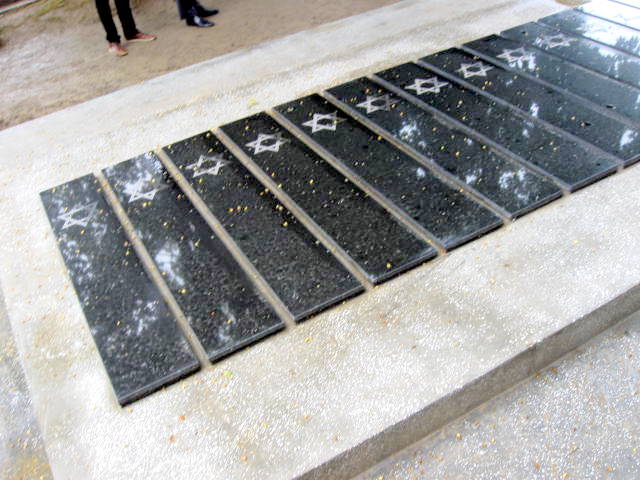
Iasi, Romania. Dedication of the New Grave and Monument to Popricani Massacre Victims in Jewish Cemetery (June, 2011). Photos courtesy of Lucia Apostal, FED-ROM

Romania: Popricani (Mass-Grave) Memorial at Iasi Cemetery Dedicated
by Samuel D. Gruber

(ISJM) Last April I wrote about the reburial in the Iasi, Romania Jewish cemetery of the remains Jewish massacre victims discovered in November 2010. In June a monument was erected to cover the grave. The inscription was composed by Romanian "Elie Wiesel" Institute for Study of Holocaust.
According to the Elie Wiesel National Institute, the victims were killed in the summer of 1941 at Popricani, close to Iasi, by the Romanian army, an ally of the Nazis during World War II. They were among more than 15,000 Jews killed in Iasi during pogroms in 1941. A Romanian historian, Adrian Cioflanca, found the site thanks to the testimonies of Romanians who had witnessed the killings. "We will continue the historical research in order to try to determine where the victims came from, whether it was from Iasi or the surrounding villages", the director of the Elie Wiesel Institute, Alexandru Florian, told AFP.
The grave is very large - 11.00 m x 2,50 meters. The cover of the grave is made concrete, cast in place, with terrazzo finishing. This large and heavy lid sits on foundation-beams cast a half meter beyond the grave boundary. On the lid are 36 slim black granite plaques, each engraved the Magen David, symbolizing the 36 unknown victims buried, all of whom were murdered by the Romanian Army. At the far end of the grave there is a tombstone clad in black granite, with the text engraved in Romanian, English and Hebrew.

The project was organized and designed CAPI-FedRom (Lucia Apostol) and carried out by the Jewish Community of Iasi, with full financial support of Caritatea Foundation.

The monument dedication took place as part of the commemoration ceremony of the 70th anniversary of the Iasi Pogrom, that was held on June 28 2011, in Iasi.

Saturday, July 2, 2011

Romania: Radauti Synagogue Restoration

Romania: Radauti Synagogue Restoration
by Samuel D. Gruber

My sister Ruth Ellen Gruber recently reported on her Jewish Heritage Travel Blog that our ancestral synagogue in Radauti, Romania is under restoration, a process that appears to be proceeding quickly - a rare occurrence in Romania - where the Jewish community is overwhelmed with care for so many sites and is always strapped for funds.


Radauti, Romania. Synagogue interior. Photos: Ruth Ellen Gruber

I has a special fondness for the Franz Josef Synagogue - as it is known in memory of the Austrian emperor especially beloved by Bukovina Jews. Not only is it the site of my grandfather's bar mitzvah, but it is one of the first "historic" (by which I mean pre-modern) synagogues I ever visited. I was there with my parents on a trip to Romania in 1972. I was a skinny teenager with longish hair, but taller than any remaining Jew we met in the town (see picture). I remember well how one of the men who showed us the synagogue was amazed (real or feigned) over my hair.

When told I was a great-grandson of Anschel Gruber, he expressed skepticism (in part because of my hair), and said - "Well, Anshel Gruber was a very pious Jew, if you are his grandson, than read..." and he opened a siddur and stuck it in front of my face. Fortunately, my Junior Congregation and bar mitzvah Hebrew was good enough, and I passed the test.

Radauti, Romania. Two views of my visit in 1972. That's me on the bottom left, with my mother Shirley Moskowitz next to me. Note the Moorish-style horseshoe arches on the Ark and Ark wall. Photos: Jacob W. Gruber.

The next time I came to the synagogue was in the bitterly cold winter of 1978, in the company of Ruth, then UPI bureau chief in Belgrade, and Romania's chief Rabbi Moses Rosen (and retinue). Ruth and I accompanied the rabbi on his annual whirlwind Hanukkah pilgrimage to the Jewish communities of Romania. This time the old synagogue was filled with people, brilliantly lit, and filled with song from the children's choir that accompanied Rosen's roadshow. Since then much has changed in Romania - for its diminished Jewish community and for the entire country. But the synagogue still stands and is finally receiving a new lease on life. It is one of the surviving synagogues in the country deemed "operating," and by all accounts it will remain dedicated as a synagogue. How often and when it will be used is uncertain, for there are few Jews left in the area.

Radauti, Romania. Synagogue, interior decoration. The inclusion of instruments is a common occurrence in synagogues of the region - and elsewhere - illustrating the 150th Psalm. Photos: Arthur Schankler.

Monday, June 14, 2010

Romania: Restoration of Vandalized Bucharest Cemetery

Romania: Restoration of Vandalized Bucharest Cemetery

(ISJM) Dr. Aurel Vainer, President of the Federation of Jewish Communities of Romanian (FedRom) reports that the graves at the Jewish cemetery at 162 Giurgiului Road in Bucharest, that were vandalized in October 2008 are being restored, thank to assistance from the U.S. Commission for the Preservation of America's Heritage Abroad. The cemetery is the the largest Jewish cemetery in Bucharest. The 131 damaged monuments were vandalized on h Simchat Torah two and half years ago.

Restoration by the Federation of Jewish Communities of Romania (FEDROM), is being supported by the United States Commission for the Preservation of America’s Heritage Abroad. The U.S. Government agency is providing $46,000 of the cost estimated at $53,000. FEDROM will provide the rest of the funds. The restoration began in April and is expected to be completed in August.

In a public statement The Federation of Jewish Communities of Romania expressed "its sincere thanks, and deep appreciation to the U.S. Commission for the Preservation of America's Heritage Abroad – the donors, and particularly Member Larry Steinberg, who is providing $35,000 of the money –for such generous support. The Commission regularly carries out research and diplomatic advocacy on behalf of the protection and preservation of cultural monuments in more than twenty countries, and is especially active on behalf of sites of significance to ethnic and religious minorities, and the sites that have suffered due to historic and contemporary acts of intolerance. Funds to restoration projects come from private donors on an as needed basic. Commission members, appointed by the U.S. Congress and the President are encouraged to take an active role in fund raising for this work."

Vainer said “We, Jews of Romania, do believe that the project demonstrates rejection of intolerance, and is also a gesture of human solidarity, promotion of understanding, tolerance, and respect for Jewish heritage, as valuable part of the national and world heritage of all mankind.”

FedRom is responsible for over 1,000 Jewish cemeteries across the country. A small staff and limited funds makes the monitoring and maintenance of these far flung sites always difficult, and often impossible. Private funds are always needed for the work. Sadly, acts of violence and vandalism such as that of two years ago force a redirection of already limited resources.


Monday, May 31, 2010

Romania: Iasi Synagogue in Restoration

Iasi, Romania. Synagogue. Photo: ISJM files, photographer and date unknown.

Ruth Ellen Gruber writes on her blog
that the historic Great Synagogue in Iasi, in northern Romania, is under restoration. The 1671 synagogue was the oldest surviving synagogue building in Romania. Iasi had scores of synagogues before the Holocaust.

Ruth writes: "The synagogue has simple lines and tall dome and is set in a small garden, almost totally surrounded by new buildings. Inside, a huge, elaborate Ark, surrounded by frescoes, fills one end of the hall. The former women's gallery for years housed a small exhibit on local Jewish history, organized in the 1980s."

Tuesday, January 12, 2010


Sniatyn, Ukraine. (top) Garbage piled in front of Jewish cemetery prior to cleaning and (bottom) cemetery after cleaning: Photo: courtesy Sofia Dyak (July, 2009)


Sniatyn, Ukraine. Local courtyard paved with Jewish matzevot. Photo: courtesy Sofia Dyak (2009)

Ukraine: Sniatyn Jewish Cemetery Cleaned and Subject of Local Exhibition
by Samuel D. Gruber

(ISJM) Last summer the Center for Urban History in East Central Europe in Lviv organized a student project called "Sniatyn- Archeology of Memory: Discovering and Reviving the Historical Heritage of Galician Town." The project was created within the framework of the program "Memoria", initiated by the foundation "Memory, Responsibility and Future" together with the Stefan Batory Foundation. The southern Galician town of Sniatyn was chosen for the project as an example of a border city. It is located near Bukovina (now Ukraine, Moldova and Romania), an area of rich multi-cultural history, where Ottoman, Austiran and Polish-Ukrainian cultures intermingled. According to researchers from the Center, “statistics from the first half of the 20th century suggest that close to two fifths of the population was formed by Ukrainians (Ruthenians), more than a third were Jews, and one fifth was made up of Poles. Other than these three main groups, there was also a small number of Germans, Armenians and Czechs.” Bukovina was also home to an especially fine tradition of Jewish cemetery art, which can still be seen at many extant sites, but is also remembered in photographs of now-lost carved matzevot (gravestones).

Thanks to project coordinator Sofia Dyak, I am posting photographs from the camp – which was organized as a two-week as a history and conservation seminar, illustrating some of the work done. (It I now snowing out my window, so I savor these summer photos – and hope that the organizers will sponsor similar events and opportunities in 2010).


Sniatyn, Ukraine. Jewish cemetery, cleaned matzevah, presumably - because of the pitcher - of a Levite.
Photo: courtesy of Sofia Dyak (2009)

According to Dyak, “the goal of the project was to return the attention of the inhabitants of Sniatyn to the multi-national and multi-religious heritage of their city with the help of the two week program of a volunteer camp made up of youth from Ukraine, Poland and Germany” Most of the 19 participants were students from the Institute of Architecture in Lviv. The group studied and worked on conservation projects on the adjacent Jewish and Christian cemeteries and learned more about the heritage of the region, but also the contemporary life of Sniatyn. The Christian cemetery is still in use, but since the destruction of the local Jewish community in the Holocaust, the Jewish cemetery was abandoned and neglected; many gravestones had been robbed, and those still in situ were endangered by spreading tree root and excess vegetation.


Students cleaned the cemeteries and also discovered Jewish gravestones paving a courtyard. During and after the Second World War Jewish gravestones were frequently used for paving (see for examples, the polychrome matzevot recently discovered in Radom, Poland. Other examples are known from Kazimierz Dolny, where they were retrieved and erected into a monument, and from Kremenets, Ukraine).

Sniatyn, Ukraine. Conservation of matzevah at Jewish cemetery. Photo: courtesy Sofia Dyak (2009)

The project also arranged for translation of about 80 inscriptions from the Jewish cemetery. This inscriptions, as well as study of symbolic imagery used on the stones was of great interest to the students, and was also used as tool to engage wider local interest in the history and care of the site.

Sniatyn, Ukraine. Exhibition on main square, culminating project. Photo: courtesy Sofia Dyak (2009)

The two-session culminated in the presentation of an outdoor exhibition on the main city square displaying the results of volunteers’ work to engage and inform the local inhabitants. Dr. Khrystyna Boyko (National University "Lviv Polytechnic") was the academic leader of the project.


For more information click here.


Monday, December 14, 2009

New York Concert: Reviving Forgotten Synagogue Music


Carei, Romania. Synagogue (1871). Photo: (from Panoramio) by
K.Csaba


Concert: Reviving Forgotten Synagogue Music
by Samuel D. Gruber

Its obvious that synagogues are more than just buildings. Even synagogue architecture is best appreciated – at least by men - when we see the space in use, or perhaps better yet – use it ourselves. A synagogue space needs people, movement, prayer; and also music. For a medieval synagogue this might be solitary chant, or a holiday melody. For a 19th century synagogue, especially on in Central Europe, this might be specially composed cantorial music, old prayers set to new melodies, and sometimes a mixed choir (men and women) and an organ.

We can still get the feel and the sound of 19th century synagogue music in a few synagogues in Europe and America that have retained their older customs, or revive them occasionally for certain ceremonies. For most Central and Eastern European synagogues, however, even when the building survives (in part, or as a ruin, or adapted to a new use), the music has died, lost with the communities for which it was written.

A remarkable exception to this rule is the impressive Romanian Neolog synagogue of Carei, built in 1871, and situated in the country’s Hungarian speaking northwest, near the Hungarian border and not far form the better known Jewish center of Satu Mare. In 2008 American musician and photographer Yale Strom discovered a habd-notated volume of cantorial music amongst piles of unused prayer books stored in the women’s gallery of the former synagogue (given his discovery, Strom can perhaps be forgiven his trespass – for since the synagogue is kept locked, he broke in through a window). Strom made a copy of the volume (the original is now in the Carei archives), and from its melodies he has written a three part composition for string quarter that will performed this week at the Eldridge Street Synagogue in New York. The new musical arrangement doesn’t replicate the old, but it builds upon it. Strom dedicates the work, which he will perform together with the Mark Block Quarter, to those Jews who perished in the Holocaust. Following the performance Cantor Ari Priven of Congregation B’nai Jeshurun, will sing the prayers in their original form.

In Memory Of with Yale Strom

Wednesday, December 16 at 7 PM

Read all about it in Jewish Week. $15 adults; $12 students and seniors

RSVP to: hgriff(at)eldridgestreet.org or call 212.219.0888 x 205

Museum at Eldridge Street
12 Eldridge Street
Between Canal & Division Streets

Wednesday, December 9, 2009

Romania: More on Piatra Neant Synagogue Restoration

Piatra Neamt, Romania. Interior of Cathedral or Baal Shem Tov Synagogue (before restoration). Photo by Janos Kalmar, published in Synagogues by Samuel Gruber (NY: Metrobooks, 1999)


Romania: More on Piatra Neant Synagogue Restoration
by Samuel D. Gruber

As a follow up to Monday's post about the completed restoration of the 19th century Baal Shem Tov Synagogue in Piatra Neamt, Romania, I post the above photo by esteemed architectural photographer Janos Kalmar (Kalmar photographed many of the synagogues of Central Europe in 1990s - these photos really needed to collated and published as a group).

Also, I have learned that restoration of the synagogue was entirely organized by the Romanian Ministry of Culture, which allocated approximately 300,000 euro of government funds to the project from 19907 through 2009. The work was overseen by Romanian preservation architect Constantza Carp. The project got its start with a modest planning grant from the Jewish Heritage Program of the World Monuments Fund in 2001-2002.

Unfortunately, given the state of the Romanian economy, we are not likely to see considerable spending on Jewish monuments - or perhaps any monuments - in the near future. Still, the situation for many historic and beautiful Romanian synagogues remains severe. Private funds are need for many worthy projects. For many other sites future use is uncertain, so preservation efforts are mostly postponed. In some cases modest spending on building maintenance and security can protect them from more expensive repairs in the future.

I welcome information about individuals, foundations, businesses, government agencies and organizations that would like to help. The International Survey of Jewish Monuments can make introductions to needy projects, or Gruber Heritage Global can provide more detailed and comprehensive planning and funding information.

Monday, December 7, 2009

Romania: Restored Piatra Neamt Synagogue to be Re-Dedicated on December 14, 2009

Romania: Restored Piatra Neamt Synagogue to be Re-Dedicated on December 14, 2009

The Cathedral or “Baal Shem Tov” Synagogue of Piatra Neamt, Romania has been restored after an eight year effort, and will be re-dedicated on December 14, 2009, according to an announcement by Dr. Aurel Vainer, President of the Federation of Jewish Communities in Romania (FedRom) and of the President of Jewish Community of Piatra Neamt. The restoration of the historic synagogue is fittingly scheduled for Hanukah.

The oldest surviving part of the synagogue complex was erected in 1766 and is listed as a State Historic Monument in Romania.
It is the only surviving wooden synagogue in Romania, and was built utilizing the stone foundations of an earlier synagogue. There are many stories and legends associated with the synagogue, many of which concern the Ba’al Shem Tov, the found of Hasidism, who local tradition relates lived for a time in the area and sometimes prayed (in the previous) synagogue.

The simple square-plan timber building appears low from the outside, probably in order to conform to the heights of nearby buildings. The sanctuary is reached by descending steps (from a later approximately 100-year old brick annex structure) to a floor 7.5 feet below ground level, allowing a much higher-than-expected interior (about 16 feet high), surmounted by a wooden ribbed dome. A free-standing octagonal bimah, under an oval canopy, is set in the sanctuary opposite the Ark, near the west entrance.

A 2-level women’s gallery, actually a separate room, is on the north wall, and there is a one-level gallery on the west wall, above the entrance stairs. A space on the south wall is said to have been for children.

In 2001 the Federation of Jewish Communities initiated a restoration program for the synagogue, recognizing a number of serious problems including a damp and mold in the walls, a leaking roof, a wall off-axis, and a deteriorated floor and ceiling among other problems.
The masonry synagogue also needed repair. It required the installation of an appropriate water-handling system, including roof replacement, as well a replastering and painting.

According to Ruth Ellen Gruber, who has visited the synagogue on several occasions: “Chandeliers hang from the ribbed wooded dome arching over the dull, brown-green walls decorated by pale stenciled flowers. Carved and gilded lions, griffins, bunches of grapes, and other decorations ornament the compact but elaborate Aron Ha Kodesh, built in 1835 by Saraga Yitzhak ben Moshe" (
Jewish Heritage Travel, 2007, 269).

Very close by is the larger masonry Great of Leipziger Synagogue, built in 1839 and rebuilt after a fire in 1904.

Wednesday, October 28, 2009

Romania: More on Bucharest Holocaust Monument

Bucharest, Romania. Holocaust Memorial. Photos from www.holocaustmemorial.ro

Romania: More on Bucharest Holocaust Monument
by Samuel D. Gruber

(ISJM) Earlier this month I wrote about the pending dedication of the new Holocaust Memorial in Bucharest. Romania: Holocaust Monument to be Dedicated in Bucharest. The inauguration did take place, but the monument remains incomplete.

For more and continuing information about the monument and and to see pictures of the inauguration and the structure click here for the web site about the monument created by Marko Maximilain Katz, Director of MCA Romania
-The Center for Monitoring and Combating Anti-Semitism in Romania.

Regrettably, many of the inscriptions which will tell some of the facts about the Holocaust in Romania, and which are the real rationale for the memorial, were not ready for installation.


Bucharest, Romania. Inauguration of Holocaust Memorial, October 8, 2009.
Photos from www.holocaustmemorial.ro


What participants in the formal ceremony and observers (including the Romanian and international press) saw was an architectural framework and an ongoing worksite. We have all experienced time and budget overruns on construction projects. Still, in the case of a much anticipated monument such as the one in Bucharest, we can certainly wonder why the decision was taken to dedicate it before its completion. Was it simply that the government sponsors thought the deadline of the local Holocaust Remembrance day would force the contractors to hurry up? Or were there other reasons? Has rushing the dedication in any way diminished the impact of the monument?

K.K. Brattman, Managing Editor of the Holocaust Survivors and Remembrance Project: "Forget You Not" reacted strongly to the apparent inadequacies of the new monument, perceiving the one inscribed plaque in situ to be the only working that was to be included. This plaque merely indicates the sponsor and the artist, Romanian sculptor (who lives in Germany) Peter Jacobi.

Bucharest, Romania. Holocaust Memorial. Photos from www.holocaustmemorial.ro

In fact, several more historical and commemorative plaques are still to be completed and installed. The texts to these plaques – or something close to the final texts – were apparently included in the program of the inauguration.

I have been in contact with representatives of United States Holocaust Memorial Museum, the American Jewish Committee and the US Commission for the Preservation of America's Heritage Abroad, three organizations that actively pressured the Romanian government to create the Wiesel Commission, and then to follow through with many recommendations. They all shared the concerns of Mr. Brattman, but assured me that his concerns would be resolved when the monument was complete, with all the intended text.

One problem causing delay was the Hebrew inscription, which was being engraved in Germany. According to my sources, there were problems, but I don’t know whether these were in the text, the translation or the actual carving of the Hebrew letters. Other source reported that at the time of the dedication, where many things were rushed, there may have been some issues about having the proper translations (it is in Romanian, English and Hebrew) or questions about misspellings, which could require it to be remade.

I can attest from prior experience the difficulty in moving from idea to finished text on a Holocaust monuments. I have folders full of draft texts for monuments in Estonia, Croatia, Poland, Ukraine and elsewhere. Sometimes a single word or number - or the translation of the ta word - can hold up a project for a long long time.

In Bucharest (and in Washington) the general expectation is that all the problems about the final inscriptions should be resolved soon, and the final installation should take place within “a month or two.”

I encourage readers of this blog to report in from Bucharest with information and new pictures when they have occasion to visit the site.
I post here part of the moving speech by Liviu Beres, President of The Association of the Jews from Romania - Victims of the Holocaust, delivered at the unfinished monument on Romania's Holocaust Remembrance Day (the Text of the speech by the President of Romania has not yet been posted in English):

It was my destiny to have lived the best years of a person’s life during a dramatic turning point of history. It was a time when the commandment “Thou shall not kill!” was reversed. A time when the spiral of evil was expanding in Europe and all over the world, when anti-Semitism, hatred and discrimination were dominant and lawlessness became a state of the law.

Its initiators conceived the Holocaust in such a way that it was supposed to have no witnesses or history. As you know, the fate of the war turned against them and there remained many witnesses. Thus, the Holocaust has a history.

One of the witnesses is the person who wrote these lines. I belong to a fading generation: the survivors of the Holocaust.

We all know that, as persons, we move in space and change in time. We can return to the same location in space, but never in time. Only memory remains, with what you were able to keep in mind. For me, memories are often conversations with the dead or with myself, as I was at a time and changed to what I am now.

Sixty-eight years have passed since the freight trains, filled with the Jews who were deported from Bukovina, were running to the Dniester River. They “unloaded” the merchandise at the bank of the river for them to cross to “the other side”. At the same time, after the mass executions of the Jews, which took place in July-August 1941, when the troops entered Bassarabia and Northern Bukovina, the survivors were forced to walk, in convoys, to the same place. Whoever stayed behind was shot. I was part of those convoys when I hadn’t been 14 of age, yet.

Having been looted of their goods, of their rights and especially of their right to live, the Jews were going to an unknown place, which also got a new name: Transnistria.

The extermination policy was set into motion. Tens and hundreds of thousands of people were sentenced to death. Their only fault was that they were born and their parents were Jewish. It is true: no gas chambers were used in the Holocaust perpetrated by Antonescu’s government. People died from bullets, cold, hunger, insanitary conditions and disease (and they made “all the proper conditions” for it to appear). People also suffocated in tightly closed freight trains (the death trains from Iaşi). They were set on fire and blown up while crowded in warehouses. They were hanged (Odessa) and they died because the people around were bad.

In this bleak picture, where the scene is mainly occupied by the victims, perpetrators and indifferent spectators, there were good people as well. They were not many, among those who believed in light, despite the general dark. They risked their own life so as to save others.
The Holocaust is still here, in the memory of the few survivors. It is here with us in its whole horror. It was a cruel reality, a denial of any sense of morality, a denial of humanity. This memorial that we inaugurate now and here was made in honor of the victims of this cruel reality. As a tombstone for the ones who have no grave, the memorial will be a token for all those who want to know what happened. For, if we speak about learning from the Holocaust, it means we should not only tell the truth about the past, but also show how the same mechanisms act today in various societies and in people as well.

The fear of unknown finds its release in the fear and hatred for the “stranger”. Intolerance, fundamentalism, fanaticism, they all get their nutrients and new energy precisely from this “fear”. This is why it is necessary to spread the knowledge about the Holocaust.

By knowing our past, they will be able to act efficiently so that it does not become their future. It is possible that many will start thinking about what life and death is, and especially about what the world is. Even today, there are enough signs that warn about the always active potentiality of evil.

People forget too often that whatever starts with the hatred against the Jews continues with the loathing of all that is different. Mankind, who created tyrannical utopias and suffered from their disasters, can now better understand the consequences of one’s deeds.

This Memorial about people who existed at one time was erected for the people of today and of tomorrow. It is meant to remove indifference, the lack of knowledge about this matter and it should have an important contribution in this sense.

Let me tell you that, despite of all that happened, I still believe that MAN should be the purpose of man, in life.